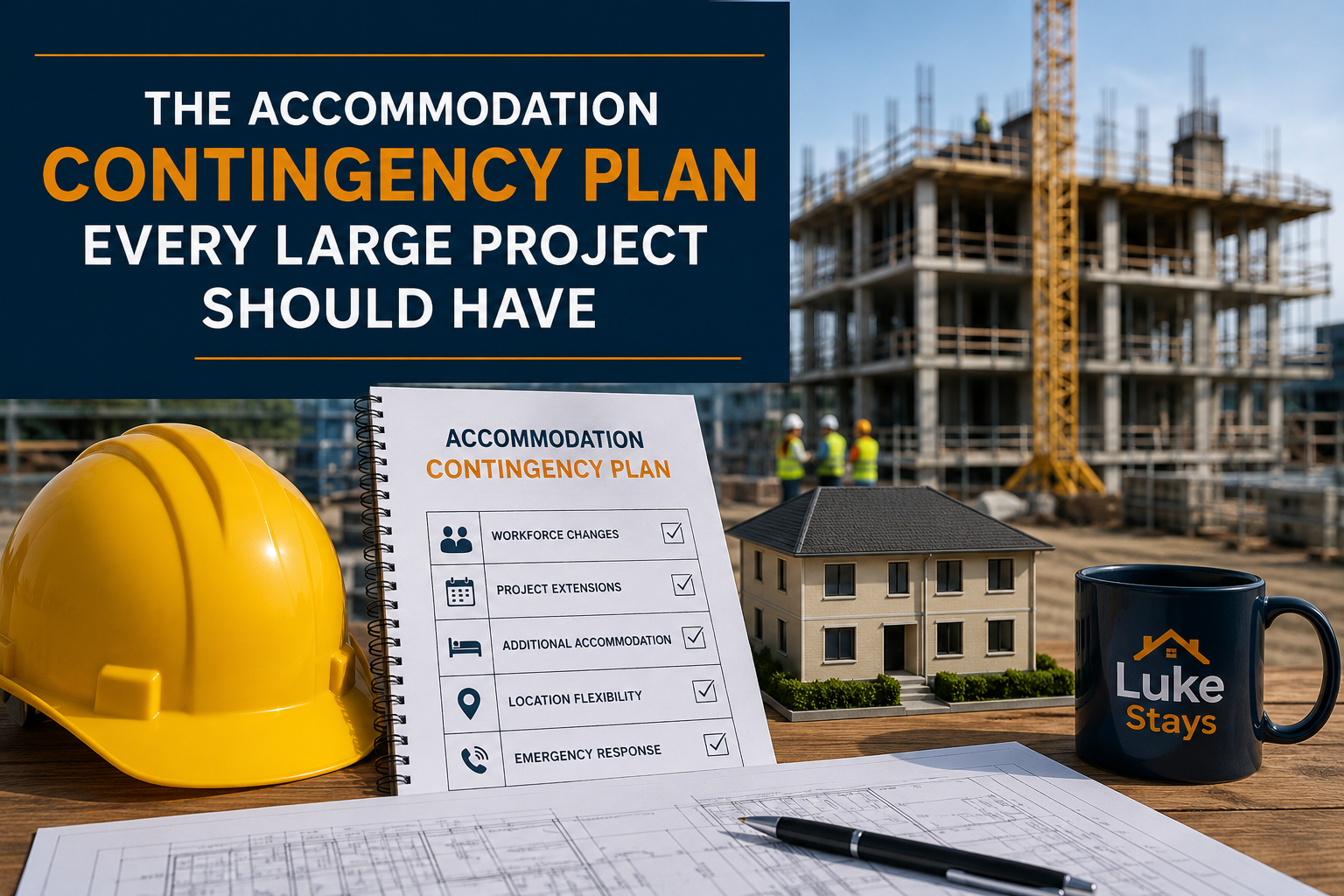
Large projects rarely go exactly according to plan.
A construction programme can move forward by weeks. A shutdown can be extended. A new phase can start earlier than expected. A subcontractor can suddenly need more workers. A project can win additional work that nobody expected when the original accommodation was booked.
And when those changes happen, accommodation can quickly become a problem.
The original workforce accommodation may no longer be large enough. Properties may need to be extended. Workers may need to move. New contractors may arrive with very little notice. Project teams can suddenly find themselves searching for suitable accommodation while simultaneously dealing with dozens of other mobilisation tasks.
That is why every large project should have an accommodation contingency plan.
It is not about expecting something to go wrong.
It is about making sure that, when something changes, accommodation does not become the thing holding your project back.
Why Large Projects Need an Accommodation Contingency Plan
For a small project with a handful of workers, finding additional accommodation might be relatively straightforward.
For a large project involving dozens or even hundreds of people, it is a completely different challenge.
Accommodation becomes part of the wider workforce logistics operation.
You need to consider:
- How many workers are arriving?
- When are they arriving?
- Where are they working?
- How long will they stay?
- Are teams working shifts?
- Will the workforce increase or decrease?
- What happens if the project is extended?
- What happens if additional workers are required?
- Who manages changes to bookings?
- How quickly can additional accommodation be arranged?
Without a plan, every change becomes an emergency.
With a plan, the same change becomes a manageable adjustment.
The goal is simple: keep your workforce housed without creating unnecessary pressure for the project team.
The Most Common Accommodation Problems on Large Projects
Before creating a contingency plan, it helps to understand what can actually go wrong.
1. The Project Runs Longer Than Expected
This is one of the most common challenges.
A project originally scheduled for three months can become four, five or six months due to delays, additional works, weather, supply issues or changes to the programme.
If accommodation was booked only until the original completion date, the workforce suddenly needs somewhere to stay for longer.
That can create a last-minute scramble.
A good contingency plan should therefore include a process for extending accommodation quickly.
Ideally, your accommodation provider should already understand the project and be able to help manage the extension rather than forcing the project team to start the search again from scratch.
2. Your Workforce Suddenly Increases
Large projects can grow quickly.
A new phase might require another team. A subcontractor might mobilise additional workers. A deadline might mean bringing more people onto site.
The problem is that accommodation requirements can increase just as quickly.
If you already have 40 workers accommodated and suddenly need space for another 15, finding suitable properties close to the project can become difficult.
This is where having an accommodation partner who understands workforce requirements can make a major difference.
Instead of starting from zero, you have a process for increasing capacity.
3. Workers Need to Stay in Different Locations
Sometimes the best accommodation solution at the beginning of a project is not the best solution later.
The project may move into a new phase. Work areas may change. A different site entrance may be used. Travel requirements may shift.
Your contingency plan should allow accommodation to change with the project.
The objective is not simply to find somewhere for workers to sleep.
It is to make sure the accommodation continues to support the operational needs of the project.
What Should an Accommodation Contingency Plan Include?
A useful contingency plan does not need to be complicated.
It needs to answer the important questions before they become urgent.
1. Define Your Minimum and Maximum Workforce
Start by identifying the expected workforce range.
For example:
Expected workforce: 50 workers
Potential peak workforce: 75 workers
This immediately gives your accommodation provider useful information.
Instead of planning only for today’s workforce, you are considering what the project could realistically require.
That makes it easier to respond when the workforce changes.
2. Establish an Extension Process
Ask an important question:
What happens if the project is extended?
Your contingency plan should identify:
- Who requests an extension?
- How early should the request be made?
- Who confirms availability?
- How are dates updated?
- How are additional workers added?
- Who receives the revised booking information?
The simpler this process is, the better.
A project manager should not have to spend hours coordinating accommodation because a project has moved by two weeks.
3. Have a Plan for Additional Workers
Your plan should also answer:
What happens if 10, 20 or 30 additional workers are required?
This is especially important during peak periods.
Rather than waiting until additional workers are already on their way, establish a clear communication process with your accommodation provider.
Give them the expected dates, approximate numbers and location requirements.
That allows the search for additional accommodation to begin as early as possible.
4. Identify Who Is Responsible
Accommodation problems become worse when nobody knows who is responsible for solving them.
Your contingency plan should identify a clear point of contact.
For example:
Project Manager → Accommodation Contact → Property/Booking Coordination
The exact structure will vary, but the principle is the same.
There should be no confusion about who to contact when circumstances change.
Build Flexibility Into Your Workforce Accommodation
One of the biggest mistakes large projects make is treating accommodation as a fixed arrangement.
Projects are rarely fixed.
Your accommodation strategy should therefore have some flexibility built into it.
Think about your workforce in terms of movement, not just numbers.
Workers may:
- Arrive at different times
- Leave at different times
- Work different shifts
- Move between project phases
- Stay longer than originally planned
- Be replaced by another team
- Be joined by additional workers
Your accommodation arrangements need to cope with those changes.
This is where professional workforce accommodation can become much more valuable than simply booking individual hotel rooms whenever a problem appears.
Don’t Wait Until There Is a Crisis
The worst time to create an accommodation contingency plan is when you desperately need one.
Imagine your project has 60 workers.
You discover on Friday that 15 additional workers need to arrive on Monday.
At the same time, the project has been extended by three weeks.
Your existing accommodation is already heavily committed.
Now the accommodation search becomes urgent.
The project team has limited time, fewer options and several other responsibilities competing for attention.
Planning earlier gives you more flexibility.
Even if you never need to activate the contingency plan, having it available provides peace of mind.
What a Strong Accommodation Partner Should Bring to the Plan
A contingency plan is only as useful as the people helping you execute it.
For large projects, your accommodation provider should be more than someone who confirms a booking.
You should look for a partner who understands that workforce accommodation is connected to the wider project.
That means being able to support changing requirements such as:
More workers.
Longer stays.
Different dates.
Different locations.
Changing project phases.
Last-minute requirements.
The right provider should make those changes easier to manage rather than creating additional administration.
Why Houses and Serviced Accommodation Can Work Well for Project Teams
For workforce groups, accommodation is not only about location.
The living environment matters too.
When workers are away from home for weeks or months, having a comfortable place to return to after work can make a significant difference.
Depending on the project and location, suitable serviced accommodation or houses can provide practical benefits such as:
- Shared living spaces
- Kitchens
- Multiple bedrooms
- Laundry facilities
- More space than individual hotel rooms
- A home-like environment
- Convenient access to the project
For teams working long hours, having somewhere practical to cook, relax and recharge can be a welcome alternative to spending every evening in a hotel room.
Your Contingency Plan Should Cover the Unexpected
A strong plan should ask uncomfortable questions before circumstances force you to answer them.
What if the project is delayed?
What if the workforce doubles?
What if a subcontractor needs accommodation for another month?
What if the project location changes?
What if workers need to arrive at different times?
What if accommodation becomes unavailable?
What if the project suddenly needs additional teams?
You do not need to predict exactly what will happen.
You simply need a response for the most likely scenarios.
That is the difference between reacting to accommodation problems and managing accommodation strategically.
A Simple Large-Project Accommodation Contingency Checklist
Before your project begins, make sure you can answer these questions:
☐ What is the expected workforce size?
☐ What is the potential peak workforce?
☐ What are the expected arrival and departure dates?
☐ What happens if the project is extended?
☐ What happens if additional workers are required?
☐ Who is responsible for accommodation?
☐ Who is the main accommodation contact?
☐ How quickly can additional accommodation be requested?
☐ What happens if the preferred properties are unavailable?
☐ Can accommodation be added or extended without restarting the entire process?
☐ Are accommodation locations suitable for the workforce and project?
☐ Is there a clear communication process for changes?
If you cannot answer these questions, your project may have an accommodation gap.
Turn Accommodation From a Risk Into a Safety Net
Large projects already involve enough uncertainty.
Your project team should not also have to worry about where the workforce will sleep if the programme changes.
An accommodation contingency plan creates a safety net.
It gives project managers a clear process when circumstances change.
It gives procurement teams a structured approach to additional requirements.
It gives workers a more reliable place to stay.
And it can help businesses avoid the disruption that comes from making accommodation decisions at the last minute.
Most importantly, it changes the role of accommodation.
Instead of being an administrative task that is dealt with whenever someone needs a bed, accommodation becomes part of the project’s workforce planning strategy.
How Luke Stays Can Support Your Project
At Luke Stays, we understand that workforce accommodation needs to work around the project — not the other way around.
Whether you are mobilising a new team, extending an existing project or preparing for a potential increase in workforce numbers, having a reliable accommodation partner can make the process much easier to manage.
Our focus is on providing practical accommodation solutions for contractors, project teams and businesses across the UK.
Instead of leaving your accommodation requirements until the last minute, you can plan ahead with a provider that understands the changing nature of workforce accommodation.
Planning a large project?
Don’t wait until accommodation becomes an urgent problem.
Put your contingency plan in place early, understand your potential workforce requirements and make sure you have a reliable accommodation partner ready to respond when the project changes.
Because the best accommodation contingency plan is the one you never have to panic about using.
Need workforce accommodation for your next project? Contact Luke Stays to discuss your requirements and find a practical accommodation solution for your team.