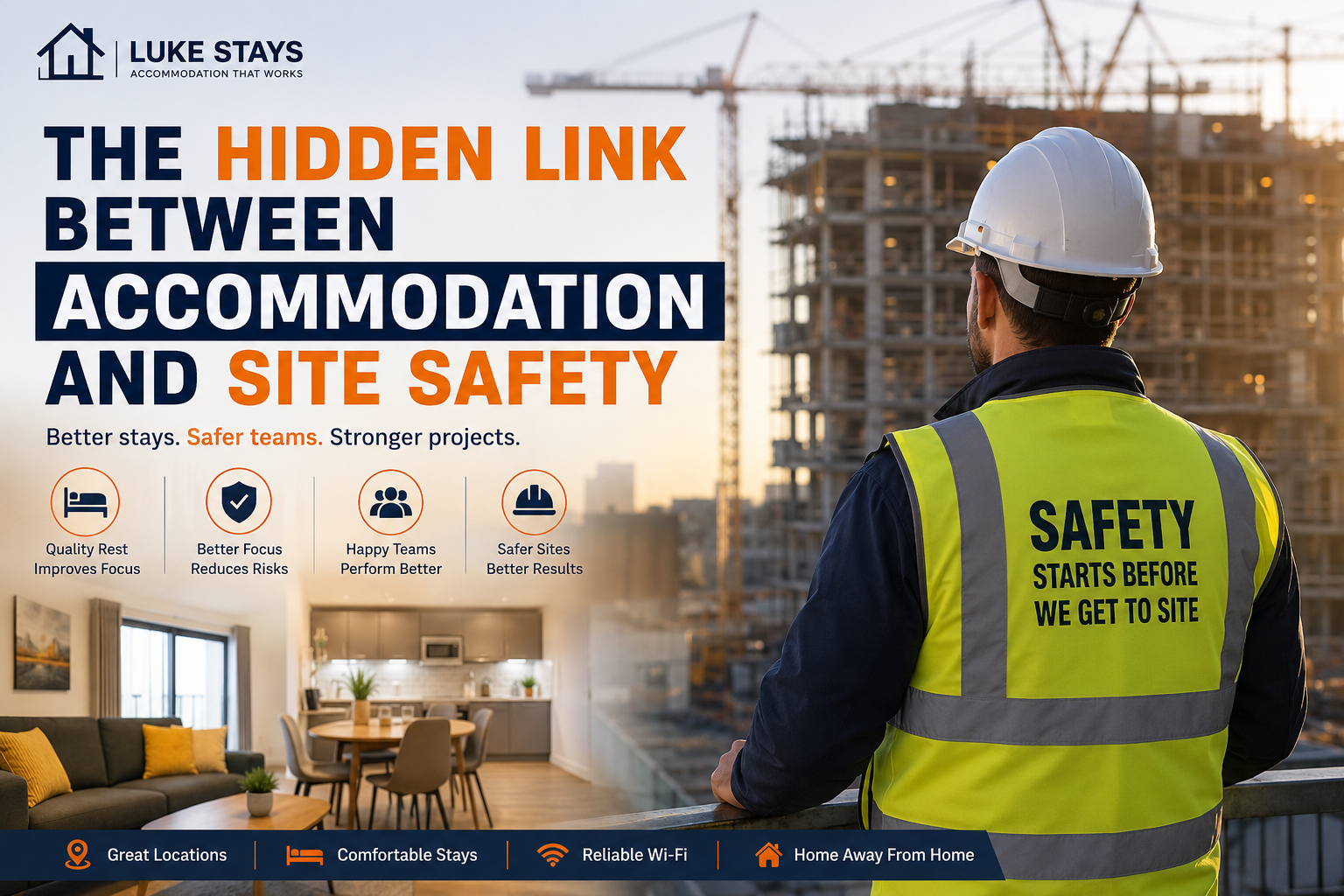
When discussing site safety, most construction firms focus on the obvious factors.
Personal protective equipment.
Risk assessments.
Toolbox talks.
Training programmes.
Equipment inspections.
These are all essential. However, there is another safety factor that often goes unnoticed despite having a significant impact on worker wellbeing and project performance.
Accommodation.
At first glance, accommodation and site safety may seem unrelated. One happens after working hours. The other happens on-site.
But experienced project managers know the reality is very different.
Where your team sleeps, rests, eats, and recovers directly influences how safely they perform the next day.
Poor accommodation can contribute to fatigue, stress, distraction, poor decision-making, and reduced productivity. Quality accommodation, on the other hand, helps workers stay rested, focused, and prepared for demanding tasks.
At Luke Stays, we’ve worked with thousands of contractors, engineers, project teams, and travelling professionals across the UK. Over the years, we’ve seen a clear pattern emerge:
Teams that stay well often work well.
Let’s explore the hidden connection between accommodation and site safety—and why more construction companies are beginning to treat accommodation as a key part of their safety strategy.
Safety Starts Before Workers Arrive on Site
Every morning, workers arrive at site carrying more than their tools.
They bring:
- Their energy levels
- Their mental focus
- Their physical wellbeing
- Their quality of sleep
- Their stress levels
All of these factors influence how safely they perform.
A worker who has enjoyed a comfortable night’s sleep in a quiet environment is far more likely to remain alert than someone who spent the night in cramped, noisy, uncomfortable accommodation.
The difference may seem small.
But on construction sites, small differences can have major consequences.
When people are handling heavy machinery, working at height, operating vehicles, or making important decisions, concentration matters.
Accommodation affects concentration more than many businesses realise.
Fatigue Is One of Construction’s Biggest Risks
Fatigue is a major contributor to workplace incidents across multiple industries.
Construction workers often face:
- Long shifts
- Early starts
- Physical labour
- Travel demands
- Tight project deadlines
If accommodation adds further strain, fatigue becomes even more likely.
Common accommodation issues include:
Long Daily Commutes
If workers must travel an additional hour or more each morning and evening, recovery time disappears quickly.
What should be eight hours of rest becomes six.
What should be quality downtime becomes additional travel.
Over weeks and months, this takes its toll.
Poor Sleeping Conditions
Uncomfortable beds, noisy surroundings, inadequate heating, poor ventilation, or overcrowded rooms can all reduce sleep quality.
Workers may technically spend enough time in bed but still wake feeling exhausted.
Lack of Recovery Space
After a physically demanding day, workers need space to relax and recover.
Accommodation that lacks comfortable communal areas, proper kitchens, or private bedrooms can increase stress rather than reduce it.
Decision-Making Suffers When Rest Suffers
Many workplace incidents are not caused by lack of knowledge.
They are caused by poor decisions.
Fatigue affects:
- Attention span
- Reaction times
- Judgement
- Problem-solving
- Communication
A tired worker is more likely to:
- Miss a hazard
- Forget a procedure
- Take shortcuts
- Misjudge a situation
- Make avoidable mistakes
The accommodation provider may never see these consequences.
The site manager certainly will.
This is why leading construction firms increasingly view accommodation as part of risk management rather than simply a logistical necessity.
The Cost of Cheap Accommodation
Every company wants to manage costs effectively.
However, choosing accommodation based solely on the lowest nightly rate can create hidden expenses elsewhere.
For example:
Reduced Productivity
Tired workers generally work slower.
Tasks take longer.
Projects can face delays.
Increased Absenteeism
Poor rest can contribute to illness, burnout, and reduced morale.
Higher absence rates often follow.
Higher Staff Turnover
Workers remember how companies treat them during projects.
Providing poor accommodation can negatively affect retention.
Greater Safety Risks
Even a single incident can result in significant financial and operational consequences.
The cheapest accommodation option can quickly become the most expensive decision.
Why Comfortable Accommodation Improves Site Performance
The best workforce accommodation supports both physical recovery and mental wellbeing.
When workers stay in quality accommodation, they benefit from:
Better Sleep
Comfortable beds and quiet environments improve recovery.
Reduced Stress
Knowing they have a clean, reliable place to stay removes unnecessary worries.
Improved Morale
Workers appreciate employers who prioritise their wellbeing.
Stronger Team Cohesion
Shared houses and serviced accommodation often create opportunities for teams to relax together after work.
Better Nutrition
Access to fully equipped kitchens allows workers to prepare healthier meals rather than relying solely on takeaways.
Each of these factors contributes to improved performance on site.
Accommodation Can Reduce Travel-Related Risks
Construction projects often require workers to travel far from home.
Driving while tired is a recognised safety concern.
By placing teams closer to project locations, businesses can reduce:
- Long-distance commuting
- Early morning travel
- Late-night journeys
- Driver fatigue
Shorter travel times create more opportunities for rest and recovery.
This benefits both workers and employers.
It’s one reason many project managers now prioritise accommodation proximity alongside cost considerations.
Mental Wellbeing Matters Too
Site safety is not only about physical hazards.
Mental wellbeing plays a major role.
Workers who are stressed, isolated, or unhappy may experience:
- Reduced concentration
- Lower motivation
- Poor communication
- Increased risk-taking behaviour
Quality accommodation can help reduce these pressures.
Features such as:
- Private bedrooms
- Reliable Wi-Fi
- Comfortable living spaces
- Access to local amenities
- Home-like environments
all contribute to a better overall experience.
When people feel looked after, they often perform better.
What Contractors Actually Want
After housing thousands of workers, we’ve learned that contractors typically value the same things.
They want accommodation that is:
Clean
Cleanliness creates comfort and confidence.
Reliable
No surprises, no complications, no last-minute issues.
Convenient
Close to project locations and transport links.
Comfortable
A genuine place to relax after work.
Practical
Parking, Wi-Fi, kitchens, laundry facilities, and enough space to unwind.
These are not luxury requirements.
They are practical necessities that support workforce performance.
Why More Construction Firms Are Reviewing Their Accommodation Strategy
Historically, accommodation was often treated as an administrative task.
Book the cheapest available option and move on.
Today, that approach is changing.
Forward-thinking companies recognise that accommodation influences:
- Worker satisfaction
- Productivity
- Retention
- Attendance
- Safety outcomes
As labour shortages continue across many sectors, companies are also competing to attract and retain skilled workers.
Providing quality accommodation has become part of that strategy.
Workers remember the companies that invest in their wellbeing.
How Luke Stays Supports Safer, More Productive Projects
At Luke Stays, we understand that accommodation is about far more than a place to sleep.
It’s about helping project teams perform at their best.
Our accommodation is designed to provide:
- Comfortable bedrooms
- Fully equipped kitchens
- Reliable Wi-Fi
- Convenient locations
- Flexible booking options
- Team-friendly properties
- Long and short-term stay solutions
Whether you’re managing a construction project, infrastructure programme, engineering contract, or corporate assignment, our goal is simple:
To provide accommodation that supports your team’s success.
Because when workers rest better, projects run better.
And when projects run better, everyone benefits.
Final Thoughts
The connection between accommodation and site safety isn’t always obvious.
Yet it exists on every project.
Every night’s sleep influences the next day’s performance.
Every hour of recovery affects concentration.
Every accommodation decision impacts worker wellbeing.
Construction firms invest heavily in safety training, equipment, and procedures.
Those investments are essential.
But they become even more effective when workers arrive rested, focused, and ready to perform.
That’s why accommodation should never be viewed as an afterthought.
It’s part of the bigger picture.
And increasingly, it’s becoming one of the smartest investments a company can make.
If you’re planning your next project and need reliable workforce accommodation across the UK, Luke Stays can help provide comfortable, practical stays that support both productivity and wellbeing from day one.