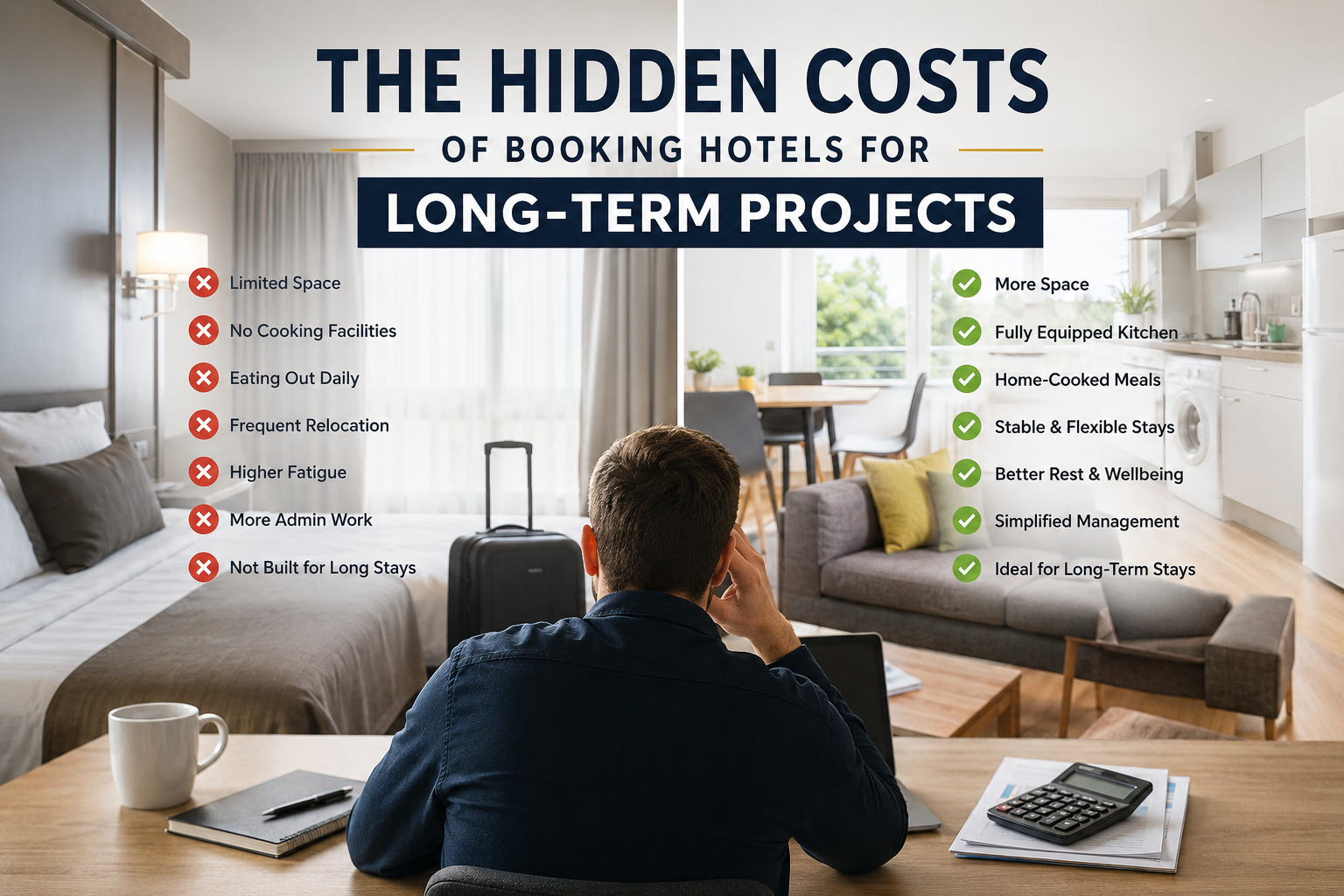
Why More Project Managers Are Switching to Contractor Accommodation Instead
When planning a long-term project, accommodation is often treated as a simple box to tick. Find a hotel, book rooms, send the team, and move on.
At first glance, hotels seem convenient. They’re familiar, easy to search online, and available almost everywhere. But for companies managing construction teams, infrastructure projects, maintenance crews, engineers, or long-term contractors, hotels can quietly become one of the biggest drains on project budgets.
What many businesses don’t realise is that the nightly room rate is only the beginning.
Behind every hotel booking are hidden costs that affect productivity, team wellbeing, logistics, administration, and ultimately, profitability.
In this guide, we’ll break down the real hidden costs of booking hotels for long-term projects — and explain why serviced accommodation providers like Luke Stays are becoming the smarter solution for companies across the UK.
The Hotel Trap: Why “Easy” Often Becomes Expensive
Hotels are designed for short stays.
A few nights for a business traveller? Perfect.
But when you place an entire workforce in hotels for weeks or months, the cracks start to appear quickly.
Long-term projects require stability, flexibility, comfort, and cost-efficiency. Hotels typically provide none of these at scale.
Here’s where the hidden costs begin.
1. The Cost Per Night Adds Up Faster Than You Think
Hotels often appear affordable at first glance.
A £95 room may not sound unreasonable. But multiply that by:
- 10 workers
- 5 nights a week
- 12 weeks
…and suddenly your accommodation spend has exploded.
That’s before factoring in:
- Parking fees
- Wi-Fi charges
- Laundry services
- Food costs
- VAT
- Early check-ins
- Late check-outs
For long-term projects, these “small extras” quickly become major budget leaks.
Serviced accommodation offers significantly better value because teams can stay together in fully equipped properties with kitchens, living areas, parking, and utilities included.
Instead of paying per room, companies often pay per property — reducing costs dramatically.
2. Daily Restaurant Meals Drain Budgets
One of the biggest hidden expenses in hotel stays is food.
Most hotels don’t provide proper cooking facilities. That means workers rely on:
- Takeaways
- Restaurants
- Expensive hotel food
- Meal allowances
Over weeks or months, food spending becomes enormous.
A contractor spending £25–£40 daily on meals can cost businesses thousands over a project timeline.
Serviced accommodation changes the equation completely.
With fully equipped kitchens, workers can:
- Cook meals
- Meal prep for shifts
- Store groceries
- Eat healthier
- Reduce takeaway dependency
This doesn’t just save money — it improves morale and wellbeing too.
3. Productivity Drops When Teams Feel Cramped
Hotels are not built for long-term living.
After a few days, small hotel rooms begin to feel restrictive and uncomfortable.
Workers returning from demanding shifts often need:
- Space to relax
- Proper seating areas
- Quiet environments
- Laundry access
- Social interaction with teammates
Instead, hotels typically provide:
- One bed
- One desk
- One television
- Minimal personal space
Over time, this affects:
- Sleep quality
- Team morale
- Mental wellbeing
- Productivity on-site
Contractor accommodation offers shared living spaces, multiple bedrooms, full kitchens, and home-style environments that help teams feel settled during lengthy projects.
Happy teams perform better.
4. Constant Room Changes Create Chaos
Hotels frequently experience:
- Overbookings
- Availability issues
- Seasonal pricing increases
- Last-minute relocations
For project managers, this creates administrative headaches.
Workers may need to:
- Move hotels mid-project
- Check in and out repeatedly
- Travel further from site
- Split across multiple locations
This wastes time and disrupts operations.
Reliable serviced accommodation providers like Luke Stays specialise in longer-term workforce stays, helping businesses secure stable accommodation for the full duration of projects.
Consistency matters when managing large teams.
5. Travel Costs Increase When Hotels Aren’t Near Site
Budget hotels are often located far from project sites.
At first, choosing a cheaper hotel outside the area might seem like a smart financial move.
But hidden transport costs soon appear:
- Fuel expenses
- Taxi costs
- Vehicle wear
- Increased mileage
- Lost time commuting
Even worse, longer travel times can lead to:
- Delays
- Fatigue
- Lower productivity
- Reduced punctuality
Strategically located contractor accommodation helps teams stay closer to work sites, reducing both transport costs and operational stress.
6. Hotel Living Leads to Team Burnout
Long-term projects are demanding enough already.
When workers spend months living in impersonal hotel rooms, burnout becomes a real risk.
People need more than just a place to sleep.
They need:
- Comfort
- Privacy
- Routine
- Space to unwind
- A sense of normality
Serviced accommodation creates a more home-like environment that supports mental wellbeing during extended assignments.
For companies struggling with retention, this matters more than ever.
Workers remember how they were treated during difficult projects.
Providing quality accommodation can directly improve staff satisfaction and loyalty.
7. Laundry Costs Become Ridiculous
Hotels often charge premium laundry rates.
For workers on construction, engineering, rail, or industrial projects, laundry is not optional.
Over time, hotel laundry services become extremely expensive.
Many serviced accommodations include:
- Washing machines
- Dryers
- Ironing facilities
That means teams can handle laundry themselves without unnecessary added costs.
It’s a small feature that creates major long-term savings.
8. Administrative Workload Increases Dramatically
Managing hotel bookings for multiple workers is time-consuming.
Project coordinators often deal with:
- Individual reservations
- Booking extensions
- Cancellations
- Payment tracking
- Invoice reconciliation
- Last-minute changes
The larger the team, the bigger the admin burden becomes.
Serviced accommodation providers simplify this process by offering:
- Centralised bookings
- Flexible extensions
- Dedicated account management
- Consolidated invoicing
This saves valuable admin hours that can be redirected toward running projects effectively.
9. Hotels Rarely Understand Contractor Needs
Hotels cater primarily to tourists and short-term business travellers.
Contractors and project teams have very different requirements.
For example:
- Early shift schedules
- Parking for vans
- Flexible check-ins
- Group bookings
- Long-term rates
- Equipment storage
- Reliable Wi-Fi
- Weekly cleaning
Specialist contractor accommodation providers understand these operational realities far better than traditional hotels.
That’s why more companies are moving away from hotel-based accommodation strategies entirely.
10. Last-Minute Hotel Pricing Can Destroy Budgets
Hotels operate on dynamic pricing.
That means rates can skyrocket due to:
- Events
- Holidays
- Seasonal demand
- Local shortages
A room costing £90 one week could suddenly jump to £180 the next.
For long-term projects, this unpredictability makes budgeting extremely difficult.
Serviced accommodation providers often offer:
- Fixed long-stay pricing
- Corporate rates
- Flexible agreements
- Predictable costs
Budget certainty is critical for successful project management.
Why Contractor Accommodation Is the Better Long-Term Solution
Businesses are increasingly realising that hotels simply weren’t designed for long-term workforce accommodation.
Modern contractor accommodation offers:
- Entire apartments and houses
- Multiple bedrooms
- Kitchens and laundry facilities
- Parking
- Wi-Fi
- Flexible booking terms
- Better locations near sites
- Lower overall costs
Most importantly, it creates a better experience for workers while helping businesses stay financially efficient.
Why Companies Choose Luke Stays
At Luke Stays, we work with businesses across the UK to provide practical, comfortable, and cost-effective accommodation for:
- Contractors
- Construction teams
- Engineers
- Corporate groups
- Relocation staff
- Infrastructure projects
Our properties are designed specifically to support longer stays.
That means:
- Spacious living areas
- Fully equipped kitchens
- Flexible booking options
- Convenient locations
- Dedicated support
- Group-friendly accommodation
We understand the challenges project managers face — and we help remove the accommodation stress completely.
Whether you’re housing 2 workers or 20+, our team can help you find accommodation that works operationally and financially.
Final Thoughts
Hotels may seem convenient initially, but long-term projects expose their hidden costs quickly.
From rising food bills and transport expenses to reduced morale and operational disruption, hotel stays often create far more problems than businesses anticipate.
Smart companies are now switching to serviced accommodation because it provides:
- Better value
- Better flexibility
- Better worker satisfaction
- Better project efficiency
When accommodation works properly, projects run smoother.
And in today’s competitive market, every efficiency matters.
If your business is planning a long-term project, now is the perfect time to rethink whether hotels are truly the most cost-effective option.
Because the cheapest nightly rate rarely delivers the best long-term value.