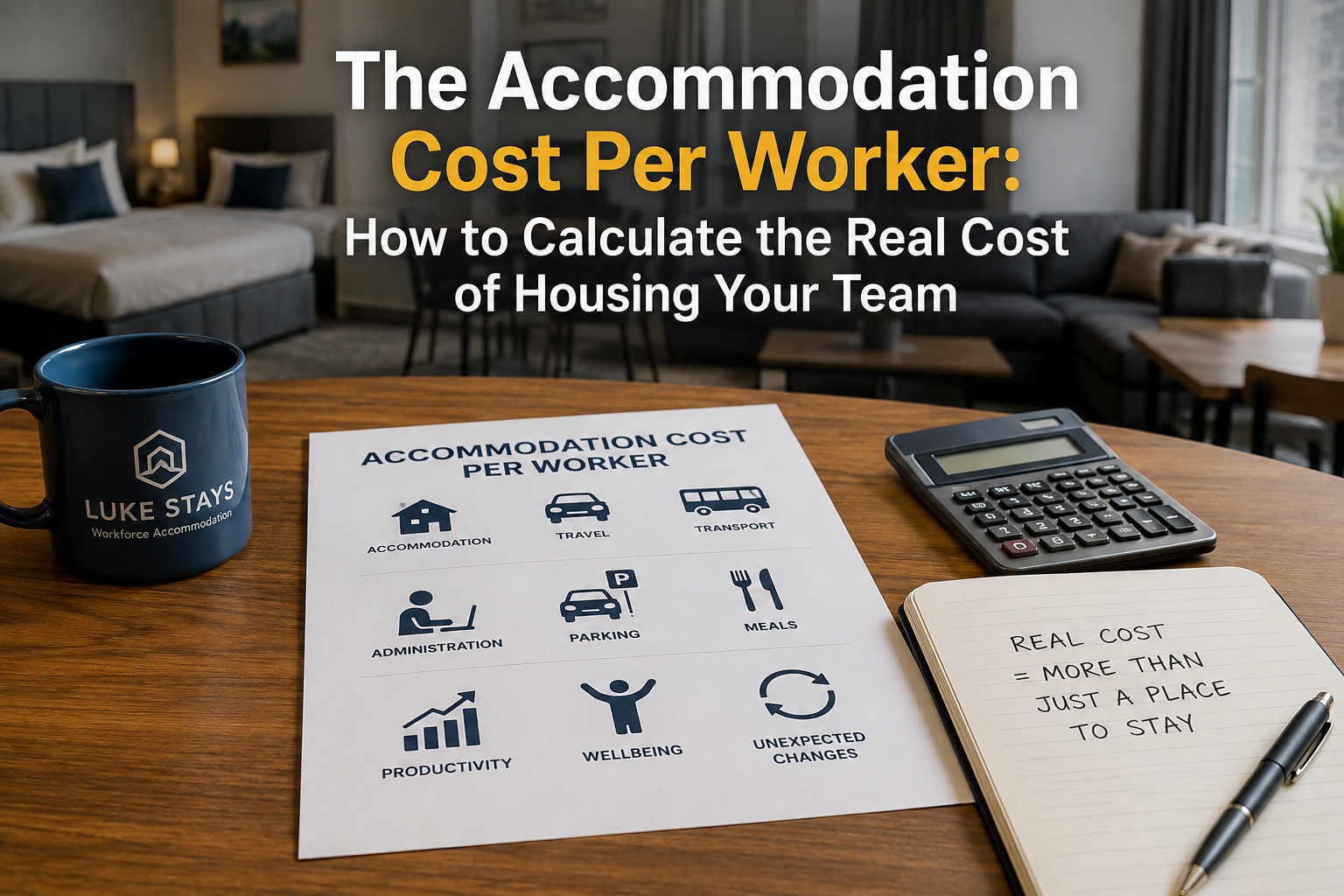
When a project requires workers to stay away from home, accommodation quickly becomes an important part of workforce planning.
At first, calculating the accommodation cost per worker sounds simple.
How many people need somewhere to stay?
How long will they be working away?
What accommodation is available?
But experienced project managers know there is much more to the calculation than the accommodation itself.
The real cost of housing a workforce includes everything that happens around the accommodation.
How far is it from site?
How much time does the team spend travelling?
How much administration does your office have to manage?
Are workers moving between different properties?
Does the accommodation work with their shift patterns?
Can the booking be extended if the project changes?
And perhaps most importantly, does the accommodation help your workforce operate efficiently?
These questions can completely change how businesses should think about accommodation cost per worker.
The objective isn’t simply to find somewhere for people to stay.
It’s to find accommodation that makes sense for the entire project.
Why the Headline Accommodation Cost Doesn’t Tell the Whole Story
One of the easiest mistakes businesses can make is treating accommodation as an isolated expense.
Accommodation sits inside a much larger workforce operation.
A property might appear suitable when viewed on its own, but its overall impact depends on how it fits into the project.
For example, consider two accommodation options.
One may be located a long distance from the site. Another may be much more convenient for the workforce.
The first option could create additional travel requirements, longer journeys and more complicated logistics.
The second could make daily routines much easier.
The difference isn’t simply about the accommodation.
It’s about everything that happens because of the accommodation.
This is why businesses should consider the total cost of housing their workforce rather than looking at accommodation as a single line on a spreadsheet.
What Should Be Included When Calculating Accommodation Cost Per Worker?
A useful workforce accommodation calculation should consider several areas.
These can include:
- Accommodation
- Location
- Travel requirements
- Parking
- Transport arrangements
- Administration
- Booking management
- Property changes
- Extensions
- Cancellations or changes to schedules
- Workforce comfort
- Time spent travelling
- Productivity
- Accommodation quality
- Flexibility
Not every project will have the same requirements.
A small team working on a short project may have completely different accommodation needs from a large infrastructure workforce working across several months.
That’s why accommodation should be planned around the project, rather than simply around the number of beds required.
1. Start With the Number of Workers
The first step is obvious, but it is still important.
How many people actually need accommodation?
Don’t only consider the workforce currently on site.
Think about the project schedule.
Will additional teams arrive later?
Will different contractors work on different phases?
Will the workforce increase during peak periods?
Will some workers rotate in and out?
A project that begins with a small team can look very different several weeks later.
Good accommodation planning allows for these changes.
2. Consider How Long Workers Will Be Away
The length of the project has a major influence on accommodation planning.
A short assignment may require a completely different approach from a long-term project.
For longer stays, workers may need accommodation that feels practical for everyday living rather than simply somewhere to sleep.
Consider whether the property provides:
- A kitchen
- Comfortable living areas
- Laundry facilities
- Suitable bedrooms
- Wi-Fi
- Parking
- Easy access to local amenities
- Convenient access to the project site
The longer workers stay away from home, the more important these details become.
3. Look Beyond the Accommodation and Consider Travel
One of the most overlooked parts of workforce accommodation planning is the journey between the property and the project site.
If accommodation is poorly located, workers may spend significant amounts of time travelling every day.
That can affect:
- Morning routines
- Shift changes
- Fatigue
- Transport requirements
- Vehicle usage
- Workforce satisfaction
- Overall project efficiency
For teams working long or unusual shifts, location can become even more important.
Accommodation that works well geographically can make daily workforce logistics considerably easier.
4. Calculate the Cost of Administration
There is another hidden cost that businesses often overlook.
Staff time.
Someone has to manage the accommodation.
That might involve:
- Searching for properties
- Checking availability
- Comparing options
- Communicating with accommodation providers
- Supplying guest information
- Coordinating arrivals
- Managing departures
- Extending bookings
- Handling changes
- Resolving issues
- Managing invoices
- Keeping project records updated
For one small booking, this may be manageable.
For several teams across different projects, it can become a significant administrative burden.
This is where having an experienced accommodation partner can make a real difference.
Instead of repeatedly starting the search from scratch, businesses can have a dedicated partner helping manage their workforce accommodation requirements.
5. Consider the Cost of Moving Workers
Accommodation changes can create more work than many businesses expect.
When workers have to move between properties, someone needs to coordinate the change.
Workers need new access information.
Project managers need updated accommodation details.
Transport arrangements may need to change.
And the workforce has to adjust to a new location.
Whenever possible, stable accommodation can make workforce management easier.
However, projects don’t always stay predictable.
Schedules change.
Sites move.
Teams increase.
Deadlines shift.
That’s why flexibility should be part of the accommodation strategy from the beginning.
6. Think About Workforce Productivity
Accommodation may not directly appear on a productivity report, but it can influence how effectively a workforce operates.
Workers need somewhere they can rest properly between shifts.
They need reasonable access to the project site.
They need practical facilities.
And they need an environment that supports their routine.
This can be particularly important for:
- Construction teams
- Engineering teams
- Infrastructure workers
- Utility contractors
- Rail workers
- Maintenance teams
- Shutdown crews
- Project specialists
- Workers operating away from their home region
Accommodation is part of the environment surrounding the workforce.
When that environment works well, workers can focus on the job rather than dealing with unnecessary accommodation problems.
7. Don’t Forget Shift Patterns
A standard Monday-to-Friday schedule is not the only working pattern businesses need to accommodate.
Many industries operate around:
- Early starts
- Late finishes
- Night shifts
- Rotating shifts
- Weekend work
- Extended working periods
- Planned shutdowns
- Emergency works
Accommodation should support the way the workforce actually works.
A property that looks suitable during the day might not be ideal for a team returning from a night shift.
Location, noise, parking, access and sleeping arrangements can all become more important when workers operate unusual hours.
This is another reason why workforce accommodation should be planned as part of the wider project logistics strategy.
8. Consider the Experience of Your Workforce
There is also a human side to accommodation.
People working away from home already spend significant periods away from their normal routines.
Good accommodation can give workers somewhere comfortable and practical to return to after work.
Poor accommodation can create another problem for the project team to manage.
Think about what workers actually need.
They may want:
- Comfortable bedrooms
- A proper kitchen
- Space to relax
- Good internet access
- Convenient parking
- Local amenities
- Easy access to the workplace
- A clean and well-maintained environment
These details matter because workforce accommodation isn’t simply about filling beds.
It’s about creating a practical base for people who are helping deliver the project.
The Real Question: What Is the Total Cost to the Business?
Instead of asking:
“What is the accommodation cost per worker?”
businesses should ask:
“What is the total impact of this accommodation on our project?”
That question produces a much more useful conversation.
It encourages project managers and procurement teams to consider:
Accommodation + Travel + Administration + Logistics + Productivity + Workforce Experience
This provides a more complete picture.
Sometimes the biggest saving isn’t achieved by changing the accommodation itself.
It can come from reducing the amount of time your internal team spends managing it.
It can come from reducing unnecessary travel.
It can come from keeping workers closer to the site.
It can come from having one accommodation partner instead of multiple suppliers.
It can come from having someone who understands the requirements of project-based workforce accommodation.
One Accommodation Partner Can Simplify the Calculation
Managing accommodation across several suppliers can make the real cost much harder to understand.
Different properties may have different arrangements.
Different teams may have different booking processes.
Different invoices may need to be checked.
Different contacts may need to be managed.
And when something changes, your team may have to repeat the process several times.
Working with one experienced accommodation partner can simplify this.
Instead of managing accommodation as a collection of separate bookings, businesses can approach it as one workforce accommodation requirement.
That can make planning, communication and administration considerably easier.
Why Early Accommodation Planning Matters
The best time to think about workforce accommodation isn’t necessarily when workers are already travelling to site.
It should be considered during project planning.
Before mobilisation, ask:
- How many workers will need accommodation?
- Where will they be working?
- What are the expected shift patterns?
- How long are they likely to stay?
- Will the workforce increase?
- Could the project schedule change?
- What facilities will the team need?
- How important is parking?
- How far should accommodation be from the site?
- Who will manage the bookings?
Answering these questions early can prevent accommodation from becoming a last-minute problem.
It also gives businesses more opportunity to find accommodation that genuinely suits the project.
How Luke Stays Can Help
At Luke Stays, we understand that workforce accommodation is about more than finding somewhere for a worker to sleep.
It’s about helping businesses create a practical accommodation solution around their project.
Whether you are accommodating contractors, construction teams, engineers, infrastructure workers or project staff, the requirements can change depending on the location, workforce size, project duration and working pattern.
That’s why the conversation should start with the project.
How many people are you accommodating?
Where are they working?
When do they arrive?
How long will they stay?
What happens if the project changes?
What does the workforce need between shifts?
These details help create a much more effective accommodation strategy.
And for businesses managing multiple teams, having a reliable accommodation partner can remove a considerable amount of pressure from project and procurement teams.
Accommodation Should Support the Project—Not Complicate It
The true accommodation cost per worker isn’t simply a number.
It is the combined impact accommodation has on your workforce, your project and your internal team.
Poorly planned accommodation can create unnecessary travel, additional administration, workforce disruption and logistical headaches.
Well-planned accommodation can do the opposite.
It can give workers a practical place to stay, simplify workforce logistics and help project teams focus on what they actually need to deliver.
That’s why the right question isn’t:
“Where can we put everyone?”
It’s:
“What accommodation solution will work best for our workforce and our project?”
That is a much smarter way to approach workforce accommodation.
Ready to Make Workforce Accommodation Easier?
If you’re planning a new project, mobilising contractors or reviewing how your business manages accommodation, Luke Stays can help.
From individual teams to larger workforce requirements, we can help businesses explore practical accommodation solutions designed around their project needs.
Speak to Luke Stays about your next workforce accommodation requirement and make accommodation one less thing your project team has to worry about.
Because when your workforce has the right place to stay, your project has one less problem to solve.