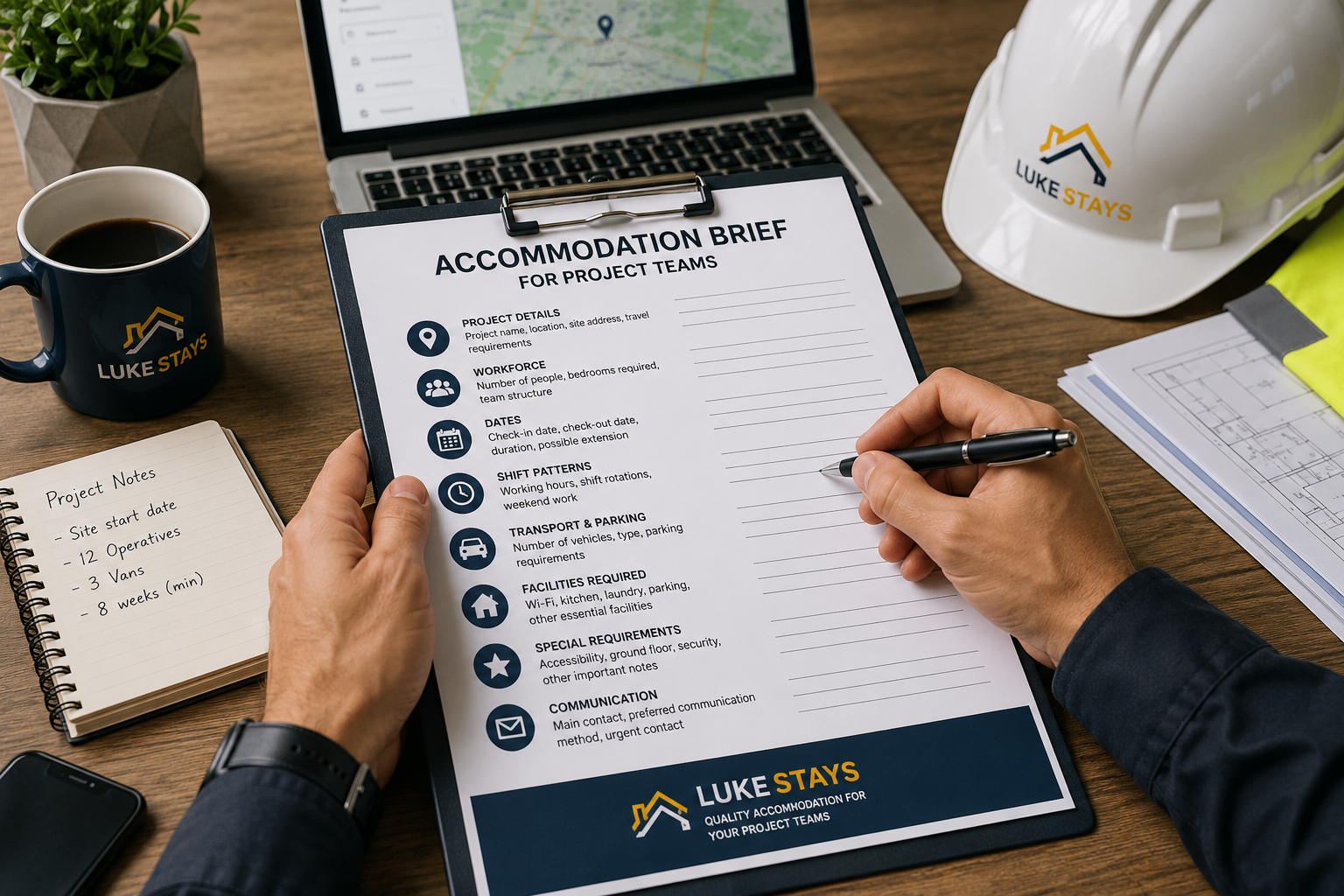
The Right Accommodation Starts With the Right Brief
When a project manager needs accommodation for a team, the request often starts with something surprisingly simple:
“We need accommodation for eight contractors near the site.”
It sounds straightforward.
But for an accommodation provider, that sentence leaves out some of the most important information.
Where exactly is the site? How long will the team be working there? What are their shift patterns? Do they need parking? How many bedrooms are required? Will the workforce change during the project? Is the accommodation needed immediately, or is there time to plan?
The better the brief, the easier it becomes to find the right accommodation.
And that matters because the wrong accommodation can create problems long after the booking has been confirmed.
A property might look suitable on paper but be too far from site. There may not be enough parking for the vehicles. The bedroom arrangement may not suit the team. Check-in might not work around night shifts. Or the accommodation may become unsuitable when the project extends.
A good accommodation brief prevents these issues before they happen.
For project managers, construction companies, engineering teams, utilities contractors and businesses managing mobile workforces, it can also make the entire booking process faster and more efficient.
Here is what your accommodation provider really needs to know.
1. Start With the Project Location
The first thing your accommodation provider needs is the actual project location.
Don’t just provide the town if you know the site address.
A postcode, site address or precise location can make a huge difference when searching for suitable contractor accommodation.
Why?
Because “near Birmingham” and “within a 20-minute drive of the project site” are very different requirements.
Your team might be working across several locations during the project too. If that is the case, tell your provider.
For example:
- Main project site
- Secondary site
- Temporary work locations
- Depot or office
- Preferred travel radius
The more accurate the location information, the more targeted the accommodation search can be.
A simple rule:
Tell your accommodation provider where your people actually need to be — not simply where the project is generally located.
This allows providers such as Luke Stays to focus on practical locations rather than simply finding a property somewhere in the same town.
2. Explain How Many People Need Accommodation
Next, provide the number of workers who need accommodation.
But don’t stop at the total number.
Your provider should ideally know how many people are arriving, how many bedrooms are required and whether everyone needs their own bedroom.
For example:
10 workers
10 bedrooms preferred
Shared kitchen and living space acceptable
No shared bedrooms
This is much more useful than simply saying:
“Accommodation for 10.”
Your team may also increase or decrease during the project.
If you know this is likely, mention it in the initial brief.
For example:
Phase 1: 6 workers
Phase 2: 10 workers
Phase 3: 14 workers
This gives your accommodation provider a clearer understanding of what you actually need.
It can also help prevent the common problem of booking accommodation that works perfectly for the first few weeks but becomes unsuitable when the workforce grows.
3. Include the Project Dates — and Possible Extensions
Dates are one of the most important parts of an accommodation brief.
Include:
- Check-in date
- Expected check-out date
- Number of nights
- Whether dates are flexible
- Whether an extension is likely
If the project is scheduled to run for three months but could continue for another month, say so.
Accommodation providers can then understand that flexibility may be important.
This is particularly useful for construction, engineering, infrastructure and maintenance projects where schedules can change.
A good brief might say:
“Initial requirement is 12 weeks, with a potential four-week extension depending on project progress.”
That single sentence can change the type of accommodation solution your provider looks for.
4. Tell Them About Shift Patterns
This is one of the details project managers sometimes overlook.
Your workers might not operate a standard 9-to-5 schedule.
You could have:
- Early starts
- Late finishes
- Night shifts
- Rotating shifts
- Weekend work
- 24-hour operations
- Different teams working different patterns
This matters because accommodation isn’t simply somewhere to sleep.
It needs to work around the way your team actually lives and works.
If workers are finishing at 2am, for example, the accommodation needs to provide a comfortable environment where they can rest without unnecessary disruption.
If the team starts at 5am, location becomes even more important.
Include shift information in your accommodation brief so your provider understands the workforce rather than just the booking.
5. Be Clear About Parking Requirements
Parking can become a surprisingly big issue for contractor accommodation.
A property may be excellent in every other respect but unsuitable if your team arrives with several vans.
Tell your provider:
- Number of vehicles
- Type of vehicles
- Whether vans need to be parked overnight
- Whether trailers are involved
- Whether secure parking is important
- Whether workers will car-share
For example:
“Eight workers travelling in six vans. Off-street parking strongly preferred.”
That’s much more useful than:
“Parking required.”
For many mobile workforces, practical parking isn’t a luxury. It’s part of making the accommodation work.
6. List the Facilities Your Team Actually Needs
Every workforce has different requirements.
Instead of asking for “a nice property,” identify what actually matters.
For example:
Essential
- Wi-Fi
- Washing machine
- Fully equipped kitchen
- Adequate bedrooms
- Heating
- Parking
Preferred
- Multiple bathrooms
- Garden or outdoor space
- Large dining area
- Separate living space
- Desk/work area
Project-specific
- Secure parking
- Easy access to major roads
- Multiple properties close together
- Accommodation suitable for longer stays
This helps your provider prioritise what matters rather than spending time looking for unnecessary extras.
7. Explain How Your Team Will Use the Property
Accommodation for a family holiday is different from accommodation for a workforce.
Your provider should know the purpose of the stay.
For example:
“This is accommodation for a team of electrical contractors working on an infrastructure project. They will work long shifts and require the property primarily for rest, cooking and laundry.”
That context is valuable.
It tells the provider what type of accommodation is likely to work best.
It also helps create realistic expectations from the beginning.
At Luke Stays, understanding the purpose behind a booking is an important part of finding accommodation that works for business travellers and contractor teams.
8. Mention Any Important House Requirements
If there are requirements that could affect the suitability of a property, include them upfront.
These might include:
- No shared bedrooms
- Ground-floor bedroom required
- Accessibility requirements
- Multiple bathrooms preferred
- No pets
- Specific parking needs
- Longer-term stay
- Separate accommodation for different teams
Don’t assume your provider will automatically know.
The more important a requirement is, the earlier it should appear in your brief.
A good accommodation provider would rather know about a requirement before suggesting a property than discover it after the booking has been confirmed.
9. Tell Your Provider How Flexible You Are
Sometimes the perfect property doesn’t exist within every requirement.
This is where flexibility can help.
Tell your provider what is:
Essential
and what is:
Nice to have.
For example:
Essential:
Within a practical drive of site, 8 bedrooms, Wi-Fi and parking.
Preferred:
Large garden and two living rooms.
That gives your accommodation provider room to find the strongest available solution without compromising the things that genuinely matter.
10. Explain How You Want Communication to Work
Project managers are busy.
The last thing you need is a long email chain every time something changes.
Tell your accommodation provider who the main contact is and how you prefer to communicate.
For example:
“Please send all booking confirmations and accommodation updates to the project administrator. Urgent issues can be communicated directly to the project manager.”
You can also explain how changes will be handled.
This becomes particularly important when managing multiple workers or multiple properties.
A clear communication process can save considerable time over the life of a project.
11. Don’t Forget About Changes
A project accommodation brief shouldn’t be treated as a one-time document.
Projects move.
Workers join. Workers leave. Timelines change. Sites move. Contracts extend.
That’s why your accommodation provider needs to understand the possibility of change.
If you already know that your workforce may increase, tell them.
If the project may extend, tell them.
If workers may rotate every few weeks, tell them.
The earlier your provider knows about potential changes, the easier it can be to plan around them.
Your Simple Contractor Accommodation Brief Template
If you’re a project manager, you can make future accommodation requests much easier by keeping a simple template ready.
Project
Project name:
Site address/postcode:
Project type:
Workforce
Number of workers:
Bedrooms required:
Expected workforce changes:
Dates
Check-in:
Expected check-out:
Potential extension:
Working Pattern
Shift pattern:
Typical start/finish times:
Weekend working:
Transport
Number of vehicles:
Van parking required:
Secure parking required:
Accommodation
Essential facilities:
Preferred facilities:
Accessibility requirements:
Bedroom requirements:
Location
Maximum preferred travel time:
Other sites/depot locations:
Communication
Main contact:
Preferred communication method:
Additional Information
Anything else your accommodation provider should know?
This takes only a few minutes to complete — but it can save much more time later.
Why a Better Brief Can Lead to Better Accommodation
The biggest advantage of a detailed accommodation brief isn’t simply making the booking process easier.
It’s improving the chance of getting accommodation that actually works for your project.
Your workforce gets a practical place to stay.
Your project manager spends less time dealing with accommodation issues.
Your procurement team gets clearer information.
And your accommodation provider has the information needed to find a more suitable solution.
That’s exactly what a workforce accommodation partnership should achieve.
Looking for Contractor Accommodation? Start With Luke Stays
Finding accommodation for one person is relatively simple.
Finding suitable accommodation for an entire project team is different.
You need the right location, the right number of bedrooms, practical facilities, suitable parking and accommodation that works around the realities of your workforce.
That’s where having an experienced accommodation partner can make a difference.
At Luke Stays, we help businesses arrange accommodation for contractors, project teams and business travellers across the UK.
Whether you need accommodation for a small team, a larger workforce, a short-term project or a longer assignment, the starting point is simple:
Tell us what your project needs.
The more information you provide, the easier it is to understand what will work for your team.
So before sending your next accommodation enquiry, don’t just write:
“We need somewhere for 10 workers.”
Send a proper brief.
Tell your provider where your team is working, when they’re arriving, how many people need accommodation, how they work, what they need and what might change.
It could be the difference between simply booking accommodation and finding a solution that genuinely supports your project.
Need contractor accommodation for your next project? Get in touch with Luke Stays and tell us what your workforce needs.