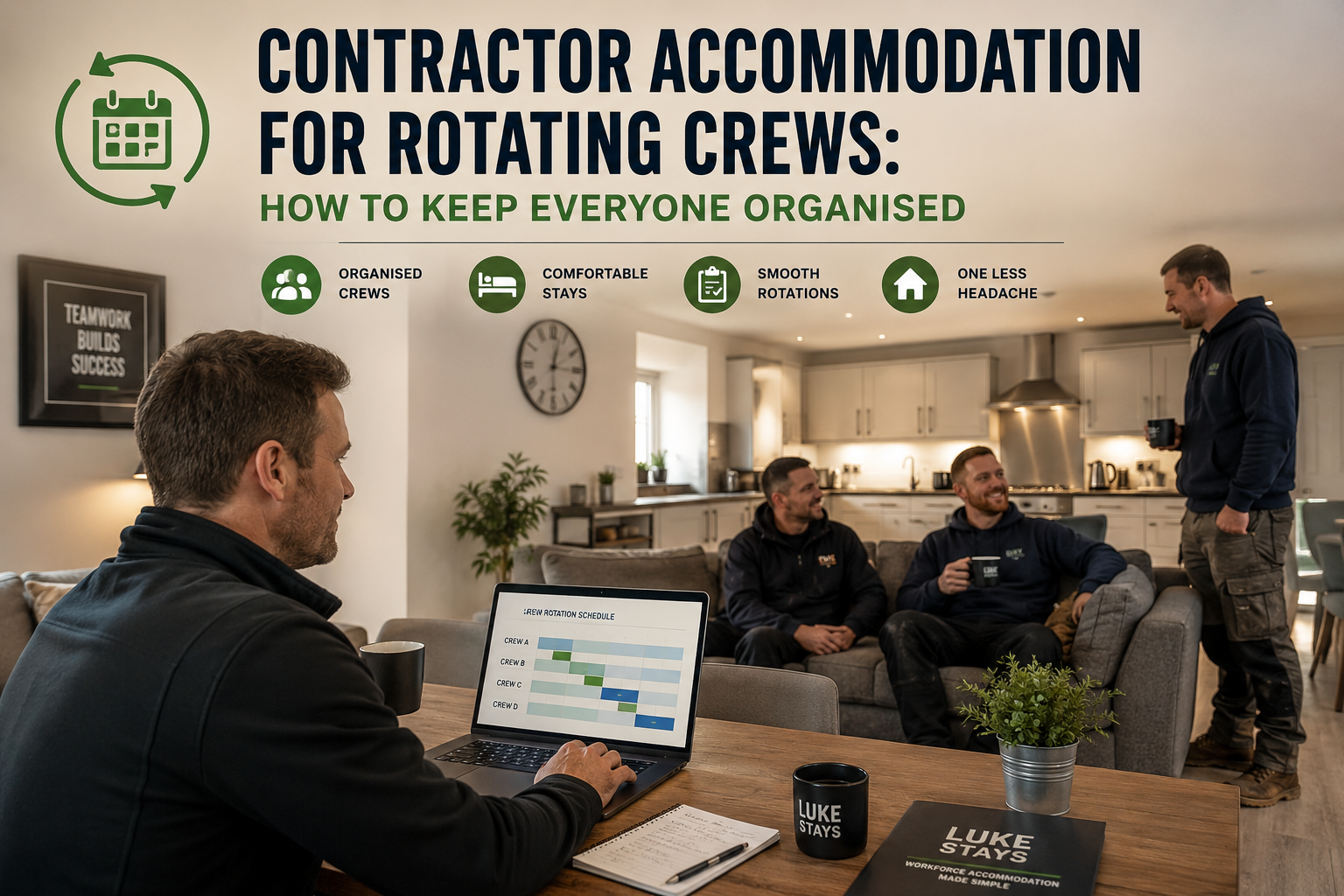
Rotating crews can keep a project moving around the clock. But when workers are arriving, leaving, changing shifts and swapping locations every few days or weeks, accommodation can quickly become one of the hardest parts of the operation to manage.
One person needs to check in on Monday. Another finishes on Wednesday. A replacement crew arrives Thursday. Then the project changes schedule and suddenly three more workers need somewhere to stay.
Sound familiar?
For project managers, construction companies, engineering firms, utilities contractors and other businesses working with mobile teams, contractor accommodation for rotating crews is not simply about finding somewhere for people to sleep.
It is about keeping the whole accommodation process organised while the project keeps changing.
The right accommodation strategy can reduce administration, make crew movements easier to manage and give workers a comfortable place to return to after a demanding day.
Here is how to make it work.
Why Rotating Crews Make Accommodation More Complicated
Booking accommodation for a fixed team is relatively straightforward.
You know who is travelling, when they are arriving and when they are leaving.
Rotating crews are different.
Your workforce might include:
- Day-shift and night-shift workers
- Different teams working on different phases of a project
- Workers travelling from different parts of the UK
- Contractors joining or leaving throughout the project
- Teams moving between sites
- Workers staying for different lengths of time
- Last-minute changes caused by project delays or schedule changes
The accommodation needs to move with the workforce.
That is where the process can become messy.
Without a clear system, businesses can end up managing multiple properties, multiple booking platforms, different check-in arrangements and numerous invoices — often while simultaneously dealing with everything else happening on site.
The answer isn’t necessarily more administration.
It is better organisation.
1. Start With the Project, Not Individual Bookings
One of the biggest mistakes businesses make is treating every accommodation booking as a separate task.
Instead, think about the entire project.
Before making bookings, establish:
Where is the project?
Identify the main site or sites and understand how far workers are realistically expected to travel.
How long will the project run?
Even if the schedule is subject to change, establish the expected duration.
How many workers are involved?
Think beyond the first team. Consider how the workforce could change during different project phases.
What does the rotation look like?
Are crews staying Monday to Friday? Seven days? Two weeks on and one week off? Are different teams arriving as others leave?
The more clearly you understand the workforce pattern, the easier it becomes to build an accommodation plan.
This turns accommodation from a collection of individual bookings into part of the project’s wider logistics strategy.
2. Build Accommodation Around Crew Rotations
Rotating workers need accommodation that works with their schedule — not accommodation that creates another scheduling problem.
For example, imagine a project with three crews.
Crew A arrives Monday and works until Friday.
Crew B arrives Friday afternoon and works through the following week.
Crew C then takes over the next rotation.
If every booking is handled independently, there can be unnecessary gaps, duplicated administration or confusion over who is staying where.
A structured accommodation plan allows you to map:
Crew → Dates → Property → Check-in → Check-out → Project/site
This simple structure can make a huge difference.
It also makes changes easier to communicate when the project schedule moves.
3. Keep Teams Together Where Practical
When several workers are travelling to the same project, keeping them together can simplify logistics.
Instead of placing every contractor in a separate hotel room or different property, a suitable larger property can provide shared accommodation for the team.
Depending on the project, this can offer advantages such as:
- Easier coordination
- Simpler travel arrangements
- Shared living facilities
- More consistent accommodation
- Less time spent managing multiple bookings
- A more practical home-from-home environment
For longer projects especially, contractors often appreciate having access to a proper property rather than simply returning to an individual hotel room every evening.
The accommodation becomes somewhere they can actually relax between shifts.
4. Create a Single Source of Truth
Rotating crews create one major administrative challenge:
Information changes.
A worker who was originally scheduled to leave Friday might now leave Sunday.
Another contractor might be added to the project.
A shift could be moved forward.
If accommodation information is spread across emails, spreadsheets, text messages and booking platforms, it becomes surprisingly easy for something to be missed.
A central accommodation record can solve much of this.
Your team should be able to quickly see:
| Crew | Arrival | Departure | Property | Status |
|---|---|---|---|---|
| Crew A | Monday | Friday | Property 1 | Confirmed |
| Crew B | Friday | Next Friday | Property 1 | Confirmed |
| Crew C | Next Friday | Following Friday | Property 2 | Pending |
The exact system you use matters less than having one reliable place where the latest information is recorded.
This is particularly important when several people within your business are involved in workforce logistics.
5. Give Workers Clear Check-In Information
Even the best accommodation plan can fall apart if workers don’t know what to do when they arrive.
Rotating crews may arrive at different times, sometimes after long journeys or late shifts.
They need straightforward information.
Ideally, workers should know:
- The property address
- Check-in instructions
- Where to collect or access keys
- Parking arrangements
- Wi-Fi details
- Check-out instructions
- Who to contact if there is a problem
Clear instructions reduce unnecessary calls to project managers.
Instead of a worker contacting the office because they cannot find the property or don’t know how to enter, the information is already available.
That means your team can focus on the project rather than solving accommodation questions.
6. Plan for Changes Before They Happen
Projects rarely go exactly according to the original schedule.
A delivery gets delayed.
A site phase finishes early.
A new team is required.
Bad weather affects the programme.
A contractor becomes unavailable.
The accommodation plan needs enough flexibility to deal with those changes.
This is why it is useful to work with an accommodation provider that understands the reality of contractor projects.
The relationship should not feel like:
“Here is your booking confirmation. Good luck.”
It should feel more like:
“We understand your project, your workforce and what you need from accommodation.”
That difference becomes particularly valuable when plans change.
7. Don’t Forget About Location
For rotating crews, location can be just as important as the property itself.
A cheaper property that requires workers to spend significantly longer travelling to site may not actually be the better option.
Longer journeys can mean:
- More travel time
- Greater transport requirements
- Increased fatigue
- Less time available for rest
- More complicated crew movements
When selecting contractor accommodation, consider the entire journey between accommodation and site.
A practical location can make life easier for both workers and project managers.
For businesses running multiple projects, this becomes even more important.
8. Think About the Worker Experience
It is easy to look at accommodation purely from the company’s perspective.
How much does it cost?
How quickly can it be booked?
How many people can it sleep?
But there is another question worth asking:
What will the worker experience be like?
Contractors may spend weeks or months away from home.
After a long shift, having a clean, comfortable and practical place to stay matters.
A property with a proper kitchen, living space, bedrooms and useful amenities can provide a much more comfortable environment than a basic room.
And when workers are happier with their accommodation, it can contribute to a better overall experience of the project.
Accommodation is not the whole employee experience.
But it is certainly part of it.
9. Make Scaling Easier
Perhaps the biggest challenge with rotating crews is that the workforce rarely stays exactly the same size.
You might start with ten workers.
Then the project reaches its busiest stage and suddenly needs thirty.
Later, the workforce drops back to twelve.
Your accommodation strategy needs to scale accordingly.
A good accommodation partner should be able to help businesses find additional properties when workforce requirements increase and adjust arrangements when requirements change.
This can be particularly valuable for contractors operating across multiple UK locations.
Instead of starting from scratch every time the workforce moves, you have a repeatable process.
10. Reduce the Number of Suppliers You Have to Manage
Imagine managing:
- Several hotels
- Multiple serviced accommodation providers
- Individual landlords
- Different booking contacts
- Separate invoices
- Different cancellation policies
- Multiple check-in processes
Now imagine doing that while your crews are rotating every week.
The administrative burden can become significant.
Working with one accommodation partner where possible can simplify the process.
You have one relationship to manage, one point of contact and a consistent approach to arranging workforce accommodation.
That is exactly where a specialist provider such as Luke Stays can add value.
Rather than treating every contractor as an isolated booking, Luke Stays can help businesses approach workforce accommodation as an organised part of their project planning.
The Real Goal: Less Accommodation Admin
The purpose of better accommodation planning is not to create another complicated system.
It is the opposite.
The goal is to make the process simpler.
Project managers already have enough to think about.
They are coordinating people, suppliers, materials, deadlines, site access, health and safety, budgets and client expectations.
Accommodation should not become another daily fire to put out.
A well-organised system should allow you to answer simple questions quickly:
Who is staying?
Where are they staying?
When are they arriving?
When are they leaving?
What happens if the schedule changes?
If those questions can be answered without searching through dozens of emails, your accommodation process is already working better.
Why Businesses Choose Luke Stays for Workforce Accommodation
At Luke Stays, we understand that contractor accommodation is about more than finding available bedrooms.
Businesses need practical accommodation solutions that fit around the realities of working projects.
Whether you are arranging accommodation for a small crew, managing rotating teams or coordinating workforce requirements across multiple locations, having an experienced accommodation partner can make the process considerably easier.
Our aim is simple: make workforce accommodation easier to organise, easier to manage and more comfortable for the people staying.
That means businesses can spend less time chasing accommodation and more time focusing on their projects.
Ready to Make Rotating Crew Accommodation Easier?
Rotating crews don’t have to mean rotating accommodation headaches.
With the right planning, you can create a system that keeps bookings organised, gives workers clear information, supports changing schedules and reduces the amount of administration falling on your project team.
The key is to stop thinking about accommodation as a series of individual bookings.
Think of it as part of the project.
When your crews move, your accommodation strategy should be ready to move with them.
If you’re planning accommodation for contractors, construction teams, engineers, utilities workers or rotating crews, Luke Stays can help.
Get in touch with Luke Stays to discuss your workforce accommodation requirements and find a practical solution for your next project.