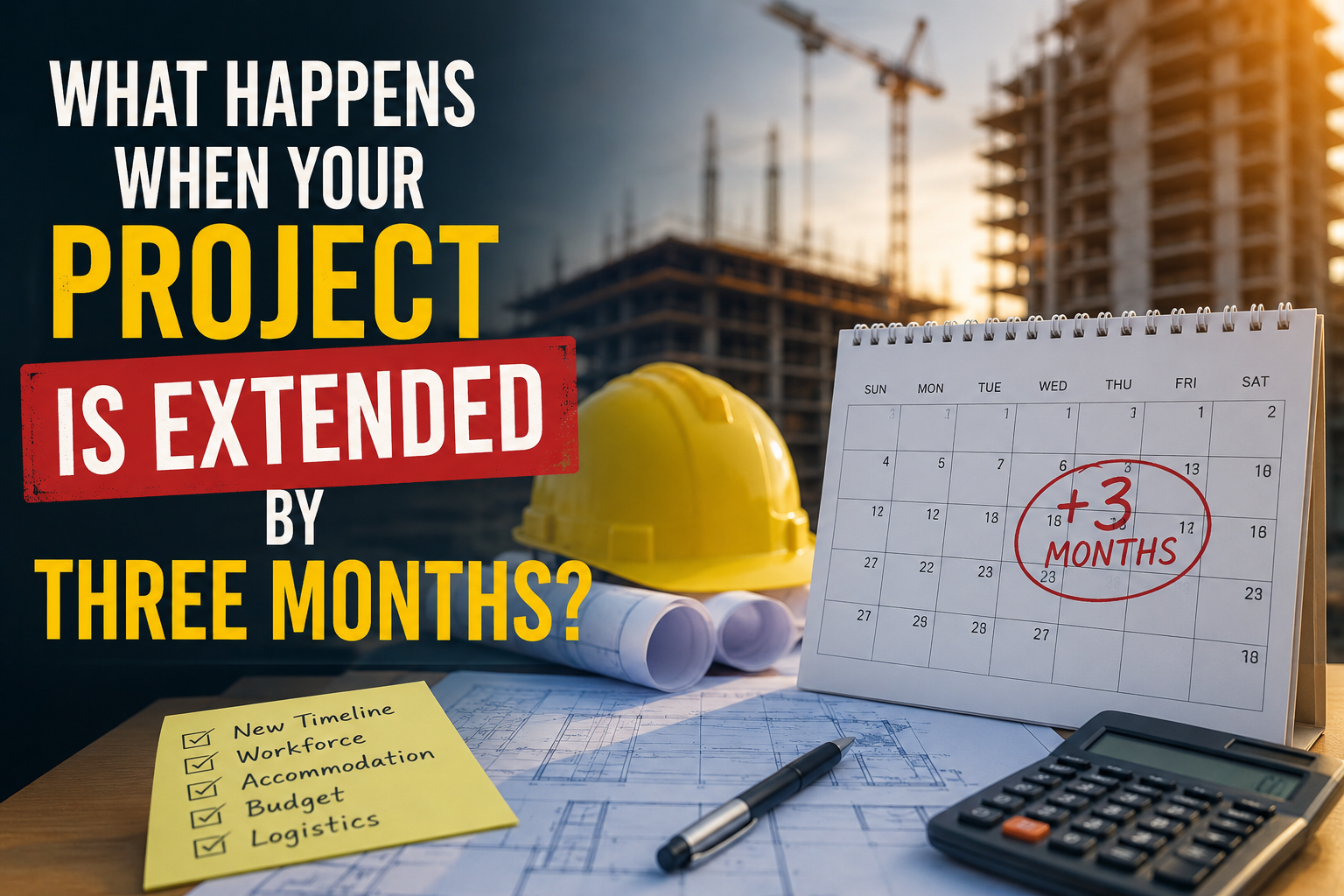
Your Three-Month Extension Just Changed the Accommodation Plan
You planned the project.
You planned the workforce.
You planned the accommodation.
Then someone says:
“We need another three months.”
Suddenly, the accommodation you thought was already sorted becomes a new problem.
The original booking is coming to an end. Contractors still need somewhere to stay. Your workforce may have changed. The project location may be getting busier. And the accommodation options you had available when the project started may no longer be available.
This is one of the realities of managing project-based work.
Construction projects change. Engineering programmes move. Infrastructure work takes longer than expected. Maintenance shutdowns get extended. Delays push schedules back.
The important thing is not whether your project changes.
It is how quickly your accommodation plan changes with it.
At Luke Stays, we understand that workforce accommodation needs to work around the project — not the other way around.
So, what should you do when your project is extended by three months?
1. Don’t Wait Until the Original Booking Is About to End
The first mistake is waiting.
If your team is currently staying somewhere and the project has been extended, it can be tempting to think:
“We’ve got plenty of time. We’ll sort the extra months later.”
But accommodation availability can change quickly.
A property that works perfectly for your team today may already be booked by the time you need those additional weeks.
The longer you leave it, the fewer suitable options you may have.
That doesn’t mean you need to panic the moment an extension is mentioned. It means you should start the accommodation conversation as soon as the new project timeline becomes reasonably clear.
An early review gives you time to consider:
- How many workers still need accommodation
- How long they will remain on site
- Whether shift patterns have changed
- Whether additional workers are joining
- Whether some workers are leaving
- Whether the existing accommodation is still suitable
- Whether the location still makes sense
- Whether you need one property or several
Three extra months is not simply three extra months on the calendar. It can change the entire accommodation requirement.
2. Check Whether Your Current Accommodation Still Works
An extension is a good opportunity to ask a simple question:
Is the current accommodation still the right solution?
Your original booking may have been ideal when the project began.
But circumstances can change.
Perhaps the workforce has increased. Perhaps the team is now working different shifts. Maybe some contractors are staying longer than others. Perhaps the original accommodation was booked for a short mobilisation period and isn’t the best option for another three months.
Accommodation should be reviewed in the same way you would review any other part of a project.
Look at:
Location:
Is the property still convenient for the site?
Capacity:
Does it still comfortably accommodate the current workforce?
Duration:
Can the accommodation support the revised project timeline?
Practicality:
Does it give your team the facilities they need for a longer stay?
Management:
Will extending the arrangement create additional administration for your team?
The goal isn’t simply to extend the booking.
The goal is to make sure the accommodation continues to support the project.
3. Your Workforce May Have Changed Too
Three months can make a significant difference to a project team.
The people who started the project may not be the people finishing it.
You might have:
- Contractors rotating in and out
- Supervisors staying longer
- New specialist workers joining
- Teams moving between sites
- Different shift patterns
- Workers finishing earlier than expected
- Additional subcontractors arriving
That means your accommodation requirement may need to be recalculated.
For example, a project that originally required accommodation for 12 workers might now need rooms or properties for 18.
Or perhaps only eight of the original workers are staying.
The best accommodation strategy is flexible enough to respond to these changes.
Instead of treating accommodation as a fixed booking, treat it as part of the workforce plan.
When the workforce changes, the accommodation plan should be able to change with it.
4. Don’t Forget the Cost of the Extension
When a project runs three months longer, the obvious additional cost is accommodation itself.
But accommodation can also create indirect costs when it is poorly managed.
Think about the time your team spends:
- Searching for available properties
- Comparing different options
- Contacting multiple providers
- Managing separate bookings
- Handling changes
- Coordinating check-ins
- Dealing with invoices
- Communicating with workers
- Finding replacement accommodation when availability changes
For a busy project manager, those tasks can quickly become another job.
This is why the cheapest accommodation option isn’t necessarily the most cost-effective option.
Time has a cost too.
A reliable accommodation partner can help reduce the amount of administration surrounding an extended project, allowing your team to concentrate on keeping the project moving.
5. Think Beyond the Next Few Weeks
A three-month extension can create a dangerous habit: solving the problem one week at a time.
At first, that might seem convenient.
You extend the booking.
Then you extend it again.
Then the project moves another few weeks.
Suddenly, nobody is sure exactly who is staying where or how long the accommodation is required.
Instead, create a revised accommodation plan.
Ask:
What is the new expected project completion date?
Then consider whether you need accommodation for the entire period or whether the workforce will reduce gradually.
For example:
Month 1: 20 workers
Month 2: 16 workers
Month 3: 10 workers
Your accommodation requirements should reflect that reduction.
Planning this in advance can make the final months much easier to manage.
6. Keep Contractors Comfortable During the Extension
There’s another factor that can easily be overlooked.
Your workforce didn’t necessarily plan to spend an additional three months away from home.
A project extension means more time away from family, more nights in temporary accommodation and more time spent living around the work schedule.
That makes the quality and practicality of accommodation increasingly important.
After a few days, almost any accommodation can feel manageable.
After several months, the difference becomes much more noticeable.
Contractors want somewhere they can return to after a long shift and feel comfortable.
That means thinking about things such as:
- Space
- Privacy
- Comfortable sleeping arrangements
- Kitchen facilities
- Living areas
- Wi-Fi
- Parking where required
- Convenient access to the workplace
- A suitable environment for longer stays
Good accommodation isn’t about luxury for the sake of luxury.
It’s about giving people somewhere practical and comfortable to switch off between shifts.
And when workers are happier with where they stay, it can make the overall project experience better for everyone.
7. One Accommodation Partner Can Make Extensions Easier
Managing an extended project becomes particularly complicated when accommodation is spread across multiple providers.
One property might be managed by one company.
Another booking could be through a different provider.
A third might involve a hotel.
Now imagine changing all three arrangements because the project has moved by three months.
That’s where administration starts to multiply.
Working with an accommodation provider that understands workforce requirements can make the process much simpler.
Instead of repeatedly starting from scratch, you have one point of contact to discuss:
- Revised dates
- Changing numbers
- Additional workers
- Different locations
- Extensions
- New bookings
For project managers and procurement teams, simplicity can be extremely valuable.
One project. One accommodation plan. One less thing to chase.
8. What If the Extension Takes You Into a Busy Period?
Timing matters.
Your original accommodation may have been booked during a period when availability was relatively straightforward.
Three months later, the situation could be completely different.
Events, seasonal demand, university terms, local projects and other construction programmes can all influence accommodation availability.
That’s why extending a project should trigger an immediate accommodation review.
Don’t assume that because you found suitable accommodation three months ago, you’ll automatically be able to find the same thing again.
The earlier you review your requirements, the more opportunity you have to secure accommodation that suits your workforce.
9. Build Flexibility Into Your Accommodation Strategy
Project extensions are easier to manage when your accommodation strategy is flexible from the beginning.
Instead of asking only:
“Where can we house the team?”
Ask:
“How easily can this accommodation arrangement adapt if the project changes?”
That distinction matters.
A good workforce accommodation plan should allow you to respond when:
- The project duration changes
- The workforce increases
- The workforce decreases
- Contractors rotate
- New specialists join
- Site locations change
- Shift patterns change
Nobody can predict every change on a construction or engineering project.
But you can make sure your accommodation plan isn’t so rigid that every change becomes a crisis.
10. Turn the Extension Into an Opportunity to Improve
A project extension isn’t always bad news.
It can actually be an opportunity to review what’s working and what isn’t.
Perhaps the original accommodation involved too much travel.
Perhaps workers would benefit from being closer to the site.
Perhaps managing several properties created unnecessary administration.
Perhaps the team needs better accommodation for the longer period.
Now is the time to improve it.
Ask your project team:
What would we do differently if we were arranging accommodation from scratch today?
The answers can help shape the next three months.
And they can also improve how you approach accommodation on future projects.
The Three-Month Extension Checklist
When your project timeline changes, run through this quick checklist:
Project
- What is the new expected completion date?
- Is the extension definitely three months, or could it change again?
- Are there further phases after the extension?
Workforce
- How many workers currently need accommodation?
- Are new contractors joining?
- Are any workers finishing early?
- Are shift patterns changing?
Accommodation
- Is the current accommodation still suitable?
- Can it accommodate the revised dates?
- Is the location still practical?
- Is it suitable for a longer stay?
- Will additional properties be required?
Administration
- Who is managing the extension?
- How many separate bookings are involved?
- How will invoices be handled?
- Who is the main point of contact?
Future Planning
- Could the workforce change again?
- Could the project be extended further?
- Do you have a flexible accommodation solution?
A few minutes spent answering these questions can prevent hours of problems later.
Don’t Let Three Extra Months Become Three Extra Headaches
Project extensions are part of working in construction, engineering, infrastructure and other project-based industries.
The programme changes.
The workforce changes.
The accommodation needs to change too.
The mistake is treating accommodation as something that can simply be dealt with after the project schedule has been updated.
Instead, make it part of the extension planning process.
Review the workforce. Reassess the location. Check the accommodation. Consider the additional duration. Think about future changes.
Most importantly, make sure your accommodation provider understands that your requirement isn’t simply “three more months.”
It’s about supporting your workforce through the next stage of the project.
At Luke Stays, workforce accommodation is designed around the realities of project-based work. Whether you are extending an existing project, bringing in additional contractors or planning accommodation for a longer programme, having the right accommodation partner can make the process considerably easier.
Your project may have changed. Your accommodation plan should be ready to change with it.
Need accommodation for an extended project?
If your project has been extended and you need reliable accommodation for contractors or workforce teams, Luke Stays can help you plan the next stage.
Get in touch with Luke Stays to discuss your project requirements and find an accommodation solution that works for your team.