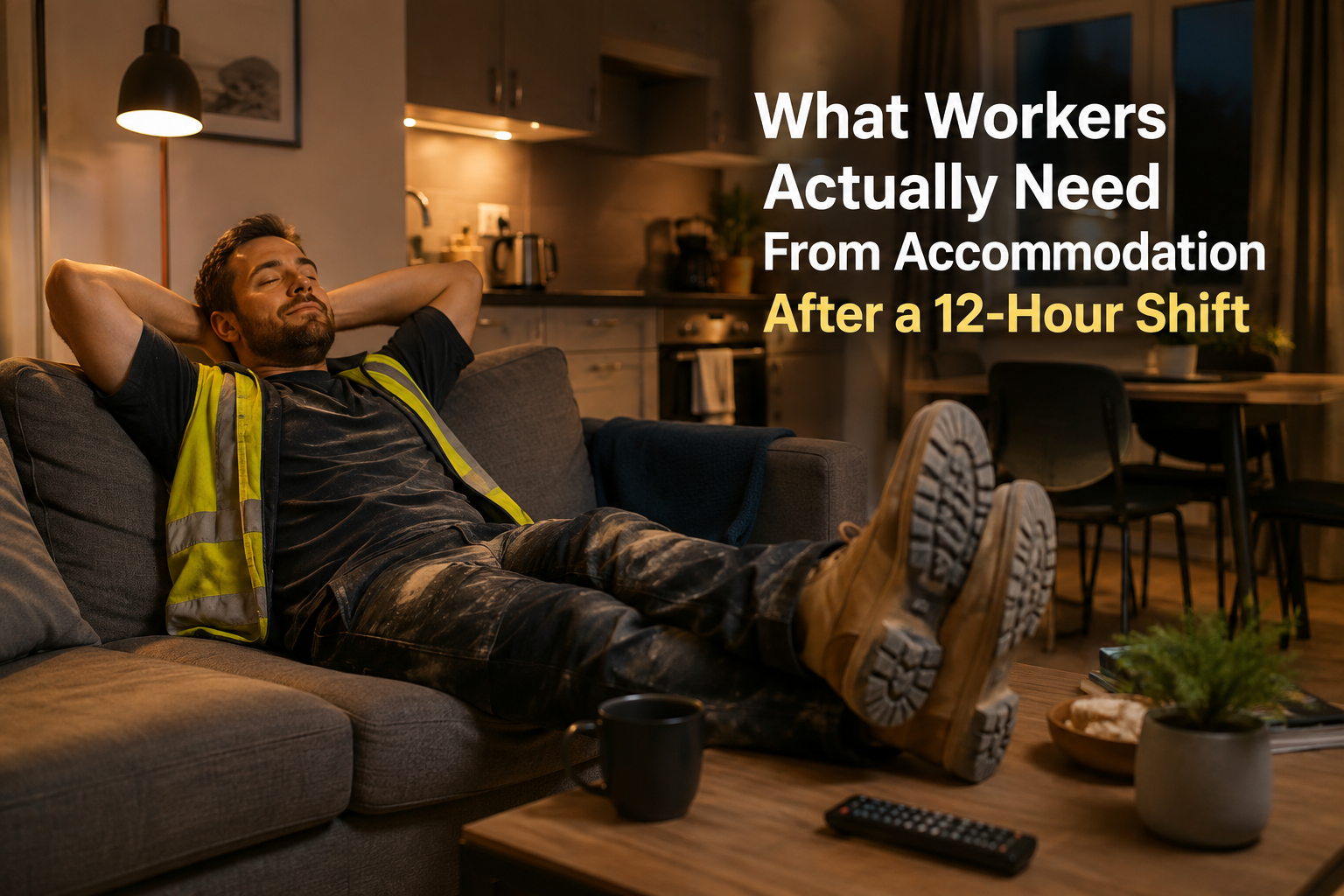
A 12-hour shift takes a lot out of a person.
By the time a worker leaves site, they probably aren’t thinking about luxury facilities, impressive lobbies or whether their accommodation looks good in photographs.
They are thinking about one thing:
“Can I get somewhere comfortable, quiet and convenient where I can properly switch off?”
For contractors, engineers, construction teams, rail workers, utility crews and other mobile workforces, accommodation is more than somewhere to sleep. When workers are away from home for days or weeks at a time, where they stay can have a direct impact on how they recover between shifts.
That is why choosing workforce accommodation should not simply come down to finding an available room.
The right accommodation needs to work around the people using it.
At Luke Stays, we understand that after a demanding day on site, the small details can make a big difference.
So, what do workers actually need after a 12-hour shift?
Let’s take a closer look.
1. A Comfortable Bed Comes First
It sounds obvious, but it is one of the most important things to get right.
After 12 hours of physical or mentally demanding work, workers need somewhere they can properly rest.
A comfortable bed isn’t a bonus. It is fundamental.
Poor sleep can make the next working day feel considerably harder. When workers are staying away from home for several nights, uncomfortable accommodation can quickly become frustrating.
A good night’s sleep, on the other hand, gives workers the opportunity to recover and start the next shift feeling more prepared.
This is particularly important for teams working long hours, early starts, night shifts or physically demanding roles.
When arranging contractor accommodation, businesses should think beyond simply asking:
“Is there a bed?”
The better question is:
“Would someone who has just completed a 12-hour shift actually want to sleep here?”
That change in perspective can completely alter the accommodation decision.
2. Peace and Quiet
After spending 12 hours surrounded by machinery, traffic, conversations, alarms, tools or a busy construction site, workers often want the opposite when they get back to their accommodation.
Quiet.
Not another noisy environment.
Not a room where they can hear doors constantly opening and closing.
Not somewhere they have to compete with a busy hotel environment.
Just somewhere they can close the door, relax and recover.
For workforce accommodation, the surrounding environment matters.
Workers may have different schedules from the people around them. One person might be starting a shift at 5am while another is returning at midnight.
Accommodation that provides a comfortable environment for rest can make a significant difference to the overall experience.
For employers, this matters too.
Because accommodation isn’t separate from workforce management.
It is part of it.
3. A Convenient Location
Imagine finishing a 12-hour shift and discovering you have another hour-long journey before reaching your accommodation.
That is not an ideal end to a long day.
Location matters because every unnecessary minute spent travelling can reduce the amount of time available for rest.
For workers, accommodation should ideally provide convenient access to the workplace, local amenities and essential services.
A well-located property can help reduce unnecessary commuting and make the whole working week easier to manage.
For project managers, this is where accommodation planning becomes particularly important.
It isn’t enough to find somewhere available in the right town.
You need to consider:
- How far is it from the site?
- How easy is the journey?
- What are the transport options?
- Are shops nearby?
- Can workers easily get food?
- Is the location practical for the shift pattern?
These questions can help turn accommodation from a logistical headache into a genuine support for the workforce.
4. Somewhere to Prepare Proper Food
After a long shift, workers need to eat.
And while grabbing takeaway food occasionally is convenient, it isn’t always practical or desirable when someone is away from home for an extended period.
Having access to useful kitchen facilities can give workers more flexibility.
They can prepare breakfast before an early shift, make something after work or store food for another day.
This is one reason why serviced accommodation and property-based workforce accommodation can be attractive for longer stays.
Workers can have more of the everyday facilities they would expect from home, rather than feeling as though they are living out of a suitcase.
That difference can become increasingly important when a two-night stay turns into two weeks.
5. Space to Actually Switch Off
After 12 hours on site, nobody wants to feel as though they are still at work.
Workers need somewhere that feels separate from the working environment.
A place where they can sit down.
Watch television.
Make a meal.
Call family.
Scroll through their phone.
Read.
Or simply do absolutely nothing.
That last one is underrated.
When accommodation provides more usable living space, workers have greater flexibility in how they spend their downtime.
For businesses housing several people, this can also provide a better experience than putting everyone into individual hotel rooms with limited space.
The goal isn’t to make accommodation extravagant.
It is to make it liveable.
6. Reliable Wi-Fi
After a 12-hour shift, workers may want to call home, stream something, check messages, organise their next day or simply relax online.
Reliable Wi-Fi has become a basic expectation.
For workers staying away from their families, it can be especially important.
A quick video call with children, a partner, friends or family can make a long period away from home feel much easier.
From an employer’s perspective, reliable connectivity also supports practical needs.
Workers may need to communicate with colleagues, check schedules or access information related to their work.
Accommodation should support modern working and personal life rather than creating another obstacle.
7. A Simple Arrival Experience
After a long journey followed by a 12-hour shift, the last thing someone wants is a complicated check-in process.
Workers want to know:
Where is the property?
How do I get in?
Where do I park?
What do I need to know?
Clear arrival information can make a surprisingly big difference.
When accommodation is being arranged for multiple workers, this becomes even more important.
Project managers don’t want to spend their evenings answering questions such as:
“What’s the address?”
“Where are the keys?”
“Which door do I use?”
“Where can I park?”
A good accommodation provider should help remove those questions from the process.
That is where a professional workforce accommodation partner can add real value.
8. Parking and Practical Facilities
For many contractors and mobile workers, getting to and from site means using a vehicle.
That makes parking more than a convenience.
It can be an important part of the accommodation decision.
Workers need to know whether parking is available and whether the arrangement is practical for their vehicle and working routine.
Other practical considerations can matter too:
- Washing facilities
- Laundry
- Kitchen equipment
- Storage
- Heating
- Easy access
- Local shops
- Transport links
These aren’t glamorous features.
But after a 12-hour shift, practical features are often the ones workers appreciate most.
9. Cleanliness They Can Trust
Nobody wants to arrive at accommodation after a long day and immediately start worrying about whether the property is clean.
Clean accommodation creates confidence from the moment workers walk through the door.
For businesses booking accommodation for teams, consistent standards are especially important.
You don’t want one worker saying their property was excellent while another arrives somewhere that doesn’t meet expectations.
Consistency matters.
It helps workers feel looked after and gives project managers greater confidence that accommodation is being handled professionally.
10. Flexibility When Projects Change
Construction and infrastructure projects rarely run perfectly according to the original plan.
Projects can be extended.
Schedules can change.
Teams can increase or decrease.
Workers can rotate.
A shift pattern can change.
Accommodation needs to be able to respond.
This is one of the biggest reasons businesses benefit from working with an experienced workforce accommodation provider rather than treating every booking as a one-off transaction.
If the project changes, the accommodation requirement may change with it.
A good provider should understand that.
11. Accommodation That Feels Like Home
Workers may be away from home because their job requires it.
That doesn’t mean they stop needing the comforts of home.
A place to cook.
A comfortable bed.
A sofa.
A television.
Wi-Fi.
Privacy.
A clean bathroom.
A practical location.
These simple things can help accommodation feel less temporary.
And that matters when someone is working away from home for weeks or months.
The difference between somewhere that feels like a room you are occupying and somewhere that feels like your temporary home can be significant.
Why This Matters to Employers
It is easy to think of accommodation as simply another project expense.
But the reality is more complicated.
If workers are travelling long distances to work, spending too much time commuting, struggling to sleep or unhappy with their accommodation, the effects can reach beyond the accommodation itself.
It can affect the overall working experience.
That is why companies should think of accommodation as part of their workforce strategy.
The objective isn’t simply:
“Find beds for the team.”
It is:
“Create the right environment for the team to work, rest and recover.”
That is a much better way to approach workforce accommodation.
The Luke Stays Approach
At Luke Stays, we believe accommodation should make life easier for workers and the businesses organising their stays.
Whether you’re arranging accommodation for a small contractor team or coordinating stays for a larger workforce, the same principle applies:
Workers deserve somewhere they can genuinely switch off after a demanding shift.
And businesses deserve an accommodation partner that understands the pressures of project work.
That means thinking about location, comfort, practicality and the overall experience — not simply availability.
Because when someone has completed a 12-hour shift, accommodation isn’t just where they sleep.
It is where they recover.
Planning Accommodation for Your Workforce?
If you’re responsible for accommodation for contractors, engineers, construction workers, project teams or other mobile workers, don’t wait until the week before everyone arrives.
Start with the workforce.
Understand their shift patterns.
Consider the site location.
Think about travel time.
Look at the facilities they actually need.
Then choose accommodation that supports the way they work.
Luke Stays can help make that process simpler.
From individual workers to larger project teams, the right accommodation can give your workforce a comfortable base while reducing the accommodation administration sitting on your project team’s shoulders.
After all, when your workers have spent 12 hours getting the job done, the least you can give them is somewhere worth coming back to.
Need accommodation for your workforce? Get in touch with Luke Stays to discuss your requirements and find a practical accommodation solution for your team.