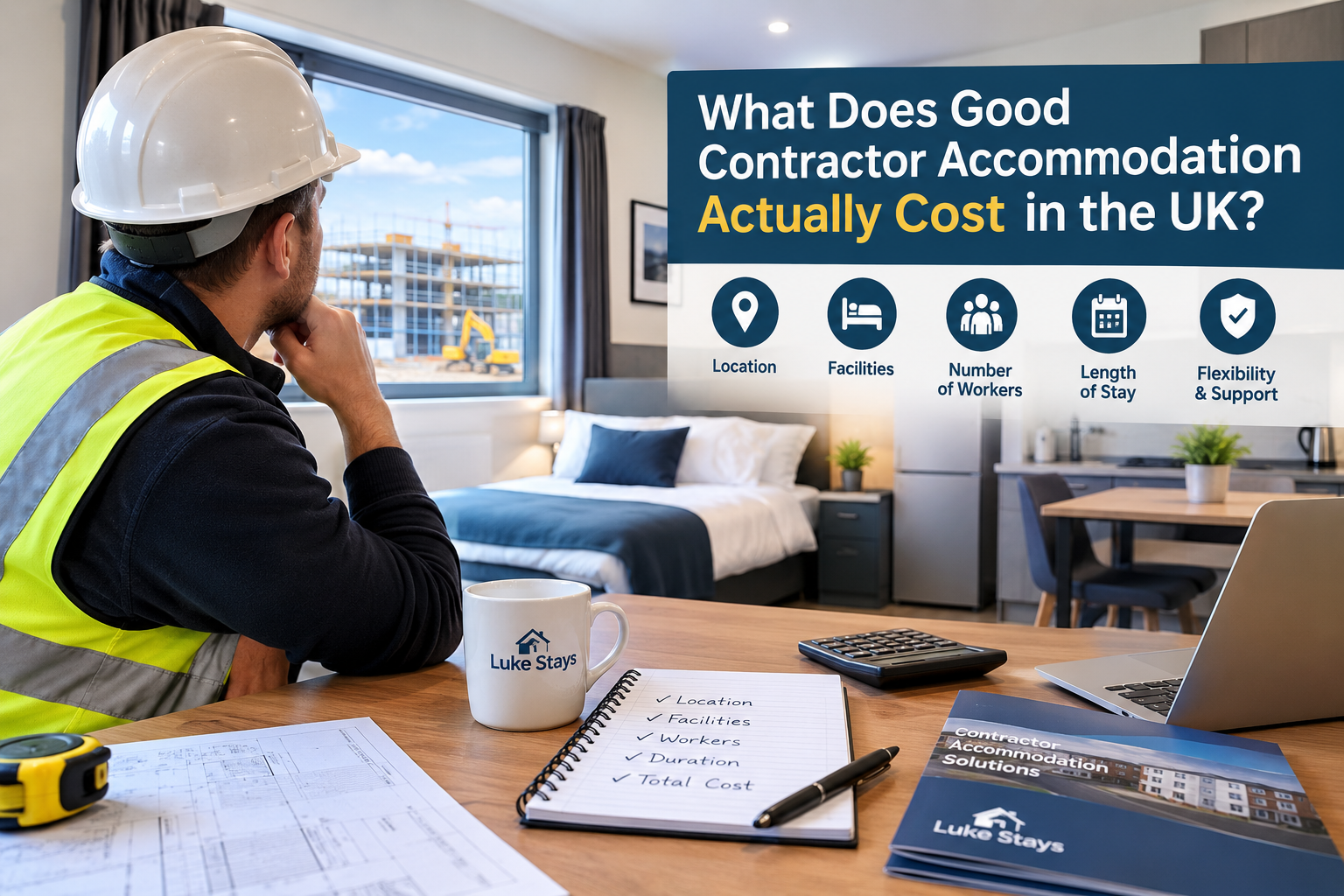
Wondering what good contractor accommodation actually costs in the UK? The answer is more complicated than finding the cheapest room or multiplying a nightly rate by the number of workers.
For contractors, construction companies, engineering teams, project managers and businesses operating away from home, accommodation is part of the wider project budget. The right property can make life easier for workers, simplify logistics for managers and help a project run smoothly. The wrong choice can create additional costs, complaints and unnecessary administration.
So, what should businesses actually expect to pay for good contractor accommodation in the UK?
The important thing is to look beyond the headline price.
Good contractor accommodation should provide the right combination of location, comfort, facilities, flexibility and reliability for the people staying there — while also making commercial sense for the business booking it.
At Luke Stays, we help businesses arrange practical accommodation for contractors, project teams and workforce groups across the UK. Here is what you should consider when working out the true cost of accommodation for your team.
The Price of Contractor Accommodation Is Not One Simple Number
One of the biggest mistakes businesses make is looking for a single “average” price for contractor accommodation.
There isn’t one universal figure.
Accommodation costs can vary significantly depending on:
- Location
- Property type
- Length of stay
- Number of workers
- Number of bedrooms required
- Local demand
- Project duration
- Availability
- Parking requirements
- Required facilities
- Check-in dates
- Shift patterns
- Whether the team needs to stay together
A contractor working on a project in a major UK city may have very different accommodation requirements from a team working on a construction project in a smaller town.
Likewise, accommodation for two workers staying for three nights is a completely different booking from housing twenty contractors for several months.
That is why the better question isn’t simply:
“How much is contractor accommodation per night?”
It is:
“What will it cost to accommodate my team properly for the duration of the project?”
That small change in perspective can make a big difference.
What Makes Contractor Accommodation “Good”?
Before comparing prices, it is worth defining what you are actually buying.
Good contractor accommodation should do more than provide somewhere for workers to sleep.
After a long shift, contractors need somewhere they can genuinely switch off.
Depending on the project, that could mean:
- Comfortable bedrooms
- A proper kitchen
- Washing facilities
- Living space
- Reliable Wi-Fi
- Convenient parking
- Easy access to the worksite
- A safe and practical location
- Enough space for the number of people staying
- Straightforward check-in
- Responsive support if something goes wrong
These details matter.
A property that looks cheap on paper may become expensive if workers have a poor experience, spend too much time travelling or management has to constantly deal with accommodation problems.
The cheapest accommodation is not always the lowest-cost accommodation.
Location Can Have a Bigger Impact Than You Think
Location is one of the biggest factors affecting accommodation costs.
But there is another cost that businesses sometimes overlook: travel time.
Imagine a team staying considerably further away from the project because the accommodation was slightly cheaper.
The workers now have a longer journey every morning and evening.
That can mean:
- More fuel
- Higher transport costs
- Longer commuting times
- Greater logistical complexity
- Less downtime for workers
- More fatigue after shifts
For a short project, the difference might seem insignificant.
For a large workforce staying for several weeks or months, it can become substantial.
This is why businesses should assess accommodation based on total project value, rather than simply choosing the lowest advertised rate.
A well-located property can potentially save time and simplify workforce logistics.
Property Type Matters
Another reason contractor accommodation prices vary is the type of property being booked.
Businesses may consider:
- Individual hotel rooms
- Serviced apartments
- Houses
- Flats
- Larger multi-bedroom properties
- Corporate accommodation
- Workforce accommodation
The right option depends on the project.
For smaller teams, individual rooms may be practical.
For larger groups, booking an entire property can provide a better environment and make managing the workforce considerably easier.
Having workers in suitable accommodation together can also make logistics simpler.
Instead of managing multiple addresses, different check-in arrangements and several accommodation providers, businesses may be able to consolidate the requirement.
That is where working with an experienced accommodation partner becomes particularly valuable.
Longer Stays Can Change the Equation
The length of the project is another important factor.
Contractors might need accommodation for:
- A few nights
- Several weeks
- Several months
- An entire project
- Rotating shifts
- Extended project periods
A project that initially appears to require short-term accommodation can quickly change.
A three-week project becomes six weeks.
Six weeks becomes three months.
The accommodation strategy needs to be flexible enough to cope.
This is particularly important in construction, engineering, infrastructure, utilities, rail and other industries where project schedules can move.
A good accommodation provider should understand that projects do not always run perfectly according to the original plan.
Don’t Forget the Cost of Changing Plans
Here’s something that rarely appears on an accommodation quote:
The cost of administration.
Imagine a project manager responsible for accommodation for 30 workers.
Then:
- Five workers arrive earlier.
- Two workers leave later.
- Three workers need to move.
- The project gets extended.
- A new site starts nearby.
- Someone needs an additional night.
- Another property becomes unavailable.
Suddenly, accommodation isn’t just a booking.
It becomes a logistics project.
Every change creates another task.
Emails.
Phone calls.
Availability checks.
Invoices.
Guest details.
Check-in instructions.
Property issues.
Extensions.
Cancellations.
For businesses managing multiple projects, this can consume a surprising amount of management time.
That is one reason businesses should consider the overall service included with accommodation, not simply the accommodation price.
The Cheapest Option Can Become the Most Expensive
Let’s say you find a property that appears to be significantly cheaper than another option.
It sounds like an obvious saving.
But then you discover:
The property is much further from the site.
There is limited parking.
The workers have to share unsuitable facilities.
Wi-Fi is unreliable.
The property is difficult to manage.
Support is slow when an issue occurs.
The project is extended and the accommodation cannot easily be continued.
Now the original saving doesn’t look quite as attractive.
This is why procurement teams should compare accommodation based on value, not just price.
A better comparison might look at:
Accommodation cost + travel + administration + disruption + flexibility + worker experience.
That gives you a much more realistic picture.
What Should Be Included in a Contractor Accommodation Quote?
When comparing accommodation providers, ask what you are actually receiving for the quoted price.
A professional contractor accommodation quote should make the important details clear.
Look for information about:
1. The Property
Understand exactly what type of accommodation is being offered.
How many bedrooms are available?
How many people can stay?
Is the property suitable for your workforce?
2. Location
Check the distance and practical journey to the project site.
Don’t rely solely on a postcode.
Consider the actual travel route and transport requirements.
3. Facilities
Think about what your workers genuinely need during their stay.
Kitchen facilities, laundry, Wi-Fi, parking and comfortable living areas can all make a difference.
4. Availability
Make sure the accommodation is available for the full period required — or understand how extensions will be handled.
5. Flexibility
Projects change.
Ask how the provider handles amendments, additional nights, changing worker numbers and extensions.
6. Support
Who do you contact if there is a problem?
Good support can be extremely valuable when accommodation is being arranged for a large workforce.
Why Worker Experience Should Be Part of the Calculation
There is another part of the equation that is often forgotten.
Your workers have to live there.
After an eight-, ten- or twelve-hour shift, accommodation becomes more than a line on a project budget.
It becomes where your people eat, sleep, relax, do laundry and prepare for the next day.
If the accommodation is uncomfortable or inconvenient, it can affect how people feel about the project.
Good accommodation gives workers somewhere practical to recover between shifts.
That matters particularly when teams are away from home for extended periods.
Businesses competing for skilled contractors should also recognise that accommodation can influence the overall attractiveness of a project.
Looking after your workforce isn’t simply a nice extra.
It can be part of good project management.
How to Budget for Contractor Accommodation
The easiest way to start is to establish the complete requirement.
Ask:
How many workers need accommodation?
Then:
For how long?
Then:
Where is the project?
Then consider:
- Required bedrooms
- Preferred property type
- Parking
- Distance to site
- Shift patterns
- Check-in requirements
- Potential project extensions
- Worker rotation
- Required facilities
Once these details are clear, an accommodation provider can recommend realistic options.
This is much more effective than starting with a price and trying to force the project into whatever happens to be cheapest.
Think About the Cost Per Project, Not Just Per Night
A nightly price can be useful for comparison, but it shouldn’t be the only number you look at.
Suppose one accommodation option costs slightly more but keeps the team closer to the site, provides better facilities and requires less management.
Another option costs less but creates additional transport requirements and more administration.
Which one is actually cheaper?
The answer isn’t necessarily the one with the lower nightly price.
For workforce accommodation, the better measurement is often:
How effectively does this accommodation support the project?
That’s the question procurement teams and project managers should be asking.
When Should You Start Looking for Contractor Accommodation?
Earlier than you think.
Waiting until the last minute can reduce your options, particularly when demand is high or a project requires multiple properties.
Early planning gives you more opportunity to:
- Find suitable properties
- Keep teams together
- Choose convenient locations
- Plan around shift patterns
- Compare options
- Arrange longer stays
- Prepare for potential extensions
It also gives your accommodation provider more time to understand the project properly.
For large workforce requirements, accommodation should ideally be discussed during project planning — not when workers are already preparing to travel.
Why Businesses Choose Luke Stays
At Luke Stays, we understand that contractor accommodation is about more than finding an available bed.
Businesses need accommodation that works for their people and their project.
Whether you need accommodation for a small contractor team or a larger workforce, the aim is the same: make the process straightforward and provide practical accommodation that fits the requirement.
We can help businesses think through factors such as:
- Location
- Workforce size
- Length of stay
- Property requirements
- Project changes
- Extensions
- Workforce rotations
- Practical facilities
Instead of spending hours searching through individual properties and trying to coordinate everything yourself, you can work with an accommodation partner that understands workforce requirements.
So, What Does Good Contractor Accommodation Actually Cost?
There isn’t one figure that applies to every UK contractor accommodation requirement.
The cost depends on the location, property, number of workers, length of stay and level of accommodation required.
But the most important lesson is this:
Don’t judge contractor accommodation solely by the headline price.
Look at the bigger picture.
A good accommodation solution should balance cost, comfort, location, flexibility and convenience.
It should support your workers without creating unnecessary work for your management team.
And it should be capable of adapting when your project changes.
That is ultimately what businesses are paying for: not simply somewhere for workers to sleep, but an accommodation solution that helps the project run smoothly.
Need Contractor Accommodation for Your Next Project?
If you’re planning a construction, engineering, infrastructure, utilities, rail or other project that requires accommodation for contractors or workforce teams, Luke Stays can help you find a practical solution.
Whether you’re booking for a few workers or arranging accommodation for a larger team, getting the requirement right from the beginning can save time, reduce logistical headaches and give your workforce somewhere comfortable to stay.
Looking for contractor accommodation in the UK? Contact Luke Stays to discuss your workforce accommodation requirements and find a solution that works for your project.
Don’t wait until your team is already on the road.
Plan the accommodation early. Get the right location. Give your workers somewhere they can actually rest. And let your project keep moving.