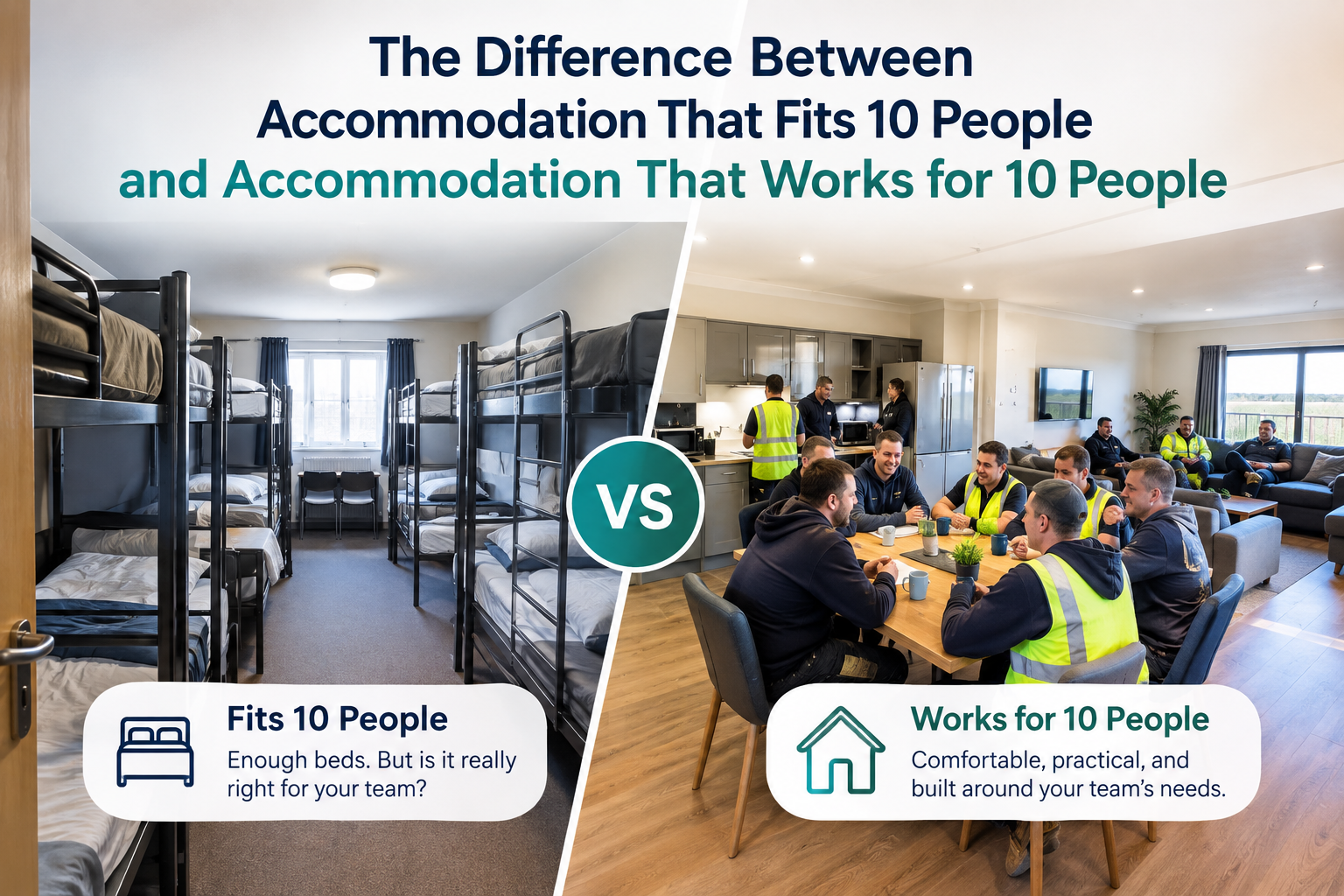
When you’re arranging accommodation for a team of contractors, finding a property that fits 10 people might sound like the main challenge.
But it isn’t.
A property can technically sleep 10 people and still be completely unsuitable for 10 working professionals.
There is a big difference between accommodation that fits 10 people and accommodation that works for 10 people.
For project managers, construction companies, engineering firms, utilities contractors and other businesses housing teams away from home, that difference matters.
After a long shift, workers need somewhere they can rest properly, prepare food, maintain some privacy and switch off before the next working day. Meanwhile, the person arranging the accommodation needs reliability, straightforward communication and a solution that can cope with the realities of a working project.
That’s where the right workforce accommodation makes a difference.
At Luke Stays, we understand that contractor accommodation isn’t simply about counting beds. It’s about creating a practical base that works for the people staying there and the business managing the project.
What Does “Fits 10 People” Actually Mean?
At the most basic level, accommodation that fits 10 people means there is sleeping capacity for 10 guests.
There may be enough beds on paper.
The booking may even look perfect when you’re comparing properties online.
But sleeping capacity is only one part of the equation.
Consider a property with:
- 10 sleeping spaces
- One small bathroom
- Limited kitchen facilities
- Minimal living space
- Little storage
- No practical space for everyone to sit comfortably
- Bedrooms with several people sharing
- Limited parking
Technically, it may accommodate 10 people.
But would 10 contractors actually want to live there for several weeks?
Would they be comfortable returning there after a 12-hour shift?
Would the property make their working routine easier or harder?
Those are much more important questions.
Accommodation Should Work Around the Workforce
Contractors don’t experience accommodation as a number on a spreadsheet.
They experience it at the end of every working day.
After travelling to site, completing their shift and dealing with the demands of the job, they need somewhere that allows them to recover.
That means thinking beyond the number of beds.
A suitable property for a team of 10 might need:
- Comfortable sleeping arrangements
- Appropriate bedroom space
- Useful kitchen facilities
- Enough bathrooms for the group
- Comfortable communal areas
- Reliable Wi-Fi
- Convenient parking
- Laundry facilities
- Easy access to the project
- A practical location for local amenities
- A layout that provides a reasonable level of privacy
These details can have a significant effect on the experience of the workforce.
And when workers are happier with where they stay, managing the project can become easier too.
Ten People Does Not Mean Ten Identical Needs
One of the biggest mistakes businesses can make is assuming that every group of 10 workers needs exactly the same accommodation.
They don’t.
A team of 10 travelling for a short shutdown project may have different requirements from a team of 10 working on a six-month construction programme.
A group working night shifts may have different needs from a team working traditional daytime hours.
A group of experienced contractors may also have different preferences from a mixed workforce.
That’s why accommodation should be considered around the way the team works, rather than simply the number of people.
Before booking, consider:
How long are they staying?
A property that works for a few nights may not be comfortable for several weeks.
What are their working hours?
Shift patterns can affect sleeping arrangements, noise considerations and access to facilities.
How far is the property from site?
A property that saves a little on accommodation but adds significant travel time every day may not provide the best overall solution.
How will the team use the property?
Will they cook together? Need parking for several vehicles? Need somewhere to relax? Need laundry facilities?
These questions turn a simple accommodation search into a workforce accommodation strategy.
The Importance of Privacy
When housing 10 people, privacy becomes particularly important.
A team may work together all day. That doesn’t necessarily mean they want to share every part of their personal time.
Having appropriate bedroom arrangements gives workers the opportunity to switch off and recharge.
This is especially relevant when accommodation is being used for longer projects.
A workforce accommodation solution should therefore consider not just how many people can sleep in the property, but how those people will actually live there.
The right balance between shared and private spaces can make the accommodation feel significantly more practical.
Shared Spaces Matter Too
Bedrooms aren’t the only consideration.
Imagine 10 contractors returning from work.
Where do they prepare meals?
Where do they sit?
Where do they relax?
Is there enough fridge and storage space?
Can several people use the kitchen without constantly getting in each other’s way?
These practical questions are easy to overlook when reviewing a property listing.
A property may have enough beds but an undersized communal area.
That can quickly become frustrating during a longer stay.
Good workforce accommodation considers the complete experience.
The property should provide spaces that support the daily routine of the people staying there.
Bathrooms Can Make a Big Difference
Bathrooms are another practical consideration that can easily be missed.
If 10 people are sharing one bathroom, the morning routine can become unnecessarily difficult.
This becomes even more important when workers have similar start times.
Nobody wants the beginning of the working day to involve queuing for essential facilities.
When comparing contractor accommodation, consider the relationship between the number of guests and the property’s facilities.
The goal isn’t simply to find a property that technically meets the occupancy requirement.
The goal is to find one that makes the team’s daily routine manageable.
Location Is About More Than Distance
A property being close to a project is useful.
But location should be considered more broadly.
Contractors may need access to supermarkets, restaurants, fuel stations, gyms, pharmacies and other local amenities.
Parking can also be important, particularly for teams travelling in several vehicles.
For project managers, the ideal accommodation location can help reduce unnecessary travel and make the workforce’s routine more straightforward.
This is one reason why workforce accommodation should be assessed from the perspective of the people actually staying there.
The Hidden Cost of Choosing the Wrong Property
Choosing accommodation based purely on capacity can create problems later.
For example, a property may accommodate 10 people but result in:
- Complaints from workers
- Difficult morning routines
- Poor sleeping arrangements
- Limited space
- Increased travel time
- Frequent requests to change accommodation
- Additional administration
- Disruption when workers leave early or need to be relocated
The original booking may have looked straightforward.
But the real-world experience can be very different.
This is why the cheapest or simplest-looking accommodation isn’t necessarily the most practical solution for a project.
The better question is:
“Will this accommodation work for our team?”
Think About the Entire Stay
One of the best ways to evaluate contractor accommodation is to imagine a typical day.
The alarm goes off.
Ten workers need to get ready.
Some start earlier than others.
They need access to bathrooms.
They prepare breakfast.
They leave for site.
At the end of the day, they return.
They shower.
They prepare food.
Some want to relax in the communal area.
Others want privacy.
Laundry needs doing.
Vehicles need parking.
And then everyone needs a comfortable night’s sleep before the cycle begins again.
That’s what accommodation needs to support.
The booking isn’t just about where people sleep.
It’s about where they live temporarily while completing the project.
Why This Matters to Project Managers
For project managers and accommodation coordinators, workforce housing can become a significant logistical task.
The larger the team, the more important it becomes to get the details right.
If accommodation doesn’t work, the issue can quickly become a management problem.
Workers may raise concerns.
Someone may request a room change.
A property may not have enough practical facilities.
Travel arrangements may become complicated.
The accommodation coordinator then has to spend additional time solving problems that could potentially have been avoided during the original selection process.
Choosing accommodation based on how the property will actually be used can help reduce those headaches.
What Should You Look For When Housing 10 Contractors?
Before confirming a property, create a simple checklist.
1. Sleeping arrangements
Does the property provide appropriate sleeping arrangements for the whole team?
2. Bathrooms
Are there enough facilities to support the group comfortably?
3. Kitchen
Can the team realistically prepare meals and store food?
4. Communal space
Is there enough room to relax without everyone feeling cramped?
5. Privacy
Do workers have appropriate personal space?
6. Parking
Can the team’s vehicles be accommodated conveniently?
7. Wi-Fi
Can workers reliably connect when they need to?
8. Laundry
Are washing facilities available and practical for longer stays?
9. Location
Is the property conveniently positioned for the project and everyday essentials?
10. Flexibility
Can the accommodation provider support changes if the project evolves?
This final point can be particularly important.
Projects rarely remain completely static.
Team sizes change. Dates move. Shifts change. Extensions happen.
Your accommodation solution needs to be able to respond.
Why Workforce Accommodation Should Be More Than a Bed Count
The phrase “sleeps 10” is useful when starting an accommodation search.
But it shouldn’t be where the search ends.
A successful workforce accommodation solution considers the entire experience.
It asks:
Can 10 people sleep here?
But also:
Can 10 people live here comfortably for the duration of their assignment?
That’s the difference.
And it’s a difference worth understanding before making a booking.
How Luke Stays Can Help
Finding suitable accommodation for a workforce doesn’t have to mean spending hours comparing properties, checking facilities and trying to work out whether a property will genuinely suit your team.
Luke Stays provides accommodation solutions designed around the practical needs of people staying away from home.
Whether you’re arranging accommodation for a small contractor team or coordinating housing across a larger project, the objective should remain the same: find accommodation that works for the workforce, not simply accommodation that fits them in.
That means considering location, facilities, comfort, privacy and the realities of the team’s working routine.
Instead of asking only how many people a property can sleep, start by asking what your workforce needs to make the stay successful.
Then choose accommodation around those requirements.
Ready to Find Accommodation That Works for Your Team?
If you need accommodation for 10 contractors, don’t stop at the number of beds.
Think about the full working week.
Think about the morning routine.
Think about the journey to site.
Think about what happens after a long shift.
Think about privacy, comfort, facilities and the practical details that can make a temporary stay much easier.
Because accommodation that fits 10 people and accommodation that works for 10 people are not necessarily the same thing.
When you’re ready to arrange practical workforce accommodation for your next project, Luke Stays can help you find a solution built around the needs of your team.
Need accommodation for your contractors? Get in touch with Luke Stays to discuss your workforce accommodation requirements and find a property that works for your project.