Winning a construction tender is exciting.
Months of planning, pricing, negotiations, and presentations have finally paid off. The contract is signed, congratulations are shared around the office, and suddenly everyone has the same question:
“How quickly can we get everyone on site?”
Equipment is booked.
Materials are ordered.
Health and safety documentation begins.
Subcontractors receive their instructions.
Project schedules are finalised.
Yet one crucial part of the mobilisation process is often left until the very last minute:
Where will everyone stay?
Ironically, accommodation can become one of the biggest reasons a project starts with unnecessary stress.
At Luke Stays, we’ve seen how projects that plan accommodation early experience smoother mobilisation, happier teams, and fewer unexpected costs. We’ve also seen what happens when accommodation is treated as an afterthought.
Let’s explore where accommodation fits into the construction timeline—and why getting it right from the beginning can make a huge difference.
Winning the Tender Is Only the Beginning
A tender win isn’t the finish line.
It’s actually the starting point.
Once a contract is awarded, the countdown begins.
Every department suddenly has a long checklist.
Project managers are creating programmes.
Commercial teams are finalising budgets.
Procurement teams are placing orders.
Site managers are arranging inductions.
Recruitment teams begin assigning engineers, electricians, steelworkers, supervisors, and specialist contractors.
Everyone is moving fast.
Accommodation should be moving just as quickly.
The reality is that many projects require workers to travel hundreds of miles from home. Waiting until the week before mobilisation to find suitable accommodation can create unnecessary challenges.
Why Accommodation Should Be Planned Early
Imagine this situation.
A contractor wins a major infrastructure project near Newcastle.
The project will require twelve workers for six months.
The mobilisation date is four weeks away.
Everything appears organised.
Until someone asks:
“Has anyone booked accommodation?”
Suddenly dozens of hotel websites are opened.
Prices have doubled.
Properties close to the site are fully booked.
Workers end up staying in four different hotels across the city.
Instead of travelling together, everyone drives separately.
Breakfast isn’t included.
Parking costs add up.
Evening meals become expensive.
The team never really settles.
This situation happens far more often than people realise.
Early accommodation planning avoids this completely.
Accommodation Is Part of Mobilisation
Site mobilisation isn’t simply arriving on day one.
It’s about ensuring every person has everything they need to perform from the moment work begins.
Accommodation plays a surprisingly important role.
A contractor who sleeps well is safer.
A supervisor who can prepare meals saves money.
An engineer staying close to site arrives on time.
A project manager who isn’t dealing with accommodation problems can focus on delivering the project.
Accommodation supports productivity before the first task even begins.
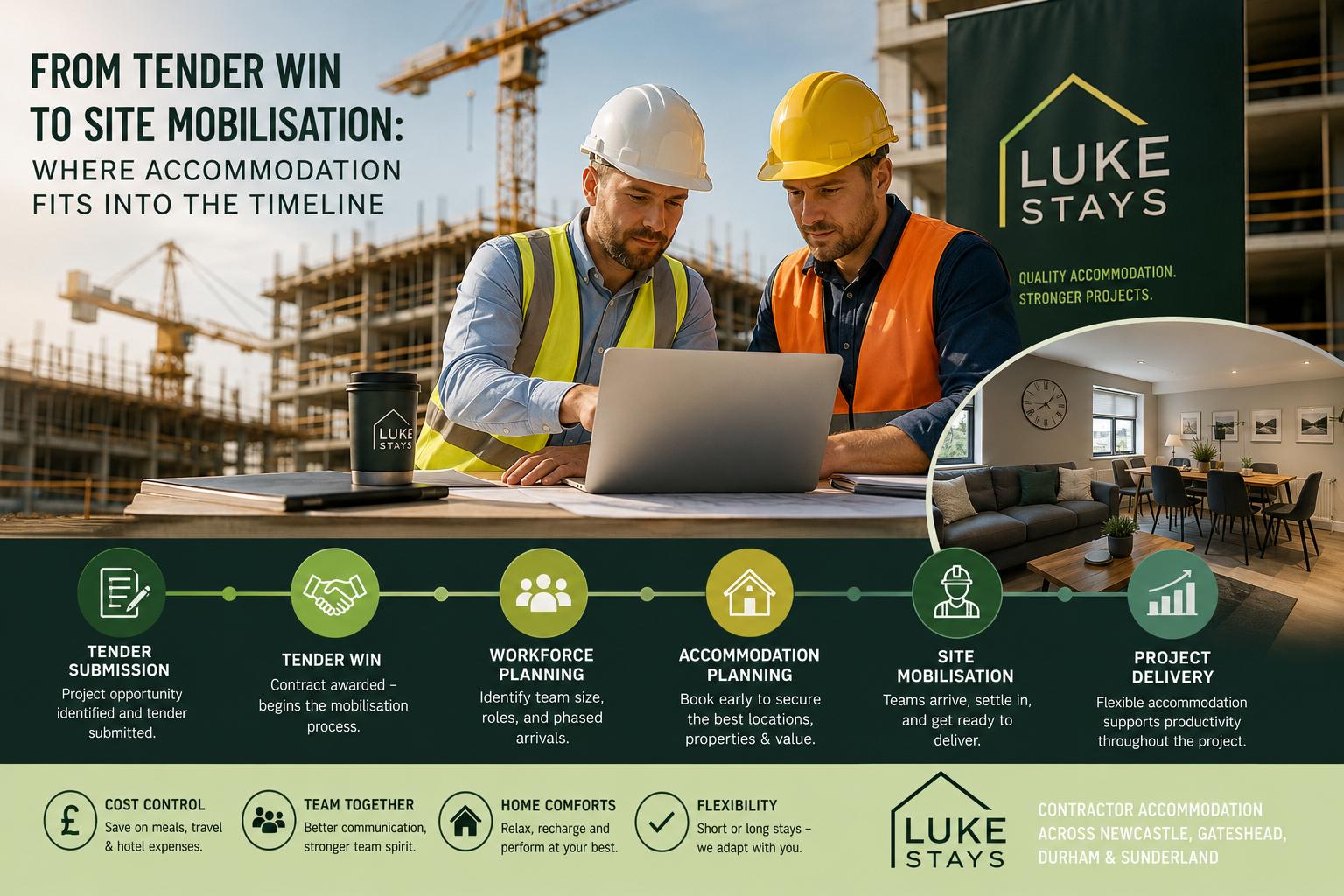
The Typical Construction Timeline
Let’s look at where accommodation naturally fits.
Stage 1 – Tender Submission
Accommodation usually isn’t booked yet.
However, experienced companies already begin estimating likely workforce numbers and project locations.
Thinking ahead provides valuable flexibility later.
Stage 2 – Contract Award
This is where accommodation planning should begin.
The earlier suitable properties are secured, the more options are available.
Instead of accepting whatever remains, companies can choose accommodation that genuinely supports their workforce.
Stage 3 – Workforce Planning
Numbers become clearer.
Will ten contractors be arriving?
Twenty?
Thirty?
Will different trades join at different times?
Accommodation providers like Luke Stays can help organise properties that grow alongside the project.
Stage 4 – Site Mobilisation
Workers arrive.
Keys are collected.
Teams settle in.
Instead of spending the first evening searching for supermarkets or driving between hotels, they’re already comfortable.
The project begins with confidence.
Stage 5 – Project Delivery
Projects rarely remain unchanged.
Deadlines move.
Extra workers arrive.
Completion dates extend.
Accommodation should be flexible enough to adapt.
That’s where serviced accommodation offers significant advantages over traditional hotels.
Hotels Aren’t Always Built for Construction Teams
Hotels serve many travellers extremely well.
Holidaymakers.
Conference visitors.
Business meetings.
But construction projects have different requirements.
Contractors often need:
- Early check-ins
- Long stays
- Parking
- Multiple bedrooms
- Kitchen facilities
- Laundry facilities
- Reliable Wi-Fi
- Flexible extensions
- Easy site access
Large serviced accommodation offers these practical advantages while helping companies control costs.
Instead of several individual hotel rooms, teams can stay together in spacious, fully furnished homes.
Keeping Teams Together Makes a Difference
Construction projects rely on teamwork.
Why separate everyone after work?
When teams stay together they naturally communicate better.
Plans for tomorrow’s work are discussed over dinner.
Problems are solved before reaching site.
New workers integrate faster.
Morale improves.
Small improvements like these often have a much bigger impact than companies expect.
Reducing Hidden Costs
Accommodation isn’t simply about the nightly rate.
The real cost includes everything around it.
Consider:
- Parking charges
- Daily breakfasts
- Evening meals
- Laundry
- Taxi fares
- Fuel
- Travel time
- Administrative time spent managing bookings
Serviced accommodation helps reduce many of these hidden expenses through fully equipped kitchens, free parking, washing facilities, and larger properties suitable for multiple team members.
When looked at over several weeks—or even months—the savings can be substantial.
Flexibility Matters Because Projects Change
Construction projects rarely follow the original programme exactly.
Weather delays occur.
Materials arrive late.
Additional phases are awarded.
New subcontractors join.
Completion dates move.
Accommodation should be able to adapt alongside the project rather than becoming another problem to solve.
That’s why flexible serviced accommodation is often a better fit for construction teams than fixed hotel bookings.
Whether your project lasts two weeks or six months, Luke Stays works with businesses to provide accommodation that can scale as project requirements change.
Why Companies Choose Luke Stays
At Luke Stays, we understand that you’re not simply booking somewhere to sleep.
You’re supporting the people delivering your project.
Our large serviced properties across Newcastle upon Tyne, Gateshead, Durham, and Sunderland are designed with contractors, engineers, project managers, and corporate teams in mind.
Our accommodation offers:
- Spacious multi-bedroom properties
- Fully equipped kitchens
- Fast Wi-Fi
- Comfortable living areas
- Free or convenient parking where available
- Flexible booking options
- All bills included
- Excellent access to major construction projects across the North East
Whether you’re accommodating a small specialist team or a larger workforce, we aim to make the accommodation process simple from enquiry to check-out.
Accommodation Should Never Be an Afterthought
The best construction projects don’t just plan materials and manpower—they plan the entire working environment.
Accommodation influences punctuality, wellbeing, productivity, communication, and overall project efficiency.
The earlier it’s considered, the smoother mobilisation becomes.
Instead of rushing to find available rooms days before work begins, businesses that plan ahead can secure better locations, better value, and a better experience for their teams.
When accommodation becomes part of the mobilisation strategy rather than a last-minute task, everyone benefits.
Final Thoughts
Winning the tender is an exciting milestone—but successful delivery depends on hundreds of decisions made afterwards.
Accommodation is one of those decisions that can quietly shape the success of the entire project.
By planning early, choosing accommodation designed for working professionals, and partnering with a provider that understands construction projects, businesses can reduce stress, control costs, and help their teams perform at their best from day one.
If your next project is taking place in Newcastle, Gateshead, Durham, Sunderland, or the wider North East, Luke Stays is ready to help you secure comfortable, flexible, contractor-focused accommodation that keeps your project moving from mobilisation through to completion.