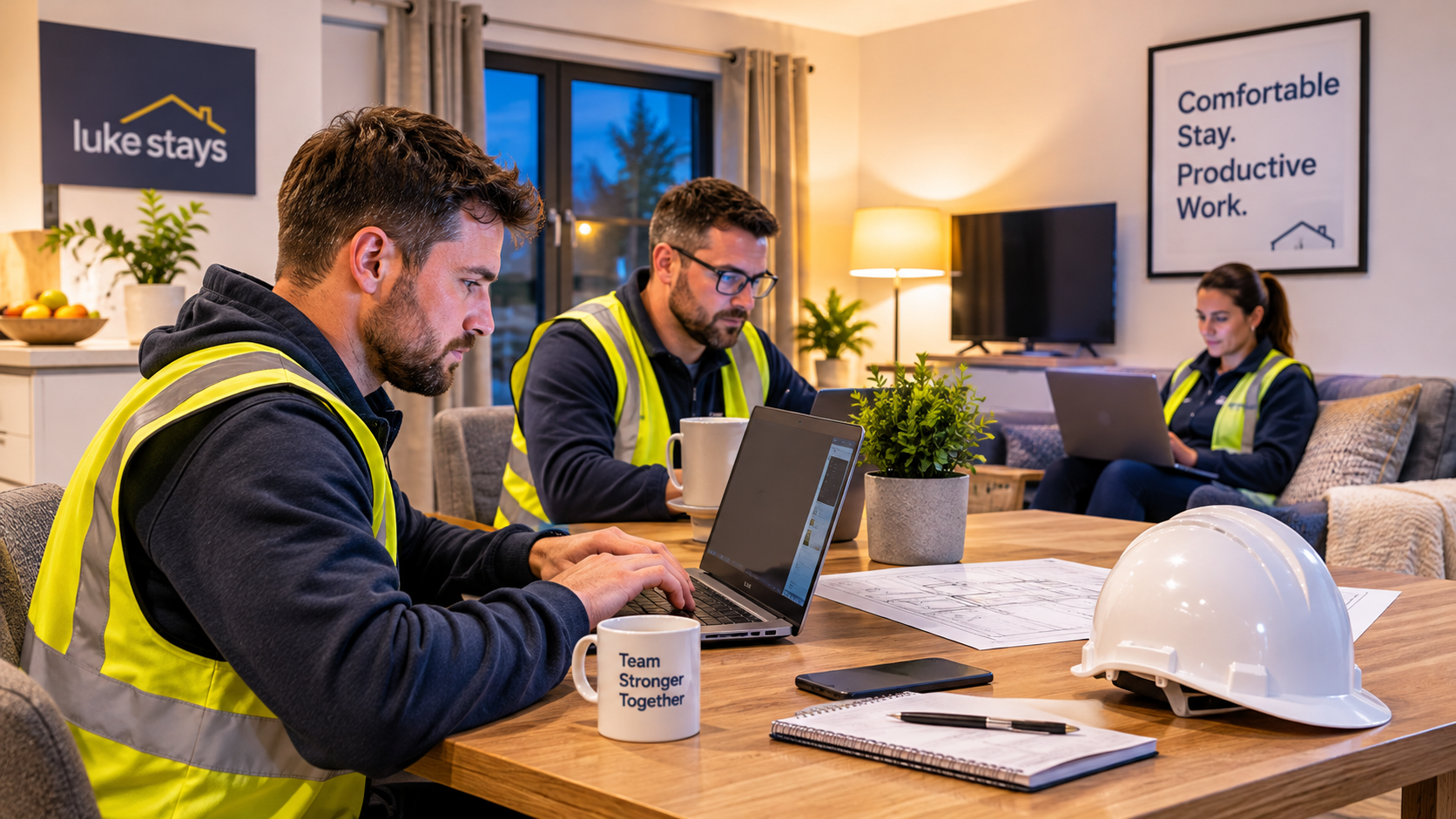
Your contractors have finished a long day on site. They return to their accommodation, have something to eat and prepare to relax. But their working day is not quite over.
One needs to complete a project report. Another has an online meeting with a client. The site supervisor needs to review tomorrow’s schedule, while another team member must upload documents and respond to emails before the next morning.
Suddenly, somewhere to sleep is no longer enough.
Your workforce needs somewhere they can comfortably switch between physical work, remote tasks and personal downtime.
This is an increasingly important consideration for businesses managing construction projects, engineering contracts, infrastructure work, industrial installations and other assignments involving travelling teams.
Choosing the right contractor accommodation for remote working can make a significant difference to productivity, employee satisfaction and the overall project experience.
But what exactly should companies look for?
At Luke Stays, we understand that workforce accommodation needs to do more than provide a bed for the night. It should support the practical demands of working professionals, including those who need to remain connected after leaving the workplace.
Here is how to choose accommodation that works just as hard as your team does.
1. Look Beyond Somewhere to Sleep
One of the biggest mistakes businesses make when arranging contractor accommodation is concentrating entirely on sleeping arrangements.
Naturally, comfortable beds, clean bathrooms and convenient locations matter. However, these are only part of the picture.
Consider a team of six electrical engineers working on a major installation project. During the day, they are on site. In the evening, two engineers need to complete technical documentation, one has a video conference, and the project manager must prepare the following day’s work schedule.
If the accommodation only offers somewhere to sleep, these activities become difficult.
Workers might end up sitting on beds with laptops, working in uncomfortable positions or struggling to find a quiet place to concentrate.
Instead, businesses should consider accommodation as an extension of the working environment.
Look for properties offering:
- Comfortable living and dining areas.
- Suitable tables or desks for laptop use.
- Reliable internet connectivity.
- Comfortable seating.
- Adequate lighting.
- Enough space for everyone to relax without disturbing colleagues.
The objective is simple: provide accommodation that supports the different demands of a contractor’s working day.
2. Reliable Wi-Fi Should Be a Priority, Not an Extra
For teams working remotely after hours, internet connectivity is essential.
A property might look impressive in photographs, offer spacious bedrooms and have excellent facilities. However, if the Wi-Fi is unreliable, it can quickly become unsuitable for professionals who depend on online communication.
Think about what happens when a worker cannot join an important Teams meeting, upload a project file or access an online system because the connection keeps dropping.
It creates frustration, wastes valuable time and can affect the next day’s work.
Before confirming a contractor accommodation booking, businesses should ask about:
- Whether Wi-Fi is available throughout the property.
- Whether the connection supports video conferencing.
- Whether multiple people can use the internet simultaneously.
- Whether there are any known connectivity limitations.
- Whether workers can access a suitable working area with a good signal.
It is also worth remembering that a property advertising Wi-Fi does not automatically guarantee that its connection will meet every business requirement.
If your team regularly transfers large files, uses specialist cloud platforms or attends multiple video meetings, explain these requirements to your accommodation provider before booking.
A good accommodation decision starts with understanding how your workforce actually works.
3. Make Sure There Is Enough Space for Everyone
A property that comfortably accommodates six people overnight might not necessarily provide enough space for six people who also need to work remotely.
There is an important difference.
When workers return after a shift, they may have different priorities. One wants to relax and watch television. Another needs to concentrate on a report. Someone else may be attending a confidential online meeting.
If everyone shares one small living area, these activities can quickly clash.
This is why businesses should consider the property’s layout rather than focusing exclusively on its maximum sleeping capacity.
For example, a suitable property might include:
- Separate bedrooms for personal space.
- A dining table that can double as a temporary workstation.
- A spacious lounge.
- Multiple seating areas.
- Enough room to move around comfortably.
For larger contractor teams, several smaller properties may sometimes provide a better arrangement than putting everyone into one overcrowded house.
The right choice depends on team size, working patterns and individual requirements.
When requesting accommodation, explain how many people will be staying and whether several team members will need to work online simultaneously.
This helps the provider identify more appropriate options from the beginning.
4. Consider Quiet Spaces for Evening Meetings
Not every remote working task involves sending an email or checking a spreadsheet.
Some contractors and project managers need to participate in important meetings with clients, suppliers, head-office teams and project stakeholders.
These meetings often require concentration and a quiet environment.
Imagine trying to discuss a project delay while three colleagues are watching television in the background.
It is hardly ideal.
Businesses should therefore consider whether the accommodation provides opportunities for workers to find a quieter space when necessary.
Separate bedrooms, additional living areas and practical room layouts can all help.
If several people regularly attend online meetings, ask whether the property has enough separate areas to accommodate these requirements.
Privacy also matters.
Workers may need to discuss confidential project information, commercial decisions or operational issues. Having somewhere suitable to conduct these conversations can make the accommodation considerably more practical.
5. Choose Accommodation That Supports Long Working Days
Remote working after hours does not necessarily mean contractors are sitting behind a laptop all evening.
Many workers combine physical site duties with administrative responsibilities.
A construction supervisor, for example, might spend ten hours coordinating site activity before returning to the property to review progress reports, respond to emails and prepare the next day’s instructions.
By this point, comfort becomes extremely important.
Poor seating, inadequate lighting and cramped surroundings can make additional work unnecessarily tiring.
Look for accommodation with practical features such as:
- Comfortable sofas and chairs.
- Proper dining furniture.
- Good lighting.
- Well-equipped kitchens.
- Comfortable bedrooms.
- Heating and suitable temperature control.
- Clean, functional bathrooms.
A well-equipped kitchen is particularly useful.
Contractors working away from home often appreciate being able to prepare their own meals rather than depending on restaurants or takeaway food every evening.
This flexibility can make longer assignments more manageable.
The best workforce accommodation should allow people to complete essential tasks while still having the opportunity to rest properly.
6. Location Still Matters When Remote Working Is Involved
If workers are completing tasks remotely after hours, it might be tempting to assume that the accommodation’s location is less important.
In reality, location remains one of the biggest considerations.
Contractors still need to travel to their project sites every morning.
A property with excellent working facilities could become inconvenient if it adds unnecessary commuting time.
For businesses managing projects across the UK, finding the right balance between accommodation quality and site accessibility is essential.
Consider:
Distance to the workplace: How long will the daily commute take?
Road access: Can workers reach the property easily after a long shift?
Parking: Is there sufficient parking for company vehicles and personal transport?
Local amenities: Are supermarkets, food shops and other useful facilities nearby?
Transport arrangements: Can every team member reach the property conveniently?
For teams working across several sites, the accommodation location should also take changing project requirements into account.
Choosing somewhere convenient today but unsuitable for the next phase can create unnecessary disruption.
At Luke Stays, we recognise that location is not simply about finding a property in the right town. It is about understanding where your workforce needs to be and how accommodation fits into the wider project.
7. Think About Privacy and Shared Living Arrangements
Contractors may work together throughout the day, travel together and share accommodation during an assignment.
However, that does not mean they want to spend every hour in the same shared space.
Privacy becomes particularly important when workers need to complete individual tasks remotely.
One person might be reviewing sensitive project documents, while another needs to speak with a client. Someone else may simply want to switch off after a demanding shift.
A suitable accommodation arrangement should balance shared facilities with personal space.
Consider the number of bedrooms, bathroom arrangements and available communal areas.
For longer assignments, these details can have an even greater impact on the overall experience.
Businesses should avoid assuming that the maximum occupancy advertised for a property automatically represents the most comfortable arrangement for their workforce.
The aim should be to find accommodation that genuinely suits the people staying there.
8. Check That the Property Is Suitable for the Length of the Assignment
A short project and a six-month contract create very different accommodation requirements.
For a two-night installation, workers might only need a convenient location, comfortable beds and basic facilities.
For a longer assignment, the requirements become more extensive.
Contractors who regularly work remotely after hours need somewhere that supports their daily routines over an extended period.
Think about what the team will need after the first week, not just on the first night.
Important considerations include:
- Fully equipped kitchen facilities.
- Laundry arrangements.
- Comfortable living spaces.
- Consistent internet access.
- Regular cleaning arrangements, where agreed.
- Reliable property management support.
- Flexibility if the project timetable changes.
Long-term contractor accommodation should feel practical and comfortable rather than like a temporary arrangement that becomes increasingly inconvenient.
Businesses should also discuss extension options with their accommodation provider if project completion dates are uncertain.
This can help reduce the disruption of having to arrange alternative accommodation halfway through an assignment.
9. Ask the Right Questions Before Confirming Your Booking
Many accommodation problems can be avoided simply by asking better questions before making a reservation.
Instead of requesting somewhere that sleeps eight contractors, provide a more detailed description of how the property will be used.
For example:
“Our team of eight engineers will be working on site during the day. Four people regularly need to complete reports, attend online meetings and access project systems during the evening. We need reliable Wi-Fi, comfortable shared spaces, suitable seating and convenient parking.”
This gives the accommodation provider a much clearer understanding of your requirements.
Here are seven useful questions to ask:
- Is reliable Wi-Fi available throughout the property?
- Can multiple people use the internet simultaneously?
- Is there a suitable table or working area for laptop use?
- Are there separate spaces for workers who need privacy?
- Does the property have sufficient bedrooms and bathrooms for our team?
- Is parking available for our company vehicles?
- Can the accommodation be extended if the project runs beyond its expected completion date?
These questions help businesses assess whether a property is genuinely suitable rather than simply available.
They also make it easier for accommodation providers to recommend appropriate options.
10. Choose an Accommodation Partner Who Understands Business Requirements
Finding a property is one thing. Finding an accommodation provider who understands workforce requirements is another.
Businesses managing multiple contractors do not always have the time to search through countless properties, compare individual facilities and coordinate separate bookings.
They need an accommodation partner who understands that project requirements can change.
A reliable provider should be willing to understand:
- The number of workers requiring accommodation.
- Project locations and commuting requirements.
- Expected arrival and departure dates.
- Remote working and internet requirements.
- Parking and vehicle arrangements.
- Individual room and shared-space preferences.
- Potential extensions or changes to the booking.
This becomes particularly valuable when businesses are managing several projects or regularly bringing contractors into different UK locations.
At Luke Stays, we understand that workforce accommodation is about more than providing somewhere for people to stay.
It is about helping businesses arrange practical accommodation that supports their teams throughout their assignments.
Whether you need accommodation for a small engineering team or a larger workforce, explaining your requirements clearly is the best starting point.
11. Don’t Forget the Importance of a Proper Work-Life Balance
There is one final consideration that businesses should never overlook.
Just because contractors can work remotely after hours does not mean they should be expected to spend every evening working.
A comfortable accommodation environment should make it easier for workers to complete essential responsibilities without sacrificing their opportunity to rest.
After a demanding day on site, people need time to eat, relax, communicate with family and prepare for the following morning.
A property that provides comfortable bedrooms, practical living spaces and suitable facilities helps create a better balance.
This is particularly important for teams staying away from home for several weeks or months.
When workers feel comfortable in their accommodation, the overall experience of working away from home can become much more manageable.
For employers, that is an important part of looking after their workforce.
Why Luke Stays Is Worth Considering for Your Next Workforce Accommodation Requirement
Arranging accommodation for contractors who need to work remotely after hours requires more thought than simply finding available bedrooms.
Your workforce needs somewhere that supports the demands of modern project work.
Reliable internet, practical living spaces, comfortable furniture, convenient locations and suitable facilities can all contribute to a better accommodation experience.
More importantly, choosing the right accommodation arrangement can help businesses avoid unnecessary disruption and make life easier for their travelling teams.
At Luke Stays, we understand that every workforce has different requirements.
A team of construction workers may have different priorities from a group of engineers, maintenance specialists or project managers.
That is why communicating your requirements before booking is so important.
If you are arranging contractor accommodation, tell us about your project location, team size, length of stay and the facilities your workers need.
We can help you explore suitable accommodation options for your workforce.
Looking for contractor accommodation that works around your project?
Get in touch with Luke Stays to discuss your requirements and find accommodation that gives your team somewhere comfortable to stay, work and recharge.
Your contractors already have enough to think about during a busy project. Make finding the right accommodation one less thing to worry about.