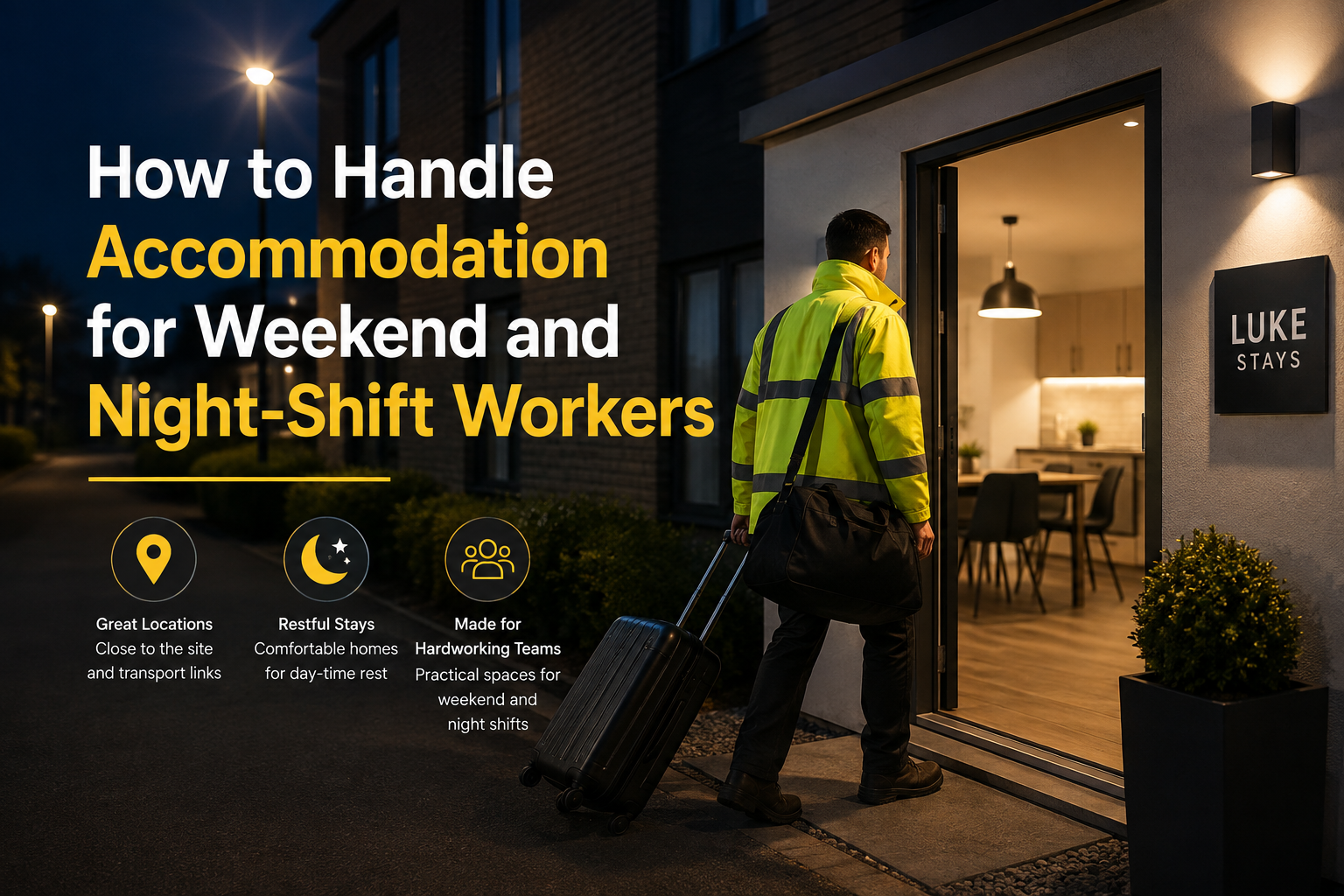
Not every working week runs from Monday to Friday.
Construction projects continue through weekends. Engineering teams work overnight. Rail and infrastructure projects often rely on possessions and extended shifts. Maintenance crews may arrive when everyone else is going home.
And that creates a surprisingly important question:
Where are your workers going to stay when their working hours don’t follow a normal schedule?
Finding a bed is one thing.
Finding accommodation that actually works for someone finishing a shift at 3am, starting work at 6am, staying for a weekend or moving between different project locations is something else entirely.
For businesses managing mobile workforces, accommodation for night-shift workers and weekend teams needs to be planned around the job — not simply booked as an afterthought.
The right accommodation can make life easier for workers, reduce logistical headaches for project managers and help keep a demanding project running smoothly.
That’s where a specialist workforce accommodation provider such as Luke Stays can make a difference.
Why Weekend and Night-Shift Accommodation Needs More Thought
A standard hotel booking might appear to solve the problem.
But workforce accommodation isn’t always that simple.
A worker finishing a night shift doesn’t experience accommodation in the same way as someone checking in at 3pm and going to bed at 10pm.
They may need to sleep during the day.
They may need somewhere practical to prepare food.
They may be staying for several nights rather than one.
They may be travelling with colleagues.
And they may need accommodation close enough to the site that a long commute doesn’t make an already demanding shift even harder.
For project managers, these details matter.
If accommodation doesn’t fit the working pattern, the consequences can quickly spread into other areas of the project.
Longer journeys can mean less rest. Poor accommodation arrangements can create unnecessary stress. Multiple bookings can increase administration. And last-minute changes can become a constant distraction for the person responsible for keeping the workforce organised.
Good accommodation planning starts by understanding how people actually work.
1. Start With the Shift Pattern
Before booking anything, look at the working schedule.
This sounds obvious, but it is one of the easiest things to overlook.
A workforce could include:
- Monday-to-Friday workers
- Weekend crews
- Night-shift workers
- Rotating teams
- Early-start teams
- Workers covering extended shifts
- Engineers moving between projects
- Contractors working short-term assignments
Each group may have different accommodation requirements.
For example, a worker finishing at 4am has very different priorities from someone finishing at 5pm.
Instead of simply asking, “How many rooms do we need?”, ask:
“How will these workers use the accommodation?”
That small change in thinking can lead to much better decisions.
2. Prioritise Location Around the Workplace
For night-shift and weekend workers, location becomes even more important.
A property that looks inexpensive or attractive on paper may not be practical if workers have to spend a significant amount of time travelling to and from the site.
Consider:
- Distance to the workplace
- Typical journey time
- Shift start and finish times
- Access to major roads
- Availability of parking where required
- Whether workers are sharing transport
- How the journey changes during unsociable hours
For night workers particularly, reducing unnecessary travel can make the working routine considerably easier.
If someone has just completed a long overnight shift, adding a lengthy journey before they can sleep isn’t ideal.
The closer and more practical the accommodation is to the project, the easier it can be to manage the workforce.
3. Think About Daytime Sleep
This is one of the biggest differences between ordinary business accommodation and night-shift worker accommodation.
Night workers often sleep during the day.
That means the accommodation needs to provide a suitable environment for rest.
A worker may return from a shift at 6am and need to sleep while the rest of the world is starting the day.
Noise, unsuitable room arrangements or an uncomfortable environment can make that difficult.
When arranging accommodation, businesses should therefore think about the worker’s complete routine.
They don’t just need somewhere to stay.
They need somewhere they can rest properly between shifts.
For longer projects, this becomes particularly important.
A workforce that is regularly getting poor-quality rest isn’t going to enjoy the same experience as a team that has a comfortable base where they can properly switch off.
4. Give Workers Somewhere That Feels Like a Base
For short assignments, a simple room may be enough.
For longer stays, however, workers often appreciate accommodation that feels more practical and homely.
This is one reason serviced accommodation and professionally managed properties can be attractive for workforce housing.
Depending on the property, workers may benefit from facilities such as:
- Comfortable bedrooms
- Living areas
- Kitchens
- Laundry facilities
- Wi-Fi
- Space to relax after work
- Convenient access to local amenities
The idea isn’t to give workers unnecessary luxury.
It’s about providing a practical place where they can eat, sleep, relax and prepare for their next shift.
That can be particularly valuable when workers are away from home for several weeks.
5. Plan Weekend Accommodation Before the Weekend Arrives
Weekend work can create another common accommodation problem.
Businesses sometimes organise weekday accommodation and then realise their workforce is still required on Saturday or Sunday.
Suddenly, the booking needs to be extended.
Properties may no longer be available.
Workers may need to move.
The project manager has another problem to solve.
This is why weekend accommodation should be included in the original workforce plan whenever possible.
If you already know that a crew will work through the weekend, plan the accommodation around the full assignment, rather than treating Saturday and Sunday as an exception.
It can make the entire process much simpler.
6. Prepare for Rotating Crews
Many industries don’t have one fixed workforce.
Instead, workers rotate.
One team finishes and another arrives.
This can happen on major construction projects, infrastructure works, engineering programmes and shutdown projects.
Accommodation needs to keep up with those changes.
A useful accommodation plan should clearly establish:
- Who is arriving
- When they are arriving
- How long they are staying
- Who is leaving
- When the next team needs the property
- Whether additional workers are joining
- Whether the project schedule could change
Without a clear system, accommodation can quickly become difficult to manage.
With the right provider, however, changing workforce requirements can be much easier to coordinate.
7. Don’t Underestimate Last-Minute Changes
Projects rarely go exactly according to plan.
A shift may be extended.
A worker may need to stay longer.
A new crew may be added.
A project deadline may move.
A weekend working requirement may suddenly appear.
For this reason, businesses should consider accommodation flexibility when choosing a provider.
The cheapest initial booking isn’t necessarily the best overall solution if every change creates another administrative problem.
Instead, ask:
“What happens if our plans change?”
That’s an important question to ask before the workforce arrives.
A reliable accommodation partner should understand that project requirements can move and should be prepared to help businesses manage those changes wherever possible.
8. Keep Accommodation Management Simple
Imagine managing accommodation for 20, 50 or 100 workers.
Now imagine those workers are spread across different locations, working different shifts and arriving on different dates.
Without a structured accommodation process, administration can become overwhelming.
There may be emails to track.
Bookings to amend.
Check-in information to send.
Extensions to arrange.
Invoices to manage.
And workers asking where they are supposed to stay next week.
This is why businesses often benefit from working with a dedicated workforce accommodation provider.
Instead of constantly searching for individual properties, the company can have a central point of contact for its accommodation requirements.
Less time spent chasing accommodation means more time available to manage the actual project.
9. Make the Worker Experience Part of the Plan
There’s another side to workforce accommodation that shouldn’t be ignored: the people actually staying there.
Workers who are away from home for extended periods already deal with long shifts, travel and demanding workloads.
Their accommodation shouldn’t add another problem.
A practical, comfortable place to stay can make being away from home easier.
It gives workers somewhere to relax after work and somewhere they can settle into a routine.
This matters for businesses too.
When companies make an effort to look after their workforce, it can contribute to a better overall working experience.
Accommodation is therefore more than a logistical expense.
It is part of how you support the people delivering the project.
10. Choose a Provider That Understands Workforce Accommodation
Perhaps the most important decision is choosing who manages the accommodation.
A general accommodation booking approach may work for an occasional business trip.
But workforce requirements can be considerably more complicated.
You may need multiple properties.
You may need longer stays.
You may need accommodation close to a particular site.
You may need to house several workers or teams.
You may need weekend and night-shift arrangements.
And you may need flexibility when the project changes.
That’s where specialist workforce accommodation can help.
At Luke Stays, the focus is on helping businesses find practical accommodation for contractors, project teams and mobile workforces across the UK.
Instead of treating every booking as an isolated overnight stay, the accommodation can be considered as part of the wider workforce requirement.
Make Night and Weekend Working Easier With Luke Stays
Weekend and night-shift work isn’t going away.
Construction projects need to meet deadlines. Engineering teams need to keep operations moving. Infrastructure projects have demanding schedules. Maintenance work often happens outside normal business hours.
Your accommodation strategy needs to keep up.
The key is to plan around the worker’s schedule, not simply the calendar.
Think about location.
Think about rest.
Think about shift patterns.
Think about weekend requirements.
Think about rotating crews.
And, most importantly, think about what happens when the project changes.
When accommodation is planned properly, it becomes one less thing for your project team to worry about.
If you’re arranging accommodation for contractors, engineers, construction workers, maintenance teams or other mobile employees, Luke Stays can help you find practical workforce accommodation suited to your project requirements.
Need Accommodation for a Weekend or Night-Shift Workforce?
Don’t wait until the next shift is approaching to start looking.
Tell Luke Stays what you need — including your location, number of workers, dates, length of stay and working pattern — and make accommodation part of your project planning from the beginning.
When your workforce needs somewhere to stay, Luke Stays can help make the process simpler.