Introduction: One Project, Several Accommodation Challenges
A project rarely stays the same from the first day to the final handover.
During the early stages, you might need accommodation for a small team of engineers and project managers. A few weeks later, the workforce could expand to include installation specialists, construction workers and subcontractors. Towards completion, some teams may leave while commissioning engineers and maintenance specialists arrive to finish the job.
Your project may be progressing exactly as planned, but your accommodation requirements can change dramatically along the way.
This is where problems begin.
A property that was perfect for ten contractors might not work for twenty-five. Accommodation booked for an initial installation team may become unsuitable when night-shift workers join the project. Meanwhile, keeping properties occupied after a team has finished its work can create unnecessary administrative pressure.
Managing contractor accommodation across multiple project phases requires more than booking somewhere to stay. It requires a plan that evolves alongside your workforce.
For construction companies, engineering contractors, infrastructure businesses and project managers across the UK, getting this right can make workforce logistics easier to manage.
At Luke Stays, the aim is to help businesses find suitable accommodation solutions for their workforce, making it easier to coordinate stays around changing project requirements.
Here is how to approach multi-phase project accommodation without creating unnecessary complications.
1. Understand Your Project Phases Before Booking Accommodation
The first mistake many businesses make is planning accommodation around the workforce they have today rather than the workforce they will need throughout the project.
Imagine a company undertaking a major industrial installation.
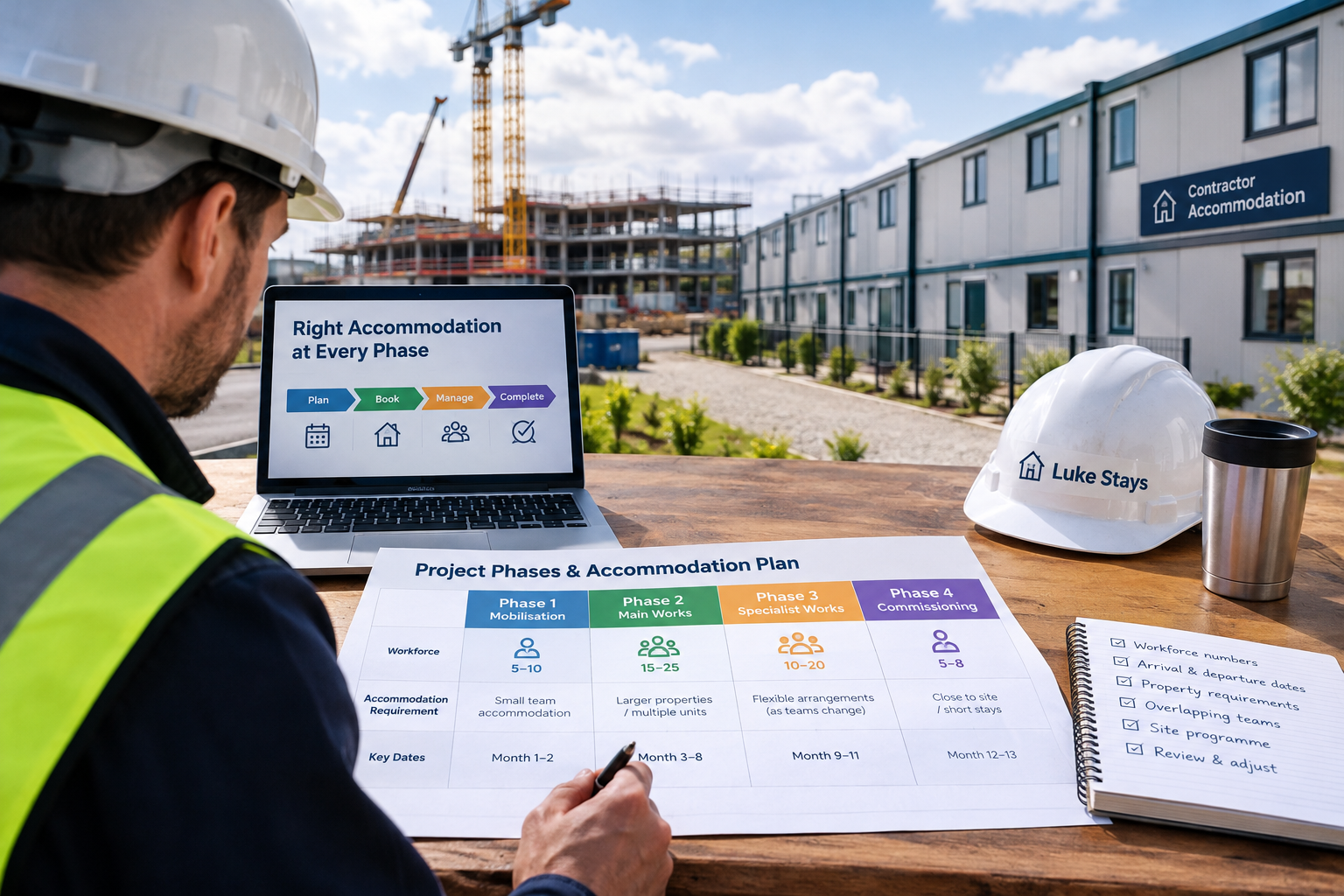
During Phase One, five engineers arrive to assess the site and prepare equipment. Phase Two introduces fifteen installation specialists. Phase Three brings additional subcontractors to complete the main works. Finally, a smaller commissioning team remains to test systems and resolve outstanding issues.
Booking accommodation separately every time the workforce changes can quickly become difficult to manage.
Instead, start by mapping out the entire project.
Identify:
- Mobilisation: Which workers need to arrive first, and when?
- Main installation or construction: When will workforce numbers reach their peak?
- Specialist works: Will additional engineers or subcontractors join temporarily?
- Testing and commissioning: Which workers will remain after the main works finish?
- Demobilisation: When will accommodation requirements reduce or end?
You do not need every date to be perfect from the beginning. What matters is having a realistic starting plan that can be updated as the project develops.
This gives you a clearer picture of when accommodation will be needed, how many people may require it and where potential pressure points could arise.
Booking tip: When requesting contractor accommodation, explain the full project timeline rather than focusing only on the immediate arrival date. This helps the accommodation provider understand your requirements and identify potentially suitable options.
2. Forecast Workforce Numbers for Every Phase
Your accommodation requirements depend on more than the total number of people working on a project.
They depend on who is arriving, who is leaving and how those movements overlap.
For example, a project may have twelve contractors during its first phase and thirty during its second. However, the accommodation challenge becomes more complicated if the original twelve workers remain for several days after the next eighteen arrive.
This overlap can create a temporary demand for thirty beds, even if the project normally operates with a smaller team.
To avoid last-minute arrangements, create a simple workforce forecast.
| Project phase | Example workforce | Accommodation consideration |
|---|---|---|
| Initial preparation | 6 workers | Suitable accommodation for a small team |
| Main installation | 24 workers | Additional capacity and coordinated arrivals |
| Specialist works | 16 workers | Flexible arrangements for changing team sizes |
| Commissioning | 8 workers | Accommodation suited to the remaining specialists |
| Final handover | 3 workers | Smaller requirements and clear departure dates |
These figures are illustrative, but the principle applies to projects of almost any size.
Pay particular attention to overlapping phases. The busiest accommodation period may not match the busiest period on site.
Also consider whether workers will stay for the entire phase or rotate between shifts. A workforce of twenty people does not automatically mean you need twenty beds every night if their attendance patterns differ.
By forecasting demand properly, you can communicate requirements earlier and reduce the risk of discovering that suitable accommodation is unavailable when a new team arrives.
3. Choose Accommodation That Can Adapt as Requirements Change
A property that works for one project phase may not be suitable for the next.
During early planning, a small team might be comfortable sharing a larger house. When the workforce expands, however, additional bedrooms, bathrooms, kitchen facilities or parking may become essential.
The solution is to assess accommodation against the needs of each phase rather than choosing a property based on capacity alone.
Consider the following questions:
- Does the accommodation provide enough suitable bedrooms?
- Are there adequate bathroom and kitchen facilities for the number of occupants?
- Is the property practical for workers travelling to the site?
- Can workers park company vehicles safely and conveniently where required?
- Is there enough space for contractors to relax after long shifts?
- Will the arrangement remain suitable if the project timeline changes?
- Can the accommodation requirements be adjusted if the team expands or reduces?
Think about how the property will function on an ordinary working day.
Twenty workers might technically fit into a particular accommodation arrangement, but that does not necessarily mean it will support their routines comfortably.
For a long-term project, practical details matter. Contractors need somewhere to rest, prepare meals, organise their belongings and recover between shifts.
The right arrangement should support the work being carried out, not introduce another logistical problem.
When speaking to Luke Stays about your project, share the expected workforce size, location, duration, arrival dates and any important property requirements. The more complete your brief, the easier it is to assess relevant accommodation options.
4. Plan for Overlapping Teams and Staggered Arrivals
One of the most challenging aspects of multi-phase projects is managing the transition between teams.
The outgoing workforce may still need accommodation while the incoming team is preparing to arrive. Some contractors might finish on Friday, while replacements arrive on Thursday. Others may travel to the project at different times because of shift patterns or specialist responsibilities.
Without careful coordination, you can end up paying for accommodation that is no longer needed while struggling to arrange suitable space for workers who have just arrived.
Create a transition schedule that records:
- The expected departure date for each outgoing team.
- The arrival date of every incoming team.
- The number of workers requiring accommodation during the overlap.
- Any changes to bedroom or vehicle requirements.
- The person responsible for confirming each change.
Build a realistic buffer into your planning where possible. Site schedules can change, and the team completing one phase may need to remain longer than expected.
However, do not assume that every booking can be extended automatically. Check availability, revised dates and any applicable booking terms with your accommodation provider.
A well-managed transition helps workers move between project phases without unnecessary disruption.
It also gives project managers a clearer view of upcoming accommodation commitments.
5. Coordinate Accommodation With Your Site Programme
Accommodation planning should not happen in isolation from the main project schedule.
If a site manager brings forward an installation date, the accommodation team needs to know. If commissioning is delayed, the people responsible for bookings should understand whether the workforce will remain on site.
Otherwise, even a well-planned accommodation arrangement can become unsuitable almost overnight.
The answer is to make accommodation a regular part of project planning meetings.
Whenever the programme changes, ask three questions:
First, does the change affect who needs accommodation?
A new subcontractor, specialist engineer or additional shift may increase the number of workers requiring somewhere to stay.
Second, does it affect how long they need to stay?
An extended installation period could mean additional nights for the existing team, not just extra accommodation for new arrivals.
Third, does it affect where they need to stay?
If work moves to another section of a large site or a second location, the original accommodation may no longer be practical.
Assign responsibility for sharing these updates. A project manager might approve changes, while a procurement or operations coordinator communicates them to the accommodation provider.
This simple process helps prevent accommodation decisions from being made too late.
For businesses managing several projects simultaneously, consistent communication becomes particularly important.
6. Build Flexibility Into Your Accommodation Arrangements
Even experienced project managers cannot predict every change.
Weather, equipment delays, revised access arrangements, supply-chain issues and additional work can all affect a project’s timeline.
Your accommodation plan should acknowledge that uncertainty.
Start by distinguishing between confirmed requirements and provisional requirements.
Confirmed requirements include workers whose arrival dates and stay durations have been agreed. Provisional requirements might include a subcontractor who could join later or a commissioning team whose start date depends on testing progress.
This distinction allows you to discuss the most important dates and uncertainties with your accommodation provider before they become urgent.
Where appropriate, ask about:
- Extending existing stays.
- Reducing accommodation when a phase finishes early.
- Adding workers during peak periods.
- Adjusting arrival and departure dates.
- Arranging accommodation for short-term specialist teams.
- Moving to different accommodation if the project location changes.
The availability of these options will depend on the property, dates, booking terms and local demand. Flexibility should therefore be discussed and confirmed rather than assumed.
For longer projects, regular reviews can be more effective than making one large booking and hoping the original plan remains unchanged.
The objective is not to predict every possible change. It is to make sure you have a process for responding when changes happen.
7. Keep Accommodation Administration Under Control
Multiple project phases often mean multiple booking dates, properties, invoices and groups of workers.
When these arrangements are managed through scattered emails and separate spreadsheets, it becomes easy to lose track of important details.
A departure date may be missed. An extension might not be communicated to the right person. A worker could arrive without clear check-in instructions.
These issues consume time that project managers and operations teams could spend on more important responsibilities.
Create one central accommodation tracker containing:
- Worker or team name.
- Project and site location.
- Property or accommodation reference.
- Arrival and departure dates.
- Number of occupants.
- Relevant parking or access requirements.
- Confirmed changes and extensions.
- Booking contact and emergency contact details, where appropriate.
- Invoice or purchase-order reference.
Keep the tracker up to date and restrict access to authorised team members where personal information is involved.
It is also useful to establish a clear process for booking changes. For example, a site supervisor might request an extension, but a designated coordinator confirms the revised arrangements and updates the central record.
This creates accountability and reduces the risk of duplicate bookings or missed changes.
For businesses working across multiple UK locations, consistent processes can make workforce accommodation easier to coordinate from one project to the next.
8. Make Every Phase Comfortable for Your Contractors
It is easy to focus on numbers, dates and booking administration while overlooking the people who will actually use the accommodation.
However, contractors may spend weeks or months away from home. Their accommodation becomes part of their daily working routine.
After a demanding shift, workers need a comfortable place to rest. They may need cooking facilities, reliable internet access, convenient parking and enough personal space to relax.
Different project phases may also create different needs.
An early engineering team could require quiet working space and reliable internet. A larger installation team may place greater importance on practical shared facilities. A smaller commissioning team might need accommodation close to the site because of early starts or irregular hours.
Ask your workforce what matters most before confirming the arrangement.
Consider whether the accommodation supports the team’s working hours, travel requirements and length of stay.
This is particularly important for night-shift workers and teams involved in continuous operations, where ordinary check-in arrangements or unsuitable sleeping conditions can cause unnecessary difficulty.
Suitable accommodation does not guarantee better project performance, but it can remove avoidable frustrations from workers’ daily lives.
For employers, that is a worthwhile part of workforce planning.
9. Review Accommodation at Every Phase Change
Do not wait until the project is nearly finished to assess whether the accommodation plan is working.
Schedule a review before each major phase begins.
For example, two weeks before a new installation team arrives, confirm the expected headcount, arrival dates, property requirements and any outstanding changes. The appropriate lead time will depend on the scale of the project and accommodation availability.
During the review, ask:
- Has the workforce forecast changed?
- Are the existing bookings still suitable?
- Do any stays need to be extended?
- Are new workers joining earlier than expected?
- Are any workers leaving sooner than planned?
- Will the next phase require a different accommodation arrangement?
- Have all changes been confirmed with the relevant provider?
Record the decisions and assign responsibility for the next steps.
A short review can prevent a long list of avoidable problems.
It also helps you build a more accurate picture of how accommodation is being used throughout the project.
By the time the final phase arrives, you will have a clearer understanding of what worked, what needs improving and how to approach accommodation planning for your next contract.
10. Choose an Accommodation Partner Who Understands Project Requirements
Managing accommodation across several phases can become complicated when every change requires starting the search again.
Different arrival dates, changing workforce numbers, multiple locations and extended deadlines all create additional coordination work.
Working with an accommodation provider that understands these requirements can make the process more manageable.
When evaluating a provider, look beyond the initial property options.
Ask how they handle changing dates, additional workers, extensions and requests for accommodation in different locations. Explain your project schedule and find out what information they need to assess suitable options.
It is also worth discussing communication arrangements, property suitability, booking confirmation processes and the availability of support if requirements change.
No provider can guarantee that every property will remain available throughout a project. Nevertheless, clear communication and realistic planning can help you make better-informed decisions.
Luke Stays supports businesses looking for accommodation solutions for contractors, project teams and workforces across the UK. Sharing your requirements early gives the team an opportunity to understand your project and explore relevant options.
Whether you are preparing for a short installation, a lengthy construction programme or a project involving several specialist teams, start the conversation before accommodation becomes an urgent problem.
Why Early Accommodation Planning Can Make a Difference
Consider two companies working on similar projects.
The first company books accommodation for its initial team and deals with every new requirement as it appears. When the workforce expands, the coordinator searches for additional properties. When the programme changes, existing bookings need to be reviewed. Each new phase creates another round of administration.
The second company maps out its project phases before work begins. It forecasts workforce numbers, identifies likely transition periods and agrees on a process for communicating changes. Its plan is reviewed as the programme develops.
Neither company can eliminate every unexpected event. However, the second company has a clearer process for managing the accommodation consequences.
That is the real value of planning.
It helps reduce last-minute searching, gives decision-makers better visibility and makes it easier to coordinate accommodation with the people, dates and locations involved.
For businesses delivering projects to tight deadlines, those benefits can make a meaningful difference to day-to-day operations.
Conclusion: Make Accommodation Part of Your Project Strategy
When a project has several accommodation phases, success depends on anticipating change rather than reacting to it.
Start with a clear project timeline. Forecast workforce numbers for every phase, account for overlapping teams and choose accommodation based on practical requirements rather than capacity alone.
Keep the site programme and accommodation plan connected. Review arrangements before each transition, maintain accurate booking records and communicate changes as early as possible.
Most importantly, remember that accommodation is not simply somewhere for contractors to sleep. For a workforce operating away from home, it is part of the environment in which they recover, prepare for work and maintain their daily routines.
Getting these arrangements right can make workforce logistics easier to manage from mobilisation through to final handover.
Planning a project with multiple workforce phases?
Talk to Luke Stays about your contractor accommodation requirements. Share your project location, expected workforce numbers, arrival dates and estimated duration to help identify suitable options for your team.
Whether you need accommodation for a small specialist crew, a growing installation workforce or several teams arriving at different stages, planning ahead is the first step towards a smoother arrangement.
Contact Luke Stays to discuss your project accommodation requirements and explore suitable accommodation options for your workforce.