Contractor Accommodation | Workforce Accommodation | Project Accommodation
When a company manages several contractor projects at once, maintaining consistent accommodation standards can quickly become a challenge.
One team might be working in Newcastle, another in Leeds, while a third is supporting a project hundreds of miles away. Different locations, different property providers, different booking arrangements and different expectations can make it difficult to deliver the same accommodation experience across the entire workforce.
And here is the problem: workers notice the difference.
One team arrives at a comfortable, well-equipped property with everything they need. Another discovers limited kitchen facilities, inconvenient parking or accommodation that does not properly suit their working arrangements. Even when both teams are completing equally important projects, their experiences can be completely different.
For businesses, inconsistent contractor accommodation is more than an inconvenience. It can create additional administration, unnecessary complaints, employee dissatisfaction and difficulties managing a growing workforce.
So, how can companies establish consistent accommodation standards across every contractor project without making the booking process unnecessarily complicated?
The answer is to create a clear accommodation strategy, establish practical standards and work with accommodation partners who understand the demands of contractor travel.
Why Consistent Contractor Accommodation Standards Matter
Imagine managing five projects across different parts of the UK.
Each project has its own team, schedule and accommodation requirements. If every project manager makes independent accommodation decisions, the results can vary considerably.
Some properties might offer everything workers need after a long shift, while others may fall short. Some bookings might be managed efficiently, while others require repeated emails, changes and follow-ups.
Over time, these differences become difficult to control.
Consistent accommodation standards help businesses establish a more dependable experience for their workforce, regardless of project location.
There are several important benefits.
1. A better experience for contractors
Workers who regularly travel for projects need somewhere comfortable, practical and suitable for their routines. Reliable accommodation can make working away from home more manageable.
2. Easier project management
When accommodation requirements are clearly defined, project managers spend less time explaining expectations, resolving avoidable issues and arranging replacements.
3. Greater control over accommodation quality
Businesses can assess properties against the same criteria instead of relying on individual opinions or inconsistent booking decisions.
4. A more professional approach to workforce management
Providing suitable accommodation demonstrates that a company takes its workforce arrangements seriously. It can also contribute to a more positive experience for contractors returning for future projects.
Ultimately, consistency helps businesses manage accommodation as part of their wider operational strategy rather than treating every booking as a separate task.
1. Create a Clear Accommodation Standard Before Booking
The first step is deciding what acceptable contractor accommodation actually looks like for your business.
Without an agreed standard, different project managers may have completely different expectations.
For example, one manager might prioritise location above everything else. Another might focus on the number of bedrooms, while someone else may consider parking and kitchen facilities essential.
None of these priorities is necessarily wrong. However, without a shared approach, accommodation decisions become inconsistent.
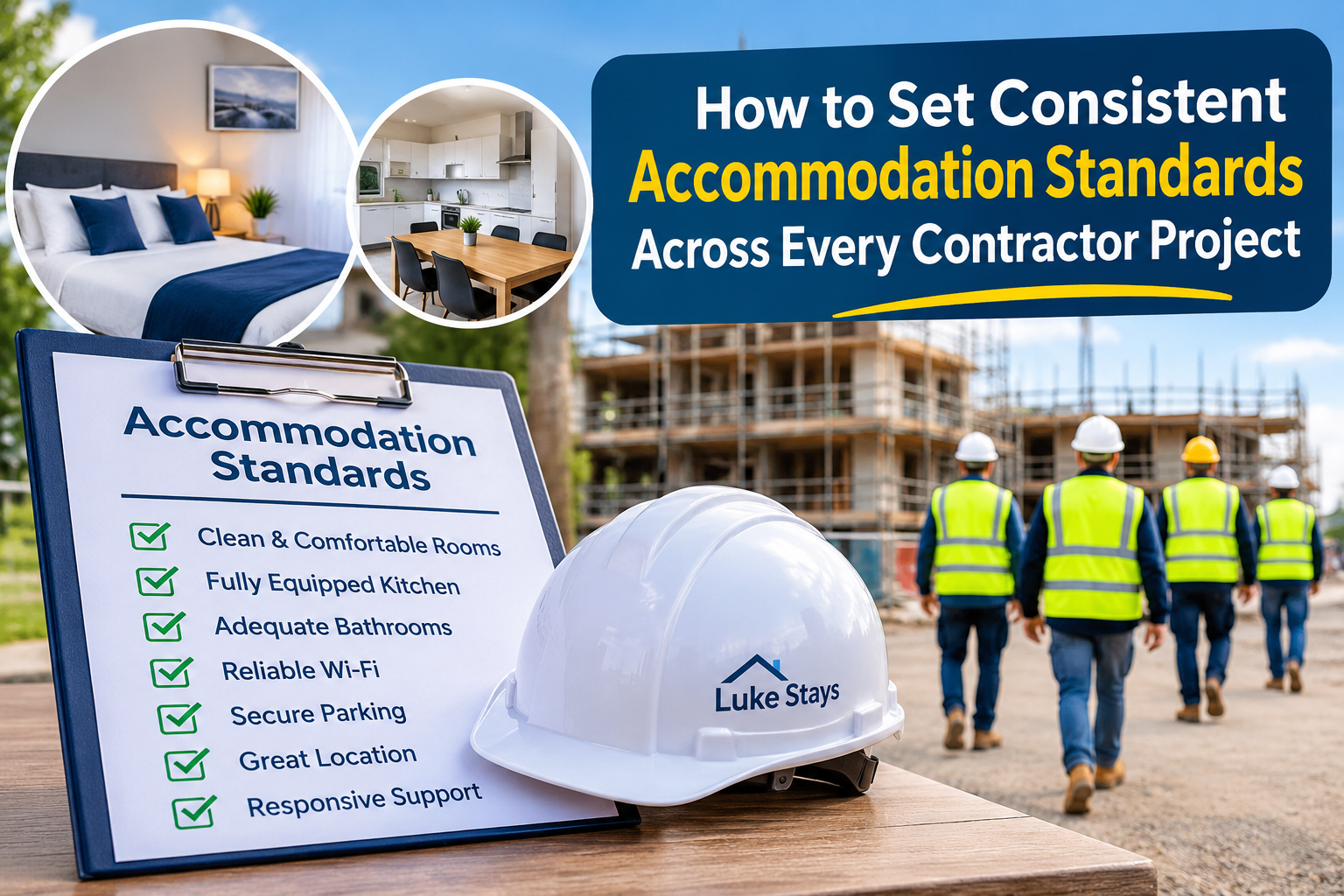
Start by creating a straightforward accommodation standard that covers the essentials.
Consider including:
- Clean, comfortable and properly maintained properties.
- Suitable sleeping arrangements for the number of workers.
- Functional kitchens and appropriate cooking facilities.
- Sufficient bathrooms for the size of the team.
- Reliable internet access.
- Practical parking arrangements.
- Convenient access to project locations.
- Clear check-in and check-out instructions.
- Responsive support when accommodation problems arise.
These requirements provide a common foundation for every project.
Importantly, standards should reflect the actual needs of your workforce. A small team working on a short assignment may have different requirements from a large group staying for several months.
The objective is not to make every property identical. It is to make sure every property meets an agreed level of suitability.
2. Separate Essential Requirements from Project-Specific Needs
One of the biggest mistakes businesses make is assuming that consistent accommodation means booking the same type of property for everyone.
In reality, different projects have different demands.
A team working on a construction site might need substantial parking for work vehicles. Contractors supporting an industrial shutdown may need accommodation that accommodates early starts and late finishes. A team working across several locations might benefit from properties that reduce daily travel between sites.
The accommodation standard should therefore have two parts.
Non-negotiable requirements
These are the minimum standards every property must meet, regardless of location or project size.
For example, cleanliness, appropriate sleeping arrangements, functional facilities and clear arrival instructions.
Project-specific requirements
These are additional arrangements based on the nature of the work.
For example:
- Parking for vans and company vehicles.
- Additional bedrooms for expanding teams.
- Properties close to multiple project locations.
- Suitable arrangements for rotating shifts.
- Flexible booking periods where project dates may change.
This approach creates consistency without sacrificing flexibility.
It also helps accommodation providers understand exactly what a business needs before suggesting suitable properties.
3. Use One Accommodation Brief Across All Projects
When several departments or project managers arrange contractor accommodation, information can easily become inconsistent.
One person might request parking, while another forgets to mention it. One project manager may specify individual beds, while another only provides the total number of workers.
These small differences can create significant problems when the accommodation is arranged.
A standard accommodation brief helps prevent this.
Every project should provide the same core information before accommodation is sourced.
This should include:
- Project location and site address.
- Number of contractors requiring accommodation.
- Required arrival date.
- Expected departure date or likely project duration.
- Bedroom and bed requirements.
- Parking requirements.
- Working patterns and shift arrangements.
- Preferred property type.
- Any additional facilities or accessibility requirements.
- Contact details for the person managing the booking.
Using a consistent brief makes it easier to compare accommodation options and reduces the risk of important details being overlooked.
It also allows accommodation providers to make more relevant recommendations from the beginning.
For businesses managing several projects, this simple process can make accommodation planning significantly more organised.
4. Work with Accommodation Providers Who Understand Contractor Requirements
Not every accommodation provider understands the practical demands of workforce accommodation.
A property that works perfectly for a weekend visitor may not necessarily be suitable for a contractor staying for eight weeks.
Contractors have different routines. They may work long shifts, travel with colleagues, use company vehicles and require practical facilities throughout their stay.
Choosing accommodation providers based purely on photographs or availability can therefore lead to unsuitable arrangements.
Businesses should look for providers who understand:
- The importance of matching accommodation to team size.
- The challenges of arranging multiple properties.
- The possibility of changing project dates.
- The need for practical facilities during longer stays.
- The importance of clear communication.
- The need to respond when accommodation requirements change.
A reliable accommodation partner should be interested in understanding the project, not simply processing a booking.
This is particularly important when a business operates across different regions and needs a dependable approach to contractor accommodation.
At Luke Stays, businesses can discuss their workforce accommodation requirements and explore suitable property arrangements based on their project needs, locations and team sizes.
Rather than approaching every project as an isolated booking, companies can look at accommodation as an ongoing business requirement.
5. Establish a Consistent Booking and Communication Process
Even when suitable properties are available, inconsistent booking processes can create unnecessary complications.
For example, one project might receive confirmation several weeks in advance, while another is arranged at the last minute. One team might receive detailed arrival instructions, while another has to contact several people to find out how to access the property.
A consistent process makes these arrangements easier to manage.
Businesses should establish clear procedures for:
Booking requests: All accommodation requests should follow the same internal process.
Booking confirmations: Project managers should receive clear details of the property, occupancy arrangements and booking dates.
Arrival information: Contractors should know where they are staying, how to access the property and who to contact if they experience difficulties.
Changes and extensions: There should be a clear process for communicating changes to worker numbers or project dates.
Departure arrangements: Check-out instructions should be communicated before the end of the stay.
When everyone follows the same process, there is less room for confusion.
It also becomes easier to identify where delays or communication problems are occurring.
6. Monitor Accommodation Quality Throughout the Stay
Setting standards is important, but maintaining them requires ongoing attention.
A property may look suitable when first booked, but the actual experience of the workforce provides valuable information about whether it meets expectations.
Businesses should establish a simple feedback process.
Ask contractors whether:
- The property was clean and ready on arrival.
- The sleeping arrangements were suitable.
- Kitchen and bathroom facilities met their needs.
- Parking arrangements worked as expected.
- The location was practical for travelling to work.
- Any maintenance or access issues occurred.
- Communication and support were satisfactory.
This feedback can highlight problems that might otherwise go unnoticed.
For example, a property might have sufficient bedrooms but inadequate parking for the number of company vehicles. Another might be well located but unsuitable for workers following rotating shift patterns.
These details matter.
Regularly reviewing feedback helps companies improve future bookings and identify accommodation arrangements that consistently work well.
It also gives businesses a more objective basis for assessing accommodation providers.
7. Make Accommodation Standards Scalable as Your Projects Grow
A company might initially need accommodation for six contractors on one project.
Six months later, it could be managing several teams across different locations, with dozens of workers requiring accommodation at the same time.
A process that works for one small project may become difficult to manage at a larger scale.
This is why accommodation standards should be designed with future growth in mind.
Think about what would happen if:
- Your workforce doubled within a few weeks.
- A new project started in another region.
- Several teams needed accommodation simultaneously.
- A project was extended unexpectedly.
- Contractors needed to move between locations.
- Additional workers joined during an existing booking.
Could your current accommodation arrangements handle these changes?
A scalable accommodation strategy should allow businesses to increase or adjust requirements without starting the entire booking process again.
This does not mean every change can be accommodated immediately. Availability, property suitability and location will always influence what is possible.
However, having an established process and a dependable accommodation partner can make changes easier to coordinate.
8. Keep Accommodation Management Simple Across Multiple Locations
One of the biggest frustrations for companies operating across different regions is dealing with too many separate accommodation arrangements.
Different providers, booking contacts, communication methods and property standards can quickly create an administrative burden.
A more organised approach is to establish a central point of coordination wherever possible.
This allows businesses to maintain greater visibility over:
- Where contractors are staying.
- Which projects require accommodation.
- How many workers are being accommodated.
- When bookings begin and end.
- Which arrangements may need extending.
- Whether any accommodation issues require attention.
Central coordination also makes it easier to apply the same standards across the business.
For companies managing construction, engineering, infrastructure, utilities and industrial projects, this can be particularly valuable.
The less time project managers spend chasing accommodation arrangements, the more time they can dedicate to keeping projects on track.
9. Review Your Accommodation Partner Against the Same Standards
Consistency should apply not only to the properties but also to the service received from the accommodation provider.
A good accommodation partner should offer clear communication, practical recommendations and a professional approach to managing requirements.
Businesses should regularly review whether their provider is delivering what was agreed.
Consider the following questions:
- Are accommodation options suitable for the workforce?
- Are booking details communicated clearly?
- Are changes handled professionally?
- Is support available when issues arise?
- Are properties meeting the agreed requirements?
- Can the provider assist with accommodation across different project locations?
- Does the service make life easier for project managers?
If the answers are consistently positive, the relationship can become a valuable part of your workforce planning.
If the same problems keep appearing, it may be time to reconsider the arrangements.
The objective is to build a relationship that supports your business as its accommodation requirements change.
Why Luke Stays Can Support Your Contractor Accommodation Requirements
Managing contractor accommodation across multiple projects takes more than finding available properties.
Businesses need suitable accommodation, clear arrangements and a booking process that reflects the realities of working across different locations.
Luke Stays can help businesses explore contractor accommodation options based on their workforce requirements.
Whether you are arranging accommodation for a small team, supporting a longer-term project or coordinating requirements across multiple locations, discussing your needs with an accommodation provider early can help you identify suitable options.
Instead of leaving accommodation until the last minute, businesses can plan ahead and establish a more consistent approach.
With the right accommodation arrangements, contractors have a more practical place to stay, while project managers have one less operational challenge to worry about.
Looking for contractor accommodation for your next project?
Speak to Luke Stays about your requirements, including your project location, workforce size, preferred dates and any specific facilities your contractors need.
Visit the Luke Stays website to explore accommodation options and discuss how we can help with your workforce accommodation requirements.
Final Thoughts: Consistency Creates Confidence
When businesses manage multiple contractor projects, accommodation standards should never depend entirely on which project manager happens to arrange the booking.
Every contractor deserves accommodation that meets the agreed requirements, whether they are working on a short-term assignment or a long-term project.
By creating clear standards, using consistent booking procedures, monitoring feedback and working with suitable accommodation partners, businesses can improve the way they manage workforce accommodation.
The result is a more organised process, fewer avoidable problems and a better experience for the people doing the work.
Your projects may be different. Your locations may change. Your workforce may grow. But your accommodation standards should remain consistent.
If your business is looking for a more dependable way to arrange contractor accommodation across multiple projects, contact Luke Stays to discuss your next workforce accommodation requirement.