When businesses talk about site safety, the conversation usually starts where you would expect it to: risk assessments, PPE, training, toolbox talks, equipment inspections and safe working procedures.
But there is another factor that can influence how safely people perform their jobs — and it happens away from the site.
Where your workforce sleeps matters.
For contractors travelling away from home, accommodation is not simply somewhere to shower and sleep. It is the environment in which workers recover after a demanding day, prepare for the next shift and maintain the energy and concentration needed to work safely.
A poor night’s sleep, a long commute, an unsuitable property or an uncomfortable living environment may not appear on a traditional site safety checklist. Yet these factors can affect fatigue, concentration, punctuality, morale and ultimately performance.
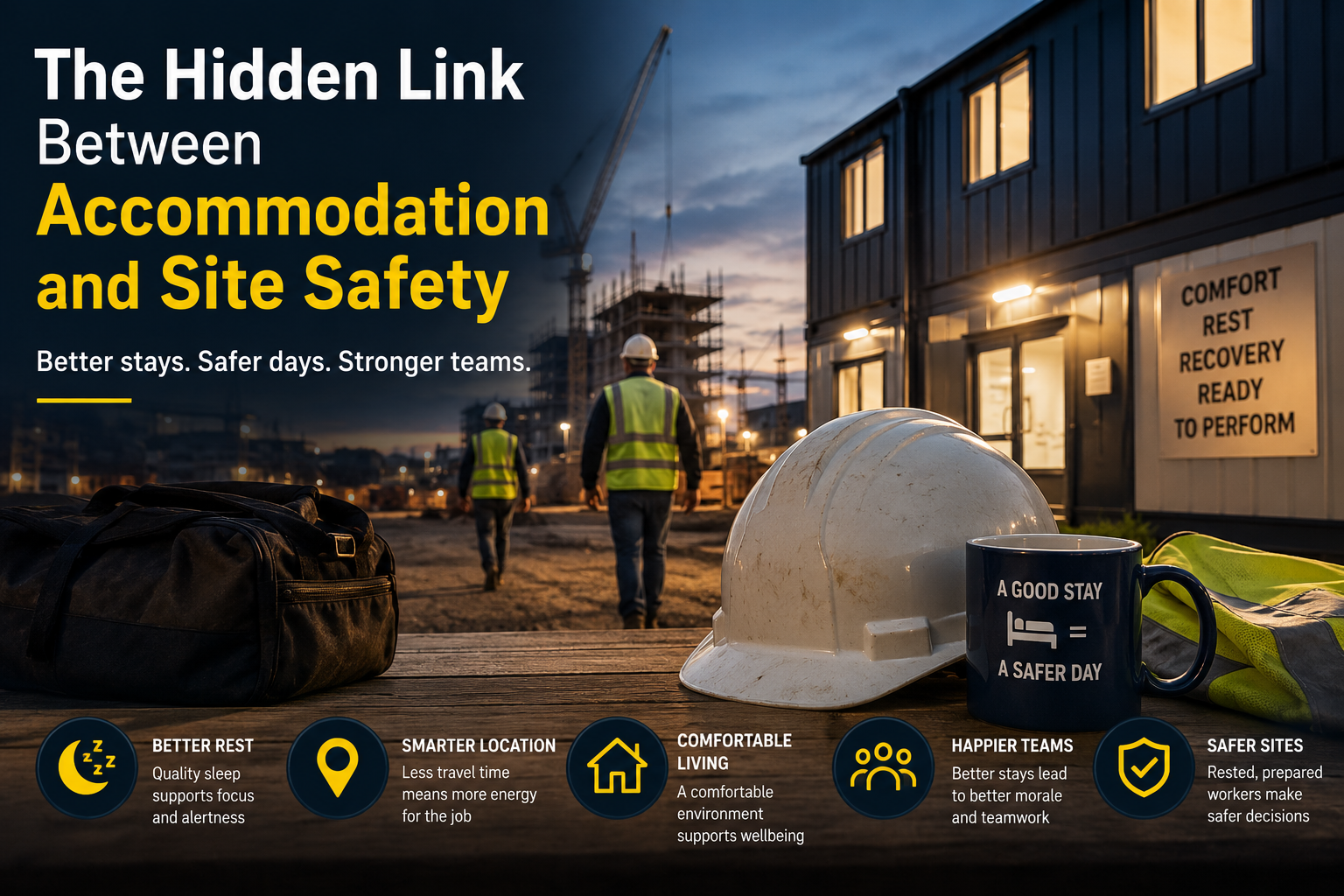
That creates a hidden connection between workforce accommodation and site safety.
For construction companies, engineering teams, maintenance contractors and project managers, understanding this connection can make accommodation a much more strategic decision.
Safety Doesn’t Start at the Site Gate
Imagine a contractor finishing a 10-hour shift.
They have spent the day working outdoors, operating equipment, moving around a busy site and concentrating on tasks where mistakes can have serious consequences.
Now imagine they have another hour-long drive before reaching their accommodation.
They arrive at a property that is uncomfortable, noisy or poorly equipped. They struggle to relax, prepare food or get a decent night’s sleep.
The next morning, the alarm goes off.
They are tired.
They still have to drive to site.
They still have to concentrate.
And they still have to make good decisions.
The accommodation may never appear in the project’s formal safety documentation, but it has become part of the wider working environment.
This is why businesses arranging contractor accommodation should think beyond price and availability.
The question should also be:
Will this accommodation help our workforce arrive rested, focused and ready to work?
Fatigue Is a Business Issue, Not Just a Personal One
Fatigue is one of the biggest reasons accommodation deserves more attention from project managers.
Workers who regularly travel long distances, sleep poorly or have inadequate recovery time may find it harder to maintain concentration.
That matters particularly in industries where employees may be working with:
- Heavy machinery
- Electrical equipment
- Vehicles
- Power tools
- Working-at-height activities
- Industrial systems
- Construction equipment
- Complex engineering processes
Nobody wants a tired worker trying to remember a critical procedure at 6:30 in the morning.
Good workforce accommodation cannot eliminate every safety risk, but it can support the recovery process that workers need between shifts.
A comfortable bed.
A quiet environment.
A suitable location.
A properly equipped kitchen.
Enough space to relax.
Reliable heating and hot water.
These may sound like basic requirements.
But basic requirements become extremely important when people are working long hours for weeks or months away from home.
Location Can Influence Safety Too
Accommodation location is another part of the equation.
A property that looks cheap on paper may become expensive when workers spend significant time travelling between the property and the site.
Long journeys can create additional fatigue before the working day has even started.
They can also make workers less willing to return to accommodation between shifts or spend more time driving after long working days.
For project managers, choosing accommodation close to the workplace can therefore have advantages beyond convenience.
It can help reduce:
Travel time + driving exposure + unnecessary stress = more time available for rest and recovery.
This is particularly important for projects involving large teams.
If 20 workers each spend an additional 45 minutes travelling every day, that quickly becomes hundreds of hours of additional travel over the course of a project.
The real cost is not simply fuel.
It is time, energy and workforce efficiency.
Better Accommodation Can Support Better Routines
A good accommodation setup makes it easier for workers to establish a consistent routine.
After work, they can return to a comfortable property, prepare a meal, relax and get ready for the following day.
That routine matters.
People perform better when they have enough opportunity to recover.
For contractors staying away from home, the accommodation effectively becomes their temporary home.
If it feels like a place where they can genuinely switch off, the transition between work and rest becomes easier.
This is particularly valuable during longer projects.
A hotel room might work for a night or two.
But for a workforce staying away for several weeks, a well-equipped property can offer something different: space to live normally while working away from home.
That difference can have a surprisingly significant impact on the overall experience.
Why Shared Workforce Accommodation Needs Careful Planning
When several workers are staying in accommodation together, the property needs to work for the whole group.
This means considering practical questions such as:
- Is there enough sleeping space?
- Are there enough bathrooms?
- Is the kitchen suitable for the number of people staying?
- Is there enough living space?
- Can workers comfortably store their belongings?
- Is the property in a suitable location?
- Is the accommodation properly maintained?
- Can issues be reported and resolved quickly?
These details might sound operational rather than safety-related.
But imagine six contractors sharing a property with one bathroom and inadequate kitchen facilities.
The result could be frustration, disrupted routines and poor recovery.
Now compare that with a property selected specifically around the needs of a workforce.
The difference becomes obvious.
The Accommodation Provider Has a Bigger Role Than You Think
Businesses sometimes view an accommodation provider as simply the company that finds somewhere for workers to sleep.
That approach misses an opportunity.
A strong accommodation partner should help businesses solve a workforce logistics problem.
That includes understanding:
Who is staying?
How many people need accommodation?
Where is the project?
How long will they be there?
When does the workforce arrive?
What facilities do they need?
What happens if project dates change?
The better these questions are handled, the easier it becomes to create an accommodation solution that supports the wider project.
For a project manager, that can mean fewer accommodation headaches and more time focused on the job itself.
One Property Problem Can Become a Project Problem
Here’s something project managers know all too well:
Small problems rarely stay small.
A minor accommodation issue might start with a broken appliance.
Then workers report it.
Someone needs to contact the provider.
Someone needs to arrange a repair.
The workforce waits.
The issue affects their routine.
The project manager gets involved.
Suddenly, a problem that had nothing to do with construction has become another item on the project manager’s already crowded list.
This is why responsive accommodation management matters.
Good accommodation should not create additional distractions for the people responsible for delivering the project.
Instead, it should remove them.
Accommodation and Workforce Morale
There is another connection that businesses sometimes overlook: morale.
Ask any contractor what they remember about a long project and they probably won’t only remember the work.
They will remember the people.
The early mornings.
The long days.
The accommodation.
The places they ate.
The nights they could actually relax.
The difference between feeling looked after and feeling like an afterthought can influence how people view the entire project.
A workforce that feels valued is more likely to have a positive experience.
And that matters when businesses want to retain skilled workers, attract experienced contractors and build strong project teams.
Accommodation is therefore part of the employee and contractor experience.
What Should Businesses Look for in Workforce Accommodation?
When booking accommodation for contractors, price should certainly be considered.
But it should not be the only consideration.
A better approach is to evaluate the overall value.
1. Location
Look for accommodation that keeps travel to the project practical.
2. Sleeping arrangements
Workers need proper sleeping environments that allow them to recover between shifts.
3. Living space
For longer stays, adequate communal space can make a significant difference.
4. Kitchen facilities
A proper kitchen allows workers to prepare meals rather than relying entirely on takeaways or eating out.
5. Bathrooms
The number and condition of bathrooms matter when multiple workers share a property.
6. Property condition
Accommodation should be clean, maintained and ready for arrival.
7. Reliable support
If something goes wrong, there should be a clear route to getting it resolved.
8. Flexibility
Construction and engineering projects can change quickly. Accommodation arrangements should be capable of adapting where possible.
These factors help transform accommodation from a basic booking into a proper workforce accommodation strategy.
The Real Cost of Choosing the Cheapest Option
Saving money is important.
But the cheapest accommodation is not necessarily the lowest-cost option.
Consider the wider picture.
If workers are travelling further, sleeping poorly, dealing with unsuitable facilities or spending more time managing accommodation problems, the original saving may quickly disappear.
Businesses should instead ask:
What is the total cost of this accommodation decision?
That includes the booking price, but also the potential impact on travel, productivity, workforce satisfaction and management time.
A slightly better accommodation solution may therefore deliver considerably better value.
Why This Matters for Construction and Engineering Projects
Large projects rarely fail because someone forgot that workers need somewhere to sleep.
The challenge is usually making sure accommodation works at scale.
A five-person team is relatively straightforward.
A 30-person workforce spread across different arrival dates is more complicated.
A project involving multiple locations is more complicated again.
And when projects overlap, accommodation can become a major logistical challenge.
This is where having an experienced accommodation partner can make a real difference.
Instead of searching for properties every time a new worker arrives, businesses can establish a more organised approach to accommodation.
That means fewer last-minute searches, fewer unnecessary administrative tasks and a more consistent experience for the workforce.
The Question Project Managers Should Be Asking
Rather than asking:
“How cheaply can we accommodate our workforce?”
Project managers should consider asking:
“How can our accommodation support the success of the project?”
That subtle change in thinking can completely alter the booking decision.
The right accommodation can support rest.
It can reduce unnecessary travel.
It can improve the workforce experience.
It can reduce administrative pressure.
It can make project logistics easier.
And it can give workers a comfortable place to return to after a demanding shift.
None of these things replace formal health and safety procedures.
But they can complement them.
Make Accommodation Part of Your Project Strategy
The safest project environment is not created by one decision.
It is created through hundreds of decisions made before and during the project.
Where people stay is one of them.
For businesses managing contractors, engineers and construction teams across the UK, workforce accommodation should be considered alongside transport, logistics, scheduling and workforce planning — not as an afterthought.
At Luke Stays, we understand that contractors need more than an address for the night.
They need practical, comfortable accommodation that works around the demands of the project.
Whether you are arranging accommodation for a small contractor team or managing requirements for a larger workforce, having the right accommodation partner can make the process significantly easier.
Because when your workforce finishes work, the project doesn’t stop.
They need somewhere to recover.
And when the next shift begins, you want them arriving ready to perform at their best.
That’s the hidden link between accommodation and site safety.
Need Workforce Accommodation for Your Next Project?
Don’t wait until your workforce is already on the way.
Start planning accommodation alongside your project mobilisation and give your team a comfortable base from which to work.
Talk to Luke Stays about your workforce accommodation requirements and find a solution that works for your project, your people and your schedule.