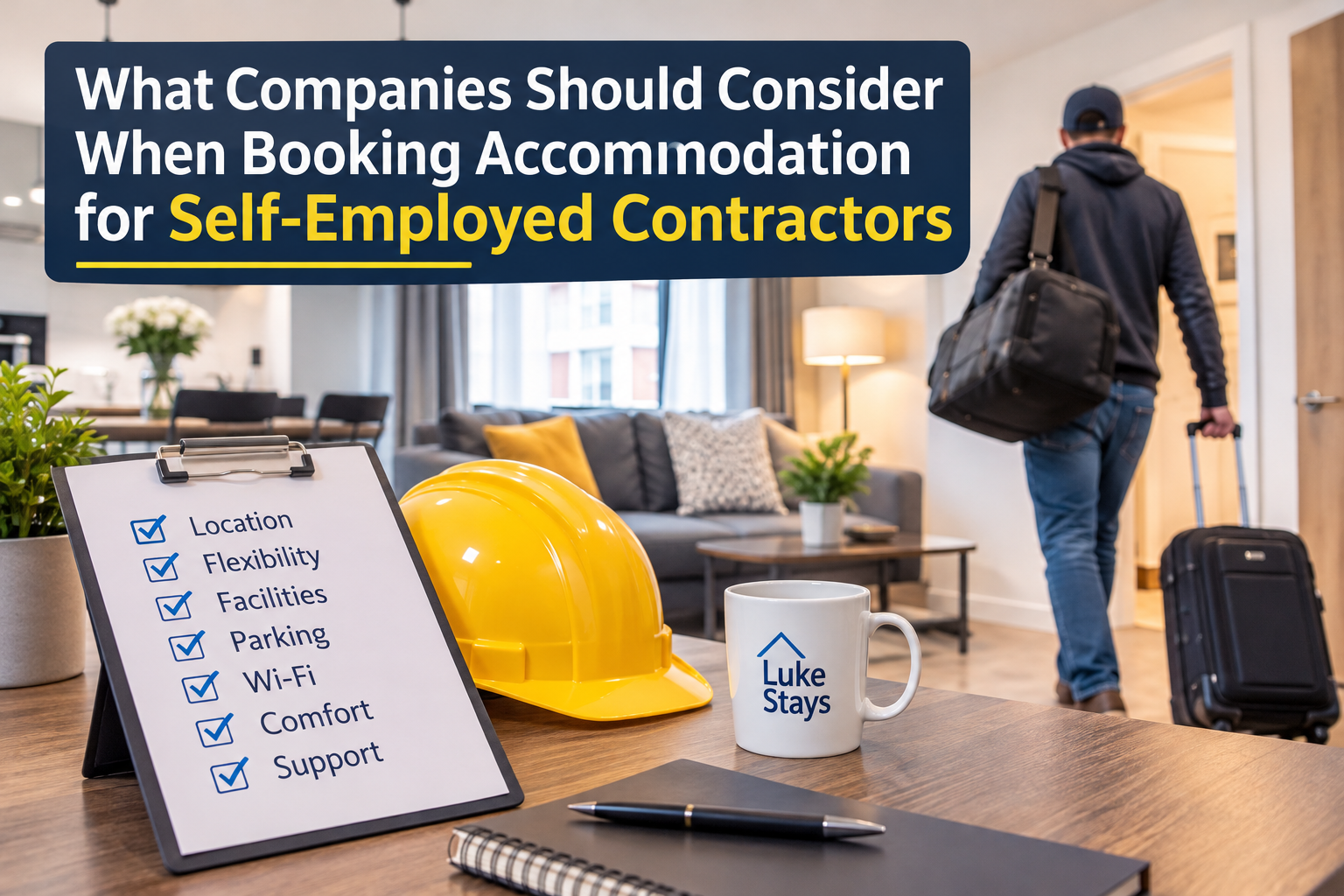
Imagine this: your company has secured an important project. The work is ready to begin, the equipment is organised, and the contractors are confirmed. Everything appears to be under control.
Then comes the accommodation question.
Some contractors are self-employed and working independently. Others have been brought in through specialist subcontractors. A few may only be required for several weeks, while others could remain on the project for months.
Suddenly, finding somewhere for everyone to stay becomes more complicated than simply booking a few hotel rooms.
Where should they stay? Will the accommodation suit their working arrangements? What happens if the project is extended? Can additional contractors be accommodated at short notice? And who will deal with any problems during their stay?
For businesses managing construction projects, engineering work, infrastructure contracts and industrial operations, these questions matter.
Self-employed contractors often work across different locations and projects, making suitable accommodation an important part of workforce planning.
Getting it right can help businesses manage logistics, support contractor satisfaction and keep projects running smoothly.
At Luke Stays, we understand that contractor accommodation needs to work around the demands of real projects. Here is what companies should consider before booking accommodation for self-employed contractors.
1. Understand the Different Needs of Self-Employed Contractors
One of the biggest mistakes companies can make is assuming that all contractors need the same type of accommodation.
A self-employed electrician working on a commercial refurbishment may have very different requirements from a specialist engineer supporting a factory shutdown.
Some contractors might be working away from home for a few nights each week. Others may need somewhere to stay continuously throughout a six-month project.
Their working arrangements can also vary.
For example:
- A self-employed plumber may work across several nearby construction sites.
- An independent electrician may be assigned to one project for several months.
- A specialist mechanical engineer may travel nationally to support different installations.
- A self-employed maintenance technician may work irregular hours during planned shutdowns.
These differences influence the type of accommodation that will be most suitable.
Before making a booking, establish how many people require accommodation, how long they expect to stay, their working hours and whether their requirements are likely to change.
The more accurately you understand the workforce, the easier it becomes to find suitable accommodation.
How Luke Stays can help: Luke Stays provides accommodation solutions for contractors and business travellers, helping companies explore suitable options based on their workforce requirements and project arrangements.
2. Choose a Location That Makes Working Life Easier
Location should be one of the first considerations when arranging contractor accommodation.
A property might look excellent online, but if it adds unnecessary travelling time every morning, it may not be the right choice.
For self-employed contractors, travelling between accommodation and the workplace can become a regular part of their routine.
Long journeys can mean earlier starts, additional travel arrangements and less time to relax after work.
When comparing accommodation locations, consider:
- Distance from the main project site.
- Access to major roads and transport routes.
- Proximity to alternative project locations.
- Availability of supermarkets and essential amenities.
- Parking arrangements for contractors travelling by car or van.
- Accessibility for contractors arriving late at night.
For projects involving multiple locations, it may be more practical to select accommodation with convenient access to the wider working area rather than focusing exclusively on one site.
For example, a business managing several construction projects across the North East of England may benefit from accommodation that provides reasonable access to different operational locations.
The objective is simple: make the contractor’s daily routine easier.
A convenient location can also make accommodation more attractive when businesses need to secure reliable self-employed workers for longer assignments.
3. Consider Flexible Booking Arrangements
Project schedules rarely remain unchanged from beginning to end.
A contractor may initially be required for four weeks, only for the project manager to discover that additional installation work is needed.
Alternatively, a project phase might finish earlier than expected, changing the original accommodation requirements.
This is particularly important when booking accommodation for self-employed contractors because their involvement can depend on specific project milestones.
Before confirming a booking, ask about:
- Extending the accommodation period.
- Changing arrival and departure dates.
- Adding additional contractors.
- Reducing the number of occupied rooms or properties.
- Arranging accommodation for replacement contractors.
- Managing different arrival and departure dates.
It is also important to understand cancellation terms and any conditions attached to amendments.
Do not assume that flexibility is automatically included.
A booking arrangement that works perfectly for a fixed project may become difficult when deadlines move.
The smarter approach: Choose an accommodation provider that understands project-based working arrangements and can discuss potential changes before they become urgent problems.
At Luke Stays, businesses can enquire about accommodation requirements for different workforce sizes and project durations.
4. Decide Whether Hotels or Serviced Accommodation Are More Suitable
Hotels are a familiar option for business travel, but they are not always the most practical choice for contractors staying away from home for extended periods.
Self-employed contractors often need more than somewhere to sleep.
After a demanding working day, they may want to prepare their own meals, do their laundry, relax in a comfortable living area and enjoy a little privacy.
This is where serviced accommodation can offer a useful alternative.
Depending on the property, serviced accommodation may offer:
- Fully equipped kitchens.
- Separate bedrooms and living spaces.
- Washing machines and laundry facilities.
- Comfortable seating areas.
- Wi-Fi access.
- More space than a standard hotel room.
For contractors staying several weeks or months, these facilities can make a noticeable difference.
Having access to a kitchen, for example, gives contractors greater control over their daily meals rather than relying on restaurants or takeaway food.
Separate living spaces can also make longer stays feel more comfortable.
For companies arranging accommodation for several self-employed contractors, a suitable house or apartment may provide a practical solution.
The important thing is to compare the actual facilities and suitability of each option rather than assuming one accommodation type will always be better.
5. Make Sure There Is Enough Space and Privacy
When booking accommodation for a group of self-employed contractors, capacity should never be the only consideration.
A property might technically sleep eight people, but that does not automatically mean it is suitable for eight working professionals staying there for several weeks.
Think about what the property will feel like during everyday use.
How many bedrooms are available? Are there enough bathrooms? Is the kitchen suitable for several people preparing meals? Is there sufficient seating and communal space?
Privacy is particularly important.
Self-employed contractors may be working different shifts, following different schedules or travelling to separate sites.
One contractor might start work at 5 am, while another may not return until late evening.
Sharing a bedroom or dealing with overcrowded facilities can quickly become frustrating.
Before booking, establish:
- Whether individual bedrooms are available.
- How many bathrooms the property has.
- Whether communal areas are adequately sized.
- Whether contractors have sufficient storage space.
- Whether the sleeping arrangements suit the length of stay.
Comfortable accommodation is not simply about appearance. It is about whether the property works for the people using it.
6. Check Wi-Fi and Facilities for Work-Related Requirements
Not every contractor finishes work when they leave the project site.
Self-employed professionals may need to complete paperwork, respond to clients, prepare invoices, check drawings or communicate with project managers after working hours.
Some may also need to attend remote meetings or access online project management systems.
Reliable Wi-Fi can therefore be an important consideration.
Before booking, establish whether internet access is available and whether its suitability can be confirmed.
Other useful facilities may include:
- A suitable table or workspace.
- Comfortable seating.
- Accessible electrical sockets.
- Good lighting.
- Mobile phone reception.
- A quiet environment for calls.
These details might seem relatively minor when comparing properties, but they can make a difference to contractors who need to manage their own businesses alongside their project responsibilities.
For companies, choosing accommodation with appropriate facilities can help create a more practical working environment outside site hours.
7. Check Parking and Access for Work Vehicles
For many self-employed contractors, their vehicle is an essential part of their business.
Electricians, plumbers, builders, engineers and other tradespeople may travel with tools, equipment and materials.
This makes parking an important part of the accommodation decision.
A property with limited or unsuitable parking could create unnecessary difficulties, particularly when contractors arrive with work vans.
Consider the following:
- Is parking available at the property?
- Is there enough space for the number of vehicles?
- Can larger vans be accommodated?
- Is parking private, allocated or on-street?
- Are there any vehicle height or access restrictions?
- Are there local parking restrictions that contractors should know about?
Do not assume that standard residential parking will accommodate commercial vehicles.
It is also worth considering how contractors will access the property when arriving late after travelling from another region.
Clear directions, straightforward check-in arrangements and confirmed access instructions can make the arrival experience much smoother.
When arranging accommodation through Luke Stays, businesses should communicate their parking and vehicle requirements during the enquiry process so that suitable options can be considered.
8. Understand the Total Booking Requirements Before Confirming
Accommodation decisions should not be based on headline rates alone.
A property that initially appears suitable may involve additional arrangements that affect the overall booking.
For example, businesses should establish what is included in the accommodation and whether any additional charges or conditions apply.
Important questions include:
- Are utilities included?
- Is Wi-Fi provided?
- Is cleaning included, and how frequently?
- Are bedding and towels supplied?
- Are there additional charges for extra occupants?
- Are there deposits or other booking conditions?
- What are the arrangements for maintenance and support?
This information helps procurement teams compare accommodation options accurately.
It also reduces the likelihood of misunderstandings after contractors have moved in.
For businesses managing multiple self-employed workers, having clear booking information makes it easier to maintain control over accommodation arrangements.
A transparent booking process is beneficial to everyone involved.
9. Consider What Happens When Something Goes Wrong
A good accommodation arrangement should not end with receiving a booking confirmation.
What happens if a contractor cannot access the property? What if an essential facility stops working? Who should be contacted if an urgent issue arises?
These are practical questions companies should ask before making a reservation.
Unexpected issues can be particularly disruptive when contractors are working away from home and have limited time to resolve problems themselves.
Before confirming accommodation, establish:
- Who is responsible for handling property-related enquiries.
- How contractors can report maintenance problems.
- What support arrangements are available.
- How urgent access issues are handled.
- Whether there is a clear contact process.
Having a straightforward communication process can help companies respond more effectively when problems occur.
It also gives contractors greater confidence that they know where to turn if something needs attention.
For project managers, this is especially important when coordinating several contractors across different locations.
10. Plan for Different Arrival and Departure Dates
Self-employed contractors do not always join a project at the same time.
A specialist contractor might arrive during the first phase, while additional tradespeople are brought in several weeks later.
Some workers may complete their assignments earlier than others.
This creates an accommodation challenge.
Booking one property for a fixed group of people might seem convenient, but it can become less practical when workforce numbers change.
A better approach is to establish an accommodation plan that reflects the actual project schedule.
For example:
| Project stage | Accommodation consideration |
|---|---|
| Initial mobilisation | Accommodation for the first group of contractors |
| Main project phase | Additional capacity as the workforce increases |
| Specialist installation | Flexible arrangements for incoming specialists |
| Final completion | Adjusted accommodation for the remaining workforce |
This type of planning can help prevent unnecessary accommodation changes and last-minute bookings.
It also allows businesses to communicate their requirements more clearly to accommodation providers.
Luke Stays can help businesses discuss accommodation requirements as workforce numbers and project arrangements develop.
11. Choose Accommodation That Supports Contractor Satisfaction
Companies sometimes concentrate so heavily on project costs and deadlines that they overlook the experience of the people carrying out the work.
However, contractors who are regularly required to work away from home need accommodation where they can rest properly and maintain a comfortable daily routine.
Consider the difference between arriving at a cramped property after a long shift and returning to somewhere with a comfortable bedroom, a proper kitchen and space to relax.
The accommodation experience matters.
Self-employed contractors are also independent professionals. They may have the flexibility to accept or decline future assignments depending on the overall working arrangements.
Providing suitable accommodation can therefore contribute to a more positive working relationship.
It demonstrates that the company has considered the practical needs of its workforce rather than simply arranging somewhere for people to sleep.
For businesses competing to secure experienced tradespeople and specialist contractors, this can be a worthwhile consideration.
12. Work With an Accommodation Provider That Understands Business Requirements
Finding accommodation for one contractor is relatively straightforward.
Finding suitable accommodation for ten, twenty or fifty self-employed contractors working across different projects is another matter entirely.
The challenge becomes greater when companies need different property types, multiple locations, extended stays and changing booking requirements.
This is why choosing the right accommodation provider is important.
Rather than treating every booking as an individual transaction, businesses should look for a provider that understands the practical demands of workforce accommodation.
A suitable provider should be willing to understand:
- The nature of the project.
- The number of contractors requiring accommodation.
- The expected length of stay.
- The location and working arrangements.
- Parking and property requirements.
- Potential changes to workforce numbers.
- The level of communication and support required.
Working with a provider that understands these requirements can make accommodation planning more manageable.
This is where Luke Stays comes in.
Luke Stays supports businesses looking for accommodation solutions for contractors, project teams and professionals working away from home.
Whether you are arranging accommodation for a small group of self-employed tradespeople or coordinating requirements for a larger workforce, discussing your needs with an experienced accommodation provider is a sensible starting point.
Why Choose Luke Stays for Self-Employed Contractor Accommodation?
When your business depends on contractors arriving on time and being ready to work, accommodation should be one less thing to worry about.
Luke Stays understands that companies need practical accommodation arrangements that reflect the realities of working away from home.
Our accommodation solutions are designed around the needs of business travellers, contractors and project-based workforces.
Businesses can enquire about:
- Contractor accommodation: Suitable accommodation options for self-employed tradespeople and specialist contractors.
- Long-term stays: Accommodation requirements for projects involving extended assignments.
- Group accommodation: Options for companies arranging stays for multiple workers.
- Flexible requirements: Enquiries involving changing project dates and workforce numbers.
- Convenient locations: Accommodation options based on project locations and travel requirements.
- Business bookings: Accommodation arrangements for companies managing workforce travel.
Instead of spending valuable time searching through unsuitable properties, speak to Luke Stays about your requirements.
We can help you explore suitable accommodation options based on your project, workforce size and expected length of stay.
Final Checklist: Before Booking Accommodation for Self-Employed Contractors
Before confirming your next contractor accommodation booking, make sure you have considered these essential points:
- How many self-employed contractors need accommodation?
- How long will they be staying?
- Is the property conveniently located for the project?
- Are the bedroom and bathroom arrangements suitable?
- Is there sufficient kitchen and living space?
- Is reliable Wi-Fi available?
- Is parking suitable for work vehicles?
- Are the check-in arrangements clear?
- Can booking dates be amended if project schedules change?
- Are all booking conditions and additional charges understood?
- Is there a clear process for reporting problems?
- Can the accommodation provider support changing workforce requirements?
Addressing these questions before booking can help businesses avoid unnecessary complications and make better accommodation decisions.
Conclusion: Make Contractor Accommodation Part of Your Project Planning
Booking accommodation for self-employed contractors involves more than finding available bedrooms.
Companies need to consider location, flexibility, privacy, facilities, parking, booking conditions and the overall experience of the people staying there.
These details become even more important when contractors are working away from home for several weeks or months.
The right accommodation can make everyday working arrangements more practical, help contractors feel comfortable and reduce the administrative pressure on project managers.
Ultimately, accommodation should support the project rather than become another challenge to manage.
If your business regularly employs self-employed contractors, now is the time to review how you arrange accommodation.
Looking for reliable contractor accommodation in the UK?
Let Luke Stays help you explore suitable accommodation for your workforce.
Whether you need accommodation for one self-employed contractor, a group of tradespeople or a larger project team, get in touch with Luke Stays to discuss your requirements.
Make your next contractor accommodation booking simpler, more organised and better suited to the people doing the work.