Managing Two Projects? Your Accommodation Strategy Needs to Keep Up
Imagine this.
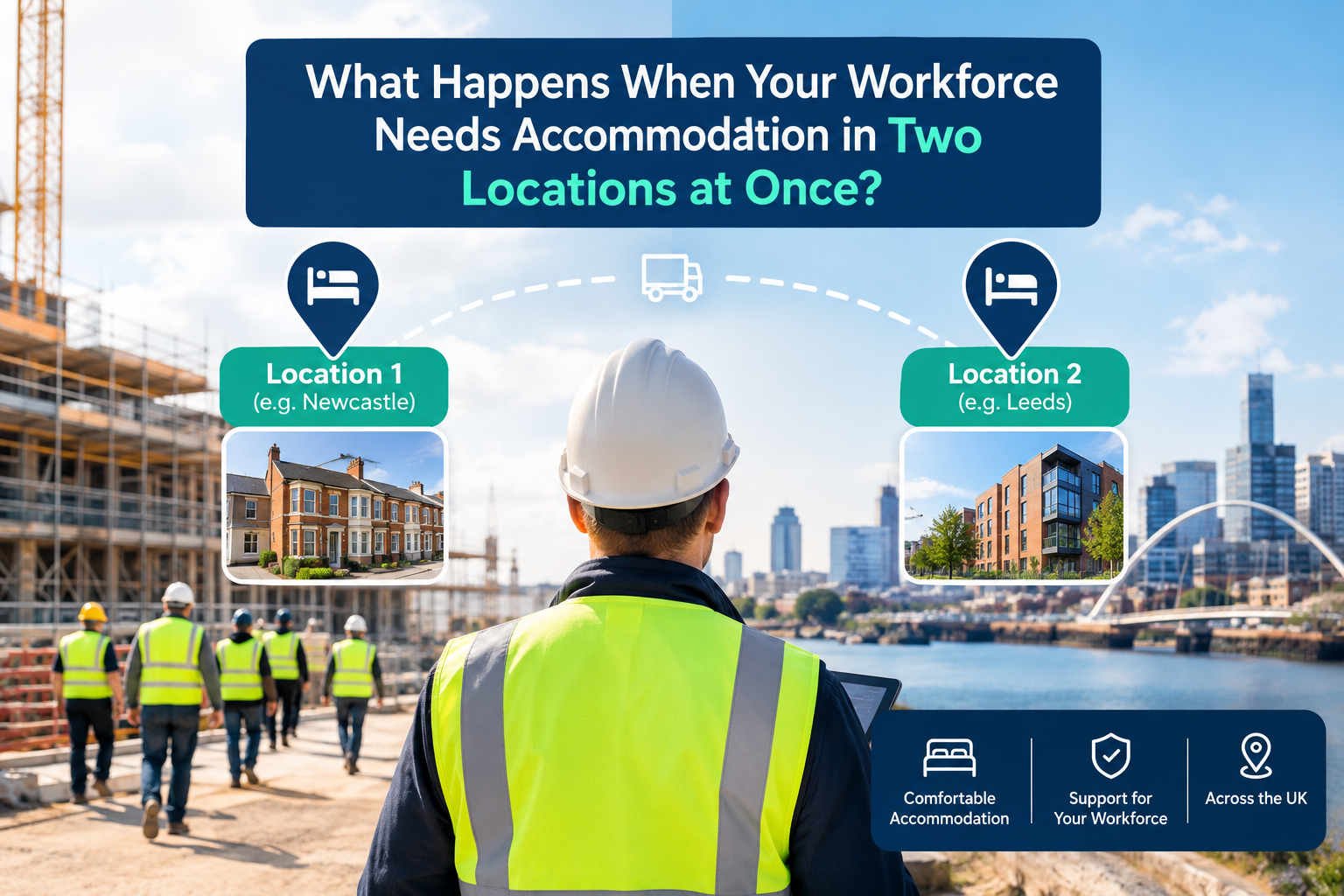
Your construction team is preparing to start work on a major project in Newcastle. At the same time, another team is due to begin an engineering contract in Leeds. Both projects are important. Both have deadlines. Both require skilled workers to arrive ready to work.
There is just one problem.
You need suitable accommodation in two different locations, at the same time.
Suddenly, organising somewhere for your workforce to stay becomes much more complicated than making a few bookings.
You need to find suitable properties, coordinate arrival dates, understand different site locations, accommodate changing shift patterns and ensure everyone has somewhere comfortable to return to after a demanding day.
And you need to do all of this without allowing accommodation arrangements to become another full-time job for your project managers.
For businesses operating across multiple UK locations, this situation is increasingly familiar. Construction companies, utilities contractors, engineering businesses and infrastructure teams often have workers deployed across several projects simultaneously.
The good news? Managing accommodation across two locations does not have to mean doubling the workload.
With the right planning and a reliable accommodation partner, your business can coordinate both locations more efficiently.
At Luke Stays, the focus is on helping businesses find practical accommodation solutions that support their workforce and project requirements.
Here is how to approach the challenge.
1. Why Two Locations Can Create Twice the Accommodation Pressure
Booking accommodation for one project can be straightforward when you know the location, number of workers and length of stay.
Introduce a second project, and the situation changes.
Your Newcastle team might need accommodation for eight weeks, while your Leeds team requires somewhere for three months. One project may involve ten contractors working day shifts, while the other requires six engineers working rotating shifts.
Each location has different requirements.
You may need to consider:
- Different arrival dates: Workers may arrive on separate days depending on project mobilisation.
- Different team sizes: One site might need accommodation for five people, while another requires space for fifteen.
- Different project durations: Contract extensions can change accommodation requirements at short notice.
- Different travel arrangements: Properties need to be practical for workers travelling to their respective sites.
- Different living requirements: Teams may need private bedrooms, cooking facilities, laundry access and comfortable communal spaces.
The danger is treating both projects as one simple booking exercise.
When accommodation is organised separately without an overall plan, project managers can end up chasing different providers, managing separate arrangements and resolving avoidable problems.
A more effective approach begins with understanding the needs of both locations before making commitments.
2. Start With One Clear Accommodation Plan for Both Sites
Before searching for properties, establish exactly what each project requires.
This sounds obvious, but incomplete accommodation requests can quickly lead to unsuitable options, unnecessary conversations and delays.
Create a separate brief for each location while keeping both within one overall workforce accommodation plan.
For each site, identify:
Project location: Where will the workers report each day? Include the site address or postcode wherever possible.
Number of workers: Confirm the expected team size and whether additional contractors may join later.
Arrival and departure dates: Establish when accommodation is needed and whether the dates are likely to change.
Length of stay: Is this a short assignment, a long-term contract or a project with an uncertain completion date?
Bedroom requirements: Determine whether workers need individual bedrooms or whether shared arrangements are acceptable.
Essential facilities: Consider kitchens, laundry facilities, parking, Wi-Fi and comfortable living areas.
Working patterns: Night shifts, early starts and rotating schedules can influence the suitability of a property.
Once these details are clear, you can compare accommodation options against the actual needs of each team.
For example, your Newcastle project might benefit from a property close to the construction site, while your Leeds team may need accommodation with parking and convenient road access.
The best solution is not necessarily the same type of property in both locations.
It is the arrangement that works for each workforce.
3. Why Using One Accommodation Partner Can Make a Difference
When two projects run simultaneously, appointing a separate accommodation provider for each location may seem like the easiest option.
Sometimes, local specialists are necessary. However, managing several providers can introduce additional administration.
You may have different booking processes, communication channels, payment arrangements, cancellation conditions and methods for handling changes.
When something goes wrong, finding the right person to contact can take longer than expected.
Working with one accommodation partner that can support both locations, where suitable properties are available, may simplify the process.
Potential benefits include:
- One central point of contact: Your team has a clearer route for accommodation enquiries and updates.
- Less administrative work: Coordinating requests and changes may become more straightforward.
- A more consistent booking process: Your project teams can follow the same approach across both locations.
- Better visibility: Keeping both requirements within one conversation can make it easier to track upcoming arrivals and outstanding decisions.
- Simpler future planning: If another project starts, you already have an established accommodation relationship.
For example, imagine your operations manager needs to increase the Newcastle team from eight workers to twelve while extending the Leeds project by another month.
Rather than starting from scratch with separate providers, a central accommodation partner may be able to review both requirements and advise on suitable options.
Availability and property suitability will always depend on the location and dates, but having a coordinated process can make the task easier to manage.
For businesses managing multiple contracts, less time spent coordinating accommodation means more time available for the projects themselves.
4. Choosing Properties That Work for Each Workforce
One of the biggest mistakes businesses make is focusing entirely on the number of beds available.
A property might technically accommodate ten workers, but that does not automatically make it suitable for a team staying for several weeks.
The same principle applies when organising accommodation in two locations.
Each property needs to work in practice.
Consider a team of six contractors working in Newcastle. If they are staying for two months, individual bedrooms, a functional kitchen, laundry facilities and comfortable communal areas may make a significant difference to their experience.
Meanwhile, a team of four engineers in Leeds may have different priorities, particularly if their work involves night shifts or irregular hours.
Before confirming a booking, consider the following.
Location and commuting time
A property that looks attractive online may be impractical if workers face a lengthy journey to the site every morning.
Assess the actual travel route, likely journey times, parking arrangements and access to the project.
Bedroom arrangements
Workers need somewhere to rest properly. Private bedrooms can offer valuable personal space, particularly during longer assignments.
Practical facilities
Kitchen equipment, washing facilities, Wi-Fi and suitable living areas can make everyday life easier.
Length of stay
A property suitable for a few nights may not provide the same convenience over several months.
Think beyond the first night and consider how the accommodation will support workers throughout the assignment.
At Luke Stays, businesses can enquire about accommodation options that match their workforce size, project location and expected stay.
The aim is to find a suitable arrangement, rather than simply fill available beds.
5. Avoid the Hidden Costs of Poor Coordination
When two projects require accommodation simultaneously, small mistakes can create bigger operational problems.
A booking confirmed for the wrong dates may leave workers without suitable accommodation on arrival. A property too far from the site may increase commuting time. A late change to team numbers may require additional bookings at short notice.
These issues can affect more than the accommodation budget.
They can also create extra work for supervisors, operations managers, procurement teams and administrators.
Consider the following scenario.
Your first project begins on Monday, but the accommodation booking starts on Tuesday. Your second team arrives on the correct date, but the property does not provide the parking arrangements they need.
Neither issue necessarily means the project will fail. However, both create avoidable pressure at precisely the moment your team should be concentrating on getting started.
A simple coordination checklist can help prevent these problems.
Before confirming each booking:
- Verify the check-in and check-out dates.
- Confirm the number of workers and bedroom arrangements.
- Check the property’s location against the worksite.
- Clarify parking and essential facilities.
- Review cancellation and amendment terms.
- Confirm arrival instructions and access arrangements.
- Identify who will handle questions or changes.
Repeat the process for both locations.
A little preparation can help reduce last-minute disruption and make accommodation arrangements more predictable.
6. What Happens When One Project Changes Before the Other?
Here is where multi-location accommodation planning becomes particularly important.
Projects rarely follow perfectly predictable schedules.
A construction phase might be extended. A maintenance shutdown could finish earlier than expected. Additional workers might be required at one site while another team reduces in size.
When two locations are involved, these changes can affect accommodation differently.
For instance, your Newcastle project may require an extra three weeks, while your Leeds team is preparing to leave earlier than planned.
If the two arrangements have been planned independently, you may need to negotiate separate amendments and review different booking conditions.
A coordinated approach helps you identify the changes early and assess the available options.
Build flexibility into your planning wherever possible.
Ask accommodation providers about extension options, availability for additional workers, notice periods and the terms that apply if dates change.
Do not assume that every booking can be extended automatically or that a property will remain available. Confirm the relevant conditions before committing.
It is also useful to nominate one person within your business to maintain an overview of both accommodation arrangements.
That person can monitor changes, communicate revised requirements and ensure the relevant teams have accurate information.
The objective is not to predict every project change. It is to make sure your accommodation arrangements can respond when changes happen.
7. Keep Your Workforce Comfortable, Even When Your Projects Are Miles Apart
Accommodation is an operational requirement, but it also affects the people doing the work.
Contractors who spend long days on site need somewhere they can relax, prepare meals, wash their clothes and get proper rest.
If accommodation is uncomfortable or inconvenient, the impact can extend into everyday working life.
Workers may spend more time travelling, struggle to maintain routines or feel less settled during longer assignments.
Now imagine managing two separate teams in different cities. Both groups deserve accommodation that supports their needs, even if the available properties differ.
This is why workforce accommodation should be evaluated from the worker’s perspective as well as the employer’s.
Ask yourself:
- Can workers get to the site without an unreasonable commute?
- Will they have a comfortable place to sleep?
- Can they prepare meals and manage everyday tasks?
- Is there enough personal space for the expected length of stay?
- Are the arrival arrangements clear and straightforward?
Getting these details right helps create a better experience for your workforce.
It can also help demonstrate that your business takes employee welfare seriously.
For companies competing for experienced contractors, the quality of accommodation may be one part of the overall employment experience that influences how workers view an assignment.
8. How Luke Stays Can Help You Plan Accommodation Across Two Locations
When projects are running simultaneously, you need more than a list of available properties.
You need accommodation options that reflect the practical requirements of your workforce.
Luke Stays can help businesses enquire about accommodation for contractors and project teams across UK locations, subject to property availability and suitability.
Whether you are coordinating construction workers, engineering teams, utility contractors or other professionals working away from home, the process begins with understanding what your projects require.
Provide the details of both locations, including:
- The towns, cities or site postcodes involved.
- The number of workers at each location.
- Your required check-in and check-out dates.
- The expected length of each assignment.
- Bedroom arrangements and essential facilities.
- Parking requirements and any other practical considerations.
With this information, the team can assess your requirements and help identify potentially suitable accommodation options.
If one project needs to accommodate ten workers for six weeks while another requires four engineers for three months, explain both requirements from the outset.
This gives the accommodation team a clearer picture of your needs and helps avoid unnecessary back-and-forth.
You do not need to wait until every project detail is finalised before making an initial enquiry. If your workforce numbers or dates are still subject to change, explain what is confirmed and what remains provisional.
The earlier you communicate your requirements, the more time you may have to explore suitable options.
9. Planning Ahead Can Give Your Business More Flexibility
If your company regularly manages projects in different parts of the UK, accommodation planning should form part of your wider mobilisation process.
Do not wait until workers are ready to travel before beginning the search.
As soon as you know the likely project locations and start dates, start assessing accommodation requirements.
For two simultaneous projects, a practical timeline could look like this:
Before mobilisation: Identify both sites, estimate team sizes and prepare accommodation briefs.
During planning: Contact accommodation providers, assess available options and confirm the arrangements that best meet your requirements.
Before arrival: Verify bookings, communicate check-in instructions and make sure workers know where they are staying.
During the assignment: Monitor extensions, workforce changes and any accommodation issues that need attention.
When projects change: Review the requirements for both locations and communicate amendments as early as possible.
This approach makes accommodation part of project planning rather than a last-minute administrative task.
It also helps your business prepare for the possibility that another contract could begin before the existing projects have finished.
As your operations grow, having a repeatable process for multi-location accommodation can become a valuable advantage.
Final Thoughts: Two Locations Should Not Mean Twice the Stress
Managing workforce accommodation in two locations at once can feel complicated, especially when project schedules, worker numbers and site requirements differ.
But the challenge becomes more manageable when you plan both requirements carefully, choose properties based on how your teams actually work and maintain clear communication throughout the process.
The key is to look beyond individual bookings.
Think about the complete accommodation arrangement: where your workers need to be, how long they will stay, what they need after work and how the arrangements will respond if your projects change.
For businesses with several active contracts, finding the right accommodation partner can also reduce the administrative burden of coordinating multiple teams.
Need contractor accommodation in two UK locations at the same time?
Speak to Luke Stays about your project requirements. Share your locations, workforce numbers and dates to enquire about suitable accommodation options for your teams.
Whether you are preparing for a new contract, expanding an existing workforce or coordinating two projects with different schedules, planning ahead can help you find an arrangement that works for your business and your people.
Contact Luke Stays today to discuss your workforce accommodation requirements and start planning your next project with confidence.