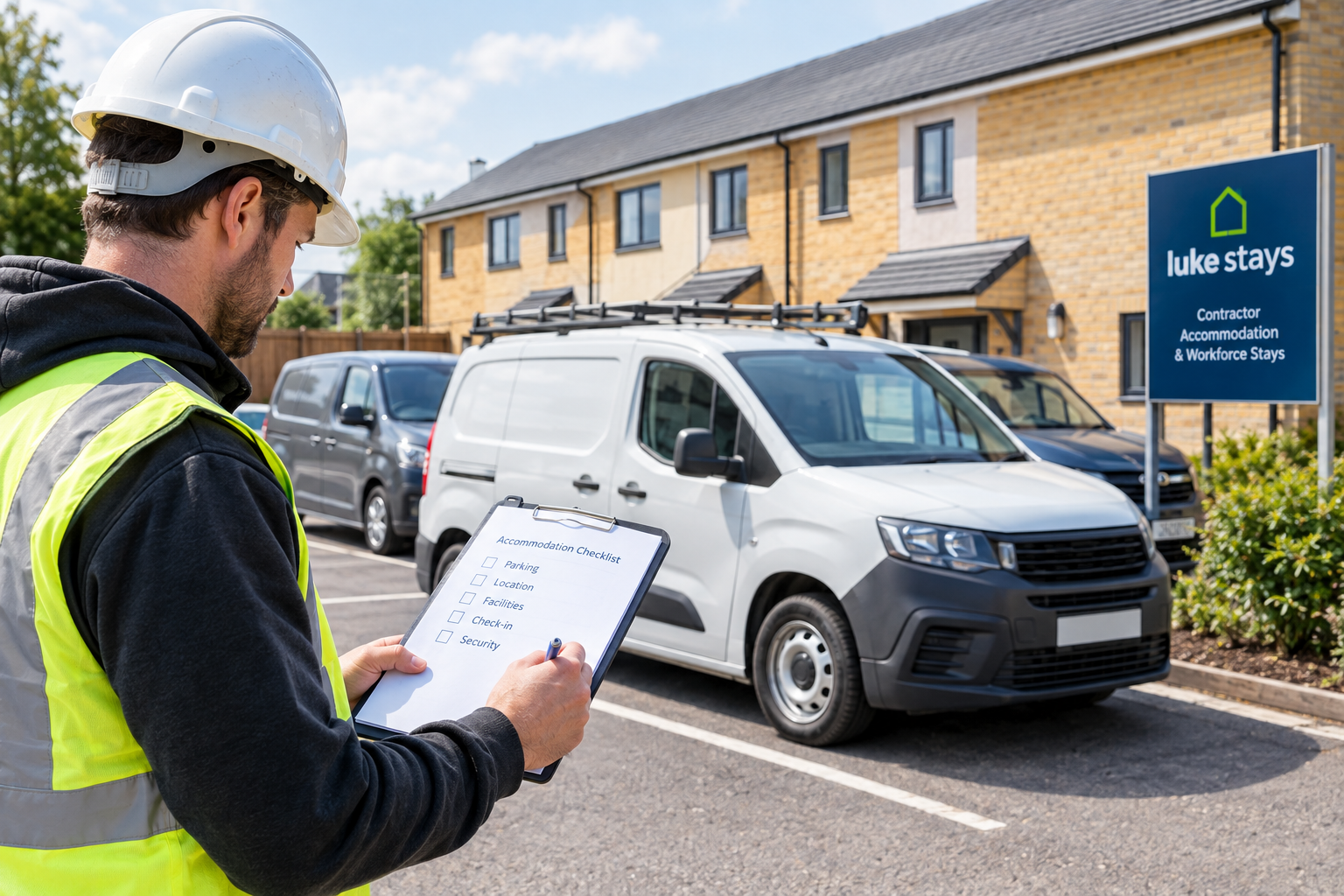
Introduction: Your Team Needs More Than Somewhere to Sleep
Imagine your contractors finishing a long day on site. They return to their accommodation, only to discover there is nowhere suitable to park their vans. One worker has to find a space on a nearby street, another is struggling to manoeuvre into a narrow driveway, and someone else is worrying about where to leave valuable tools overnight.
The accommodation might look perfect online. But if the parking does not work for your team, the booking can quickly become a problem.
For construction companies, engineering firms, utility contractors and businesses managing mobile workforces, accommodation needs to support more than a good night’s sleep. It needs to fit the way the team actually works.
When contractors travel in company cars, vans or pickups, the right parking arrangements can make daily routines easier, reduce avoidable disruption and help project managers keep everything organised.
At Luke Stays, we understand that finding suitable workforce accommodation means considering the needs of the people staying, the location of the project and the practical details that make a property work.
So, before you confirm your next booking, here is what to check when arranging accommodation for contractors with company vehicles.
1. Make Sure the Parking Fits Your Vehicles
The first question is simple: can all your vehicles fit?
It sounds obvious, but parking descriptions can be misleading when you are organising accommodation for a working team. A space suitable for a small car might not be large enough for a long-wheelbase van or a pickup with a roof rack.
Before booking, identify exactly what your team will bring.
Check:
- The number of company vehicles.
- Whether the vehicles are cars, vans, pickups or larger work vehicles.
- The length, width and height of the vehicles.
- Whether roof racks or additional equipment affect vehicle height.
- Whether the entrance and turning area provide enough room to manoeuvre.
For example, imagine you are arranging accommodation for eight electricians travelling in four vans. A property with four parking spaces may appear suitable, but that does not automatically mean all four vans will fit comfortably.
Ask the provider to confirm the dimensions and suitability of the spaces wherever possible.
Remember: available parking and suitable parking are two different things.
Getting this detail right before arrival can prevent unnecessary stress for your team and save valuable time for your project manager.
2. Confirm That Every Vehicle Has a Suitable Space
A property might advertise parking, but does it provide enough spaces for your entire workforce?
This matters particularly when several contractors arrive together or when the team works different shifts.
Before making a reservation, establish:
- How many spaces are available.
- Whether the spaces are private, allocated or shared.
- Whether any spaces are reserved for other residents.
- Whether parking operates on a first-come, first-served basis.
- Whether additional vehicles can be accommodated.
- Whether there are restrictions on overnight parking.
Consider a maintenance team of six people travelling in three vans and two cars. If the accommodation only has four usable spaces, one vehicle may need an alternative arrangement.
That can mean extra coordination, additional walking or uncertainty about where the vehicle can be left.
Do not leave this question until check-in day. Explain your vehicle requirements when requesting accommodation and ask for confirmation before booking.
If your team size might change during the assignment, mention that too. Additional parking may be subject to availability, so early communication is essential.
3. Consider Vehicle Security and Tool Storage
For many contractors, a company vehicle is more than transport. It is a mobile workspace carrying tools, equipment and materials needed for the next day’s job.
A security problem can therefore affect the entire project.
When assessing accommodation, ask about the parking environment and any security features provided. Depending on the property, these might include private parking, gated access, external lighting or CCTV.
However, never assume that a property offers these features unless they have been confirmed.
You should also consider your company’s own vehicle-security procedures. Workers may need to remove valuable equipment, secure tools properly and avoid leaving expensive items visible inside vehicles.
If your company has specific insurance requirements or restrictions concerning overnight vehicle parking, check these before confirming the booking.
It is also worth considering how accessible the parking area is. A well-lit space close to the property may be more practical than a distant space that requires workers to carry equipment over a long distance.
The objective is to choose an arrangement that suits your operational needs while being realistic about the level of security provided.
4. Choose Accommodation Close to the Work Site
A property can have excellent parking and comfortable bedrooms, but still be the wrong choice if it is poorly located.
For contractors working early starts, long shifts or tight project schedules, the daily journey between accommodation and site matters.
Before booking, consider:
- The actual driving distance to the work site.
- Typical traffic conditions during shift changes.
- Access to main roads and suitable vehicle routes.
- Whether the team will work at one site or several locations.
- Whether nearby fuel stations, shops and food options are useful.
For example, a construction team starting work at 6 am may benefit from accommodation with a straightforward route to the site, rather than somewhere that requires travelling through a busy town centre.
If workers need to visit multiple locations during the week, consider whether the accommodation provides a practical base for the whole assignment.
The cheapest or closest property is not always the most suitable. What matters is how well the location fits the team’s working pattern.
When contacting Luke Stays, provide your project location and expected travel arrangements. This helps you discuss options that better match your team’s needs.
5. Check Access for Early Starts and Late Finishes
Contractors do not always work conventional hours.
Your team might leave before sunrise, return late after overtime or arrive at the accommodation after travelling a considerable distance.
That makes access arrangements an important part of the booking.
Before confirming, ask:
- What time can guests check in?
- Is self-check-in available?
- How will access instructions be provided?
- What happens if a worker arrives later than expected?
- Is there a contact for access-related problems?
- Are there restrictions on entering or leaving the parking area?
Clear instructions can make a significant difference when workers are tired after a long journey or demanding shift.
If the booking is for several contractors arriving at different times, make sure the check-in process can accommodate the planned arrivals.
You should also confirm any requirements for collecting keys, using access codes or registering vehicles.
A straightforward arrival process reduces confusion and allows workers to settle in without unnecessary delays.
6. Look Beyond Parking: Check the Living Facilities
Parking may determine whether a property is practical for your vehicles, but the accommodation itself determines whether it works for your team.
Contractors staying away from home need somewhere to rest, prepare meals and manage everyday routines.
Before choosing a property, consider the following.
Comfortable bedrooms
Workers need a suitable place to sleep between shifts. Check the bedroom arrangements and whether the property offers enough appropriate sleeping spaces for your group.
A practical kitchen
Access to cooking facilities gives contractors more flexibility during longer stays and allows them to prepare meals around their working hours.
Bathrooms
Make sure the available facilities are appropriate for the number of people staying. Multiple workers preparing for early starts can make bathroom capacity particularly important.
Laundry facilities
For assignments lasting several weeks, washing and drying clothes can become an everyday necessity.
Wi-Fi and living space
Reliable internet access and a comfortable shared area can help workers stay connected, organise personal tasks and unwind after work.
Heating and general comfort
Consider the season, the length of the assignment and the overall suitability of the property for a working stay.
The best arrangement balances parking requirements with the practical needs of the people who will use the accommodation.
7. Check Vehicle Restrictions and Parking Terms
Never assume that every property accepts every type of vehicle.
Some accommodation may have restrictions on commercial vehicles, overnight parking, vehicle height or the use of shared driveways.
These details are easy to overlook when booking in a hurry.
Before confirming, ask whether company vans and pickups are permitted and whether any special arrangements are required.
Clarify whether parking is included in the booking or subject to additional charges. If permits, registration details or designated spaces are required, establish how these will be arranged.
Pay attention to access restrictions, including height barriers, narrow entrances and limited turning space.
If the vehicles carry company branding or specialist equipment, consider whether the parking location meets your organisation’s requirements.
Written confirmation is particularly useful when an office-based project manager arranges accommodation for workers who will arrive later.
It creates a clear record of the agreed arrangements and reduces the chance of misunderstandings.
8. Make Sure the Parking Works for the Whole Team
Having enough parking spaces is one thing. Making sure the spaces work together is another.
A narrow driveway might accommodate several vehicles but leave one van blocked in. A shared access road might become difficult to use when everyone returns at the same time.
These problems are particularly inconvenient when workers have different shift patterns.
Ask whether the parking layout allows each vehicle to enter and leave without unnecessary difficulty. If the team includes larger vans, check whether turning space is adequate.
You should also consider where the workers will unload equipment and whether they can access the property conveniently from the parking area.
For longer assignments, establish whether vehicles can remain parked for the duration of the booking or whether any restrictions apply.
These practical details can make the difference between an accommodation arrangement that works smoothly and one that creates repeated frustration.
9. Plan for Changes in Team Size and Project Dates
Projects rarely follow a perfectly fixed plan.
A contract may be extended, a new crew may join, or workers may need to move between sites. These changes can affect both the accommodation and parking requirements.
When choosing a provider, explain any likely changes as early as possible.
Ask how extensions can be requested, whether alternative properties may be available if the team grows and what happens if the required dates change.
If the number of vehicles increases, the original parking arrangement may no longer be sufficient.
Availability will depend on the property and the dates involved, so changes should never be treated as automatically guaranteed.
However, planning ahead and keeping your accommodation provider informed can make adjustments easier to manage.
For businesses running multiple projects, this flexibility can be particularly valuable when coordinating workers across different locations.
10. Compare Overall Value, Not Just the Headline Price
When comparing contractor accommodation, it is tempting to focus on the advertised rate.
But a low rate does not necessarily mean a better arrangement for your business.
A property with unsuitable parking or a longer commute may create avoidable inconvenience. Inadequate facilities may also make longer stays less practical.
Instead of comparing price alone, assess the complete offer.
Ask yourself:
- Does the parking meet the needs of every vehicle?
- Is the location practical for the project?
- Are the bedrooms and facilities suitable for the team?
- Can workers arrive and leave at the required times?
- Are the booking terms and any additional charges clear?
- Can the provider accommodate your stated requirements?
A property that meets your essential needs may offer better overall value by reducing administrative work and making everyday routines easier.
The aim is not to choose the property with the longest list of features. It is to find accommodation that works for your people, vehicles and project.
11. Give Your Accommodation Provider a Clear Brief
One of the simplest ways to improve your search is to explain your requirements properly from the start.
Compare these two requests:
“We need accommodation for six contractors.”
“We need accommodation for six contractors for four weeks, within a practical commute of our project site. The team will bring three long-wheelbase vans and one company car. We need confirmation of suitable parking for all four vehicles, access for early starts, kitchen and laundry facilities, and the possibility of extending the booking.”
The second request gives the provider a much clearer understanding of what you need.
When contacting Luke Stays, include:
- Project location: Where the team will be working.
- Team size: How many contractors need accommodation.
- Dates: Arrival, departure and possible extensions.
- Vehicle details: Number and type of cars, vans or pickups.
- Parking requirements: Space, access and any specific restrictions.
- Sleeping arrangements: The number of bedrooms and any particular needs.
- Essential facilities: Kitchen, laundry, Wi-Fi and other requirements.
- Working hours: Early starts, late finishes or rotating shifts.
A clear brief helps identify suitable options more efficiently and reduces the time spent discussing properties that cannot meet your requirements.
Contractor Accommodation Booking Checklist
Before confirming your next booking, work through this checklist:
- Parking confirmed for every company vehicle.
- Vehicle dimensions and entrance restrictions checked.
- Parking allocation and shared-space arrangements clarified.
- Available security features confirmed.
- Travel routes and distance to the work site reviewed.
- Check-in arrangements suitable for working hours.
- Bedrooms and sleeping arrangements checked.
- Kitchen, bathroom and laundry facilities confirmed.
- Company vehicle restrictions and parking terms reviewed.
- Booking dates, possible extensions and additional charges clarified.
- Essential requirements confirmed with the accommodation provider.
Taking a few minutes to complete these checks can help prevent avoidable problems after your contractors arrive.
Find Contractor Accommodation That Works for Your Team
When contractors travel with company vehicles, choosing accommodation involves more than finding available bedrooms. You need to consider parking capacity, vehicle access, location, security and the facilities your team will rely on throughout the assignment.
Getting these details right from the beginning can make accommodation easier to manage and help your workforce settle into a practical routine.
Luke Stays can help you explore accommodation options for contractors and workforce teams travelling for work. Whether you are arranging a short assignment or a longer project stay, sharing your location, dates, team size and vehicle requirements is a useful first step towards finding a suitable option.
Don’t leave parking until the last minute. Include it in your accommodation brief from day one.
Planning accommodation for contractors with company vehicles? Contact Luke Stays with your project location, team size, required dates and parking needs to discuss suitable workforce accommodation options.
Property facilities, parking arrangements, availability and booking terms vary. Confirm all essential requirements with Luke Stays before booking.