When a new project starts, there is a lot to organise.
Teams need to be recruited. Materials need to be ordered. Equipment needs to arrive. Site access needs to be arranged. Programmes need to be agreed. Suppliers need to be appointed.
With so much happening, contractor accommodation can easily become something that gets discussed later.
Sometimes much later.
The problem is that accommodation is not a small administrative detail. For projects involving workers travelling away from home, where people stay can have a direct impact on logistics, travel time, workforce experience and the smooth running of the project.
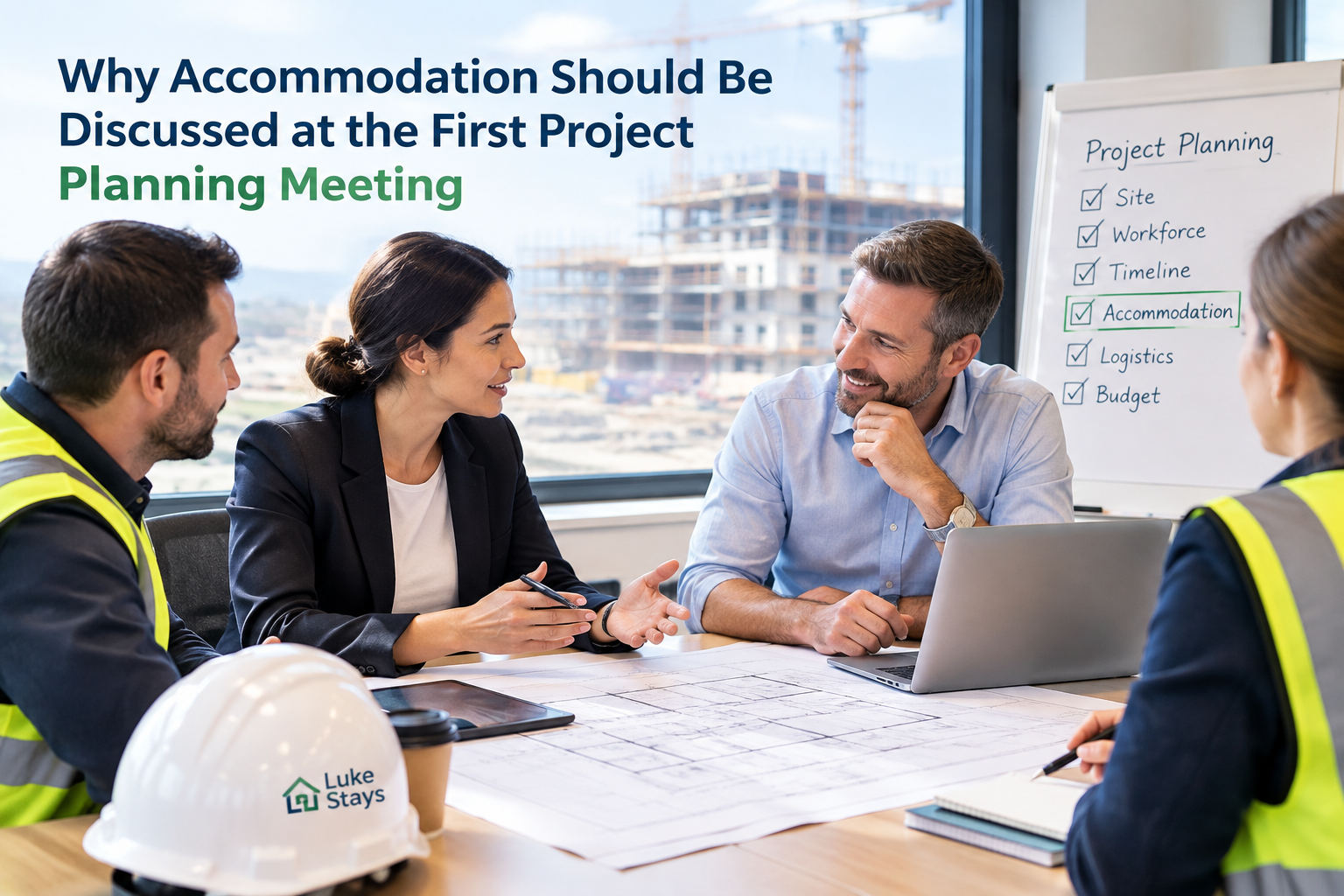
That is why contractor accommodation should be discussed at the first project planning meeting — not when the project is already approaching mobilisation.
Planning early gives businesses more choices, more time and fewer last-minute problems.
For project managers, construction companies, engineering businesses, utility contractors and other organisations managing mobile workforces, making accommodation part of the initial planning conversation can make the entire project easier to manage.
Accommodation Is Part of Project Logistics
Think about everything that needs to move when a project begins.
People need to get to site.
Equipment needs to arrive.
Materials need to be available.
Vehicles need to be coordinated.
Suppliers need to know where and when deliveries are required.
The workforce also needs somewhere suitable to stay.
Yet accommodation is sometimes treated separately from the rest of the project logistics.
That can create unnecessary complications.
If 20, 30 or 50 workers are travelling to a project location, accommodation needs to work alongside the project schedule. The property needs to be in a practical location. Check-in arrangements need to work around mobilisation. The length of the booking needs to reflect the expected programme.
These are project decisions.
They should therefore be discussed as part of project planning.
Leaving Accommodation Until the Last Minute Creates Pressure
One of the biggest mistakes businesses can make is assuming accommodation will be easy to arrange later.
Perhaps the project is several months away, so there seems to be plenty of time.
Then the project moves forward.
The start date gets closer.
The team size becomes clearer.
Other projects in the same area begin competing for available accommodation.
Suddenly, finding suitable properties for the entire workforce becomes much more complicated.
This is particularly important for projects requiring accommodation for multiple workers over an extended period.
Leaving accommodation until the last minute can mean having to compromise on location, property type, availability or convenience.
Early planning gives businesses the opportunity to avoid that situation.
The First Project Meeting Is the Right Time to Ask the Important Questions
Accommodation planning does not need to be complicated.
At the first project planning meeting, simply asking the right questions can establish the requirements.
For example:
How many workers are expected to be on the project?
The final number may not be confirmed yet, but an initial estimate is extremely useful.
Where will the workers be travelling from?
If workers are travelling from different locations, their accommodation requirements may vary.
How long is the project expected to last?
A short shutdown, several-week project and long-term construction programme may require very different accommodation strategies.
What are the working hours?
Early starts, night shifts and rotating crews can influence where accommodation should be located and what facilities workers will value.
Will the workforce remain the same throughout the project?
Some projects have a fixed team. Others involve workers joining and leaving at different stages.
Could the project programme change?
Extensions and delays are common considerations in project planning, so accommodation arrangements should ideally be flexible enough to accommodate changes.
These questions do not need to be answered perfectly on day one.
The important thing is to start the conversation.
Good Accommodation Planning Starts With the Workforce
It is easy to focus entirely on the project site.
But a project is ultimately delivered by people.
If workers are staying away from home for days or weeks at a time, accommodation becomes part of their working experience.
After a long day on site, people want somewhere they can relax, sleep properly and feel comfortable.
That means accommodation should not simply be viewed as a bed for the night.
The wider experience matters.
A practical location can help reduce unnecessary travel.
A suitable property can provide workers with space to unwind.
A well-organised booking process can reduce confusion before arrival.
And having accommodation arranged properly from the beginning can give workers one less thing to worry about.
For businesses trying to attract and retain reliable project teams, these details matter.
Location Should Be Discussed Before the Workforce Arrives
Location is another reason accommodation belongs in early project planning.
The cheapest or most obvious property is not necessarily the most practical.
A property that looks suitable on paper could create unnecessary daily travel if it is too far from the site.
Multiply that journey across several workers and several weeks, and the impact becomes much more significant.
During the planning stage, project managers should consider:
- Distance from the project site
- Typical journey times
- Local transport links
- Parking requirements
- Access for work vehicles
- Nearby shops and essential amenities
- The length of the accommodation requirement
- The size and composition of the workforce
The objective is not simply to find somewhere available.
It is to find accommodation that fits the project.
Accommodation Can Change as the Project Changes
Project plans rarely remain exactly the same from beginning to end.
A project might start with 15 workers and later require 25.
A six-week programme might become a three-month programme.
A team might move from one phase of work to another.
Additional contractors might join during a particularly busy period.
This is another reason to discuss accommodation early.
When the accommodation requirement is already part of the project plan, changes can be identified sooner.
Instead of suddenly saying, “We need another ten rooms next week,” the project team can communicate expected changes with an accommodation provider in advance.
That creates a much more organised process.
One Accommodation Partner Can Simplify the Process
Managing workforce accommodation can quickly become another task on an already busy project manager’s list.
Searching for properties.
Checking availability.
Coordinating bookings.
Managing different check-in dates.
Communicating changes.
Dealing with extensions.
Handling multiple invoices.
For larger projects, this can become time-consuming.
Working with an accommodation partner can simplify the process by giving the project team a central point of contact.
This becomes particularly valuable when a workforce is spread across several properties or when accommodation is required in different locations.
Instead of constantly starting from scratch, the business has an established accommodation process.
Why Early Planning Can Make Procurement Easier
Procurement teams also benefit from discussing accommodation at the beginning of a project.
When accommodation requirements are identified early, procurement has time to understand what is actually required rather than making rushed decisions.
The business can compare suitable options based on factors such as:
- Location
- Property type
- Capacity
- Availability
- Facilities
- Booking flexibility
- Length of stay
- Workforce requirements
- Management and support
This makes the decision more structured.
It also helps avoid the common situation where a project is nearly ready to start but accommodation has not yet been properly arranged.
Think Beyond the First Booking
Another important point is that accommodation planning should not stop once the first booking has been made.
Projects evolve.
A good accommodation plan should consider what happens next.
What happens if the project is extended?
What happens if the team size increases?
What happens if workers need to move to another site?
What happens if the programme changes?
What happens when one phase finishes and another begins?
By considering these questions at the beginning, businesses can build an accommodation strategy rather than simply making individual bookings.
That can save project teams significant time later.
Better Planning Creates a Better Worker Experience
There is also a human side to early accommodation planning.
Workers who travel for projects are already away from their normal homes, routines and families.
The quality and suitability of their accommodation can influence how they experience that assignment.
A comfortable and practical place to stay gives workers somewhere to switch off after work.
That matters.
A workforce that knows where it is staying, how to access the property and what to expect before arriving has a smoother start to the project.
It is a small part of mobilisation that can make a big difference.
Make Accommodation Part of Your Mobilisation Checklist
For businesses managing regular projects, one simple solution is to make accommodation a standard item on the project mobilisation checklist.
For example:
Project Planning Stage
- Estimated workforce size
- Project location
- Expected project duration
- Working patterns
- Accommodation requirements
- Preferred property type
- Parking and transport requirements
Pre-Mobilisation
- Confirm workforce numbers
- Confirm accommodation dates
- Confirm locations
- Arrange bookings
- Share check-in information with workers
During the Project
- Monitor workforce changes
- Manage extensions
- Add or remove accommodation as required
- Review upcoming project phases
This approach turns accommodation from an afterthought into part of the overall project system.
Why Businesses Choose Professional Workforce Accommodation
When accommodation is being arranged for one person for one night, the process can be relatively simple.
When accommodation is needed for an entire project team, it becomes a different challenge.
There are more people.
More dates.
More requirements.
More opportunities for something to go wrong.
That is where a specialist accommodation provider can add value.
At Luke Stays, the focus is on helping businesses arrange practical accommodation for workers and project teams.
Whether you are planning a construction project, engineering programme, infrastructure work, utility project or another workforce-intensive assignment, having an accommodation partner involved early can make planning easier.
Rather than waiting until the project is about to start, businesses can discuss their requirements in advance and explore suitable accommodation options around the needs of the workforce and project.
The Earlier You Plan, the More Options You Have
The main lesson is simple.
Do not wait until workers are ready to arrive before thinking about where they will stay.
Accommodation should be discussed when the project is first being planned.
You may not know the final workforce size.
You may not know the exact completion date.
You may not know whether the project will be extended.
That is okay.
You can still start the conversation.
Early planning allows the accommodation requirement to evolve alongside the project.
It gives project managers more time to consider location, capacity, working patterns and future changes.
Most importantly, it removes accommodation from the list of last-minute problems.
Start Planning Your Project Accommodation Early With Luke Stays
Your workforce accommodation should support your project — not become another problem for your project team to solve.
If you already know where your next project is taking place, now is a good time to start thinking about accommodation.
Luke Stays can help businesses explore accommodation options for contractors, construction teams, engineers and other travelling workforces.
Whether you need accommodation for a small team or are planning accommodation across a larger project, discussing your requirements early can help create a smoother booking process from mobilisation through to completion.
Planning a new project? Talk to Luke Stays about your workforce accommodation requirements and start arranging your accommodation before the project gets busy.