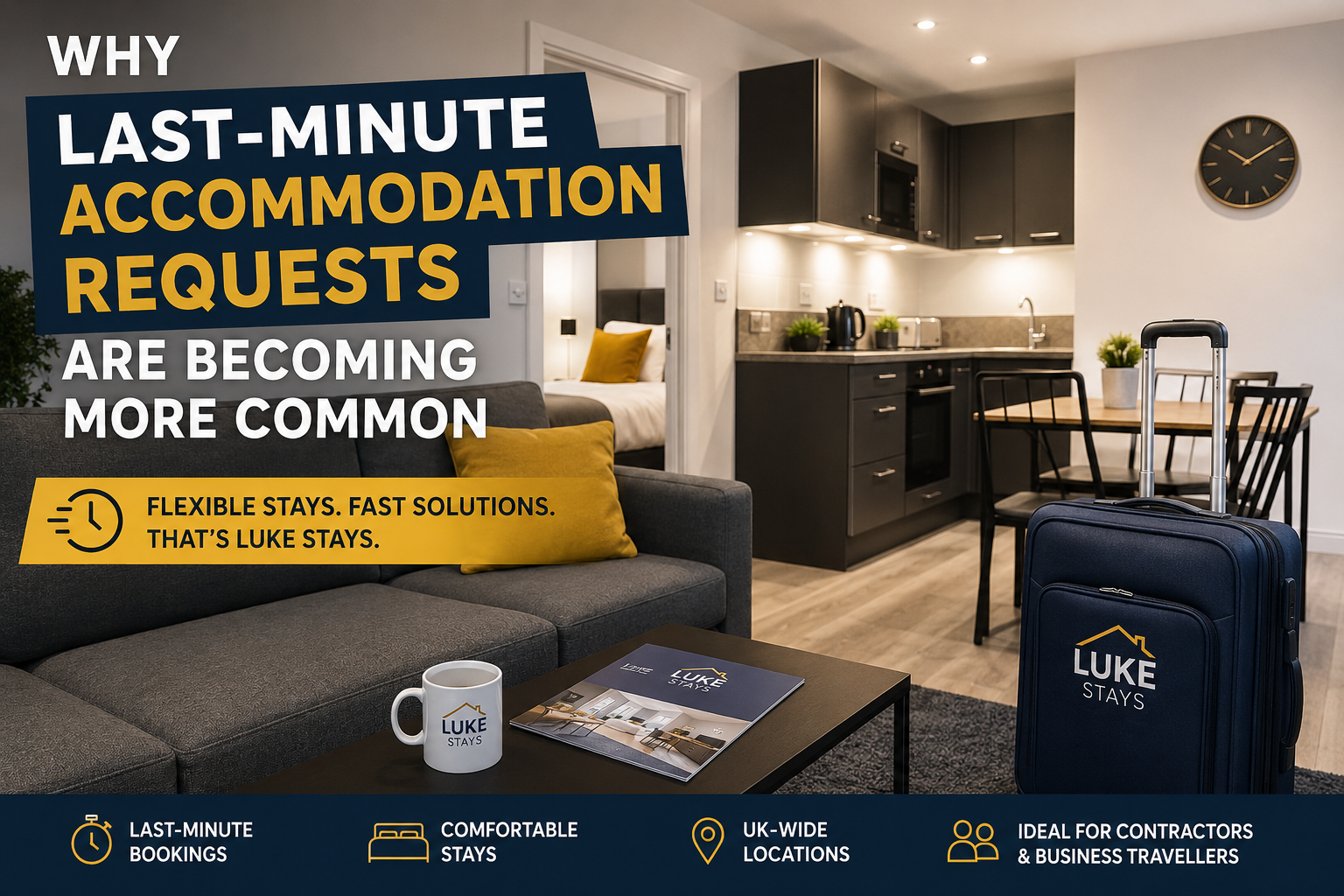
At Luke Stays, we’ve noticed a clear trend over the past few years: more guests are booking accommodation at the very last minute.
What used to be an occasional emergency booking has become a regular occurrence. Whether it’s a contractor needing somewhere to stay tonight, a project manager relocating a team unexpectedly, or a family dealing with an insurance claim, last-minute accommodation requests are arriving more frequently than ever before.
The reality is that modern business moves faster than it used to. Plans change quickly, projects evolve overnight, and flexibility has become one of the most valuable assets any organisation can have.
But why exactly are last-minute accommodation requests increasing?
And more importantly, how can businesses stay prepared when accommodation becomes an urgent requirement?
Let’s explore what’s driving this shift and why having the right accommodation partner matters more than ever.
The Traditional Booking Timeline Has Changed
A decade ago, accommodation planning often happened weeks or months in advance.
Project schedules were relatively predictable.
Corporate travel plans were approved well ahead of time.
Construction timelines followed established programmes.
Today, that’s no longer the norm.
Businesses are operating in a much more dynamic environment where:
- Projects start with shorter notice periods
- Clients make faster decisions
- Teams move between locations more frequently
- Labour shortages create staffing changes
- Supply chain issues affect schedules
- Emergency work arises unexpectedly
As a result, accommodation planning is increasingly happening days—or sometimes hours—before arrival.
For accommodation providers, adaptability has become essential.
For businesses, access to reliable short-notice accommodation can mean the difference between maintaining momentum and experiencing costly delays.
Construction and Infrastructure Projects Are Driving Demand
One of the biggest contributors to last-minute accommodation requests comes from the construction sector.
Project managers face constant changes that impact workforce accommodation requirements.
Examples include:
Unexpected Project Extensions
A project scheduled to finish on Friday suddenly requires another two weeks.
The workforce needs accommodation immediately.
Additional Labour Requirements
A contractor wins additional work and needs to bring in extra tradespeople at short notice.
Finding accommodation for ten or twenty workers quickly becomes a priority.
Delayed Deliveries
Materials arrive later than expected, causing schedules to shift.
Accommodation bookings must be adjusted rapidly.
Emergency Repairs
Utilities, highways, railways and public infrastructure often require urgent repair works.
When a team is deployed with little notice, accommodation becomes one of the first logistical challenges.
This is where flexible serviced accommodation offers a significant advantage over traditional hotel bookings.
The Rise of Flexible Working Has Changed Travel Patterns
Remote and hybrid working have transformed business travel.
Many professionals no longer travel according to fixed schedules.
Instead, they travel when needed.
This means businesses are making accommodation decisions based on immediate operational requirements rather than long-term planning.
For example:
- Team meetings arranged with short notice
- Client visits scheduled within days
- Temporary office relocations
- Training sessions announced quickly
- Project kick-offs accelerated
Employees increasingly expect accommodation providers to accommodate these changing travel patterns.
The ability to secure quality accommodation quickly has become a competitive advantage for many organisations.
Businesses Are Prioritising Agility Over Long-Term Commitments
Modern businesses place a premium on flexibility.
Rather than committing to lengthy accommodation arrangements months in advance, many organisations prefer to maintain agility.
Why?
Because business forecasts are less predictable than ever.
Companies want the ability to:
- Scale teams up or down
- Extend projects
- Relocate staff
- Respond to client demands
- Enter new markets quickly
This shift naturally creates more short-notice accommodation requirements.
Instead of booking accommodation six months ahead, organisations often prefer providers who can respond rapidly when requirements emerge.
Insurance and Emergency Housing Needs Are Increasing
Not all last-minute accommodation requests come from businesses.
Many come from individuals and families facing unexpected situations.
Examples include:
- Flood damage
- Fire damage
- Property repairs
- Structural issues
- Utility failures
- Home renovations running over schedule
When someone suddenly cannot stay in their home, accommodation becomes an urgent necessity rather than a planned expense.
Insurance providers and relocation companies increasingly rely on serviced accommodation providers who can offer comfortable, fully furnished alternatives at short notice.
Guests need somewhere that feels like home from day one.
Hotel Limitations Are Creating New Opportunities
Hotels remain a valuable accommodation option, but they aren’t always ideal for longer stays or workforce accommodation.
Many businesses are discovering challenges such as:
- Limited space
- Lack of kitchen facilities
- High costs for extended stays
- Parking restrictions
- Reduced privacy
- Multiple room bookings for larger teams
As a result, many organisations are turning to serviced accommodation as an alternative.
A serviced apartment or house can provide:
- Separate bedrooms
- Full kitchens
- Living spaces
- Dedicated work areas
- Parking
- Better value for longer stays
For teams arriving with little notice, these benefits can significantly improve comfort and productivity.
Technology Has Made Instant Booking Expectations Normal
Think about how consumers interact with services today.
Food arrives within minutes.
Taxis can be booked instantly.
Online shopping offers next-day delivery.
These experiences have changed expectations across every industry—including accommodation.
Businesses and travellers increasingly expect:
- Fast responses
- Immediate availability updates
- Simple booking processes
- Flexible check-in options
- Rapid communication
Accommodation providers who can respond quickly are becoming the preferred choice.
At Luke Stays, we’ve seen firsthand how speed and responsiveness influence booking decisions.
When accommodation is needed urgently, every minute matters.
Why Flexibility Matters More Than Ever
The biggest lesson from this trend is simple:
Flexibility is no longer a luxury.
It’s a necessity.
Businesses need accommodation partners capable of adapting to:
- Changing project timelines
- Workforce fluctuations
- Emergency requirements
- Extended stays
- Early arrivals
- Late departures
Rigid booking systems often struggle to support modern business requirements.
Flexible accommodation providers help organisations maintain operational continuity regardless of unexpected changes.
How Luke Stays Supports Last-Minute Accommodation Requests
At Luke Stays, we understand that accommodation needs don’t always arrive with weeks of notice.
That’s why we’ve built our service around responsiveness, flexibility and convenience.
Our accommodation solutions are designed for:
Contractors and Construction Teams
Comfortable accommodation close to project sites, helping workers stay rested and productive.
Corporate Travellers
Professional, fully equipped spaces suitable for both work and relaxation.
Relocation Clients
A seamless temporary home while permanent arrangements are finalised.
Insurance Guests
Safe, comfortable accommodation during periods of property disruption.
Project Managers
Simple booking processes and flexible stay durations that align with changing project requirements.
Whether it’s a single traveller or an entire workforce, our team works quickly to find practical accommodation solutions.
The Hidden Cost of Waiting Too Long
One reason businesses are increasingly making last-minute bookings is uncertainty.
However, waiting too long can create its own risks.
These include:
Reduced Availability
The best accommodation options may already be booked.
Higher Costs
Limited supply can increase accommodation expenses.
Longer Commutes
Teams may need to stay further away from project locations.
Lower Productivity
Poor accommodation choices can affect employee wellbeing and performance.
Having an accommodation partner ready to respond quickly helps reduce these risks significantly.
Looking Ahead: The Future of Accommodation Booking
The trend toward last-minute accommodation requests is unlikely to slow down.
In fact, many industry experts expect demand for flexible accommodation solutions to continue growing.
Businesses increasingly operate in environments where:
- Speed matters
- Agility matters
- Workforce mobility matters
- Rapid decision-making matters
Accommodation providers must evolve alongside these changing requirements.
Those capable of delivering fast, reliable and comfortable accommodation solutions will continue to play a critical role in supporting modern businesses.
Final Thoughts
Last-minute accommodation requests aren’t simply a temporary trend.
They’re a reflection of how modern businesses operate.
Projects move faster.
Travel patterns are changing.
Workforces are more mobile.
Unexpected situations arise every day.
For organisations navigating this reality, having access to a trusted accommodation partner provides confidence and flexibility when plans change.
At Luke Stays, we’re proud to support businesses, contractors, relocation clients and travellers with high-quality serviced accommodation across the UK—whether bookings are made months in advance or needed at the last minute.
When timing matters, flexibility matters too.
And that’s exactly where the right accommodation partner can make all the difference.